
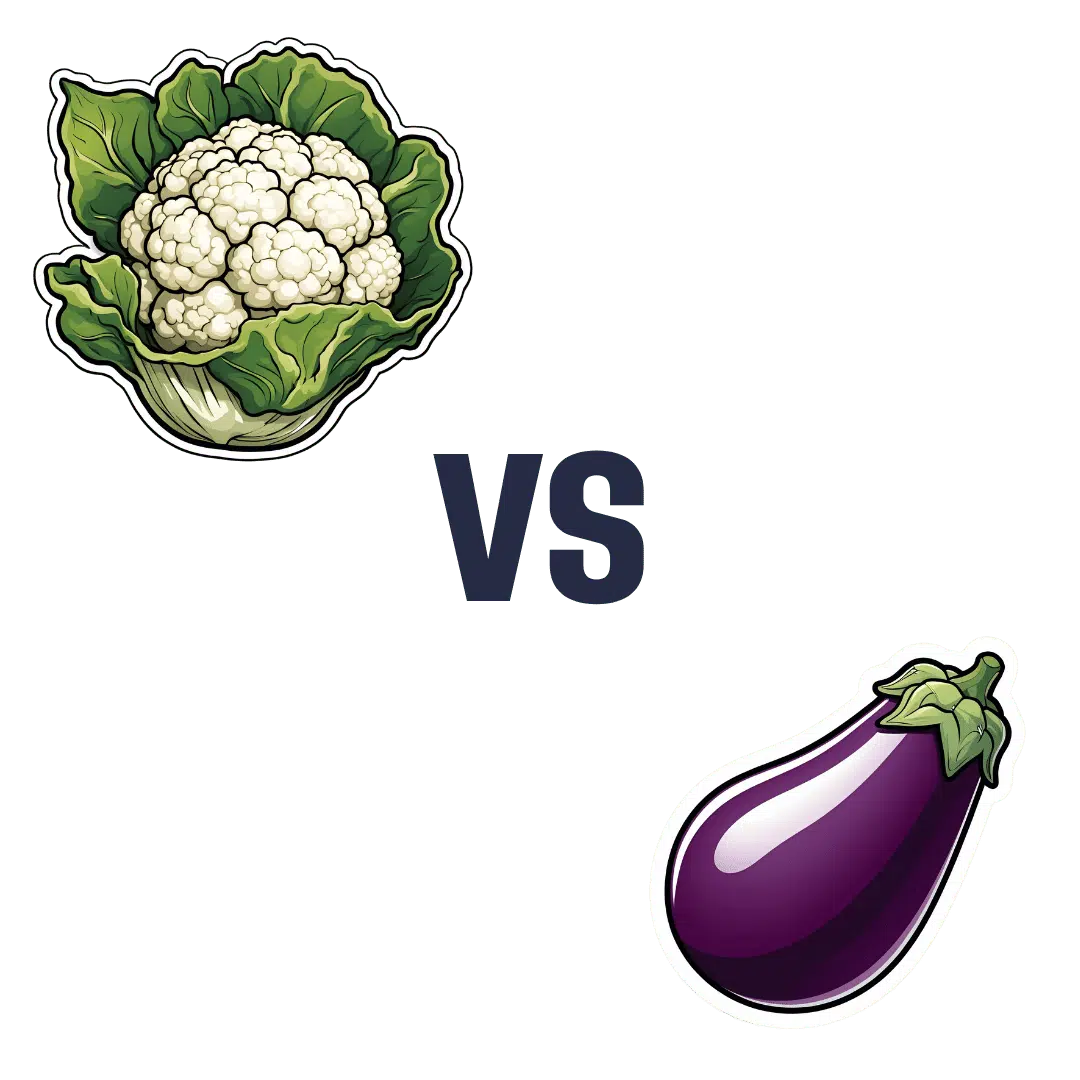
Cauliflower vs Eggplant – Which is Healthier?
10almonds is reader-supported. We may, at no cost to you, receive a portion of sales if you purchase a product through a link in this article.
Our Verdict
When comparing cauliflower to eggplant, we picked the cauliflower.
Why?
In terms of macros, cauliflower has more protein, while eggplant has more fiber and carbs. The differences aren’t huge though, and with them being balanced too, we’re going to call this round a tie.
In the category of vitamins, cauliflower has more of vitamins B1, B2, B5, B6, B9, C, K, and choline, while eggplant has more of vitamins B3 and E, making a clear win for cauliflower here.
When it comes to minerals, cauliflower has more calcium, iron, magnesium, phosphorus, potassium, selenium, and zinc, while eggplant has more copper and manganese. Another win for cauliflower.
In other considerations, cauliflower has more polyphenols overall, even though eggplant has generous anthocyanins in its skin (whence the color).
Adding up the sections makes for an overall win for cauliflower, but by all means enjoy either or both; diversity is good!
Want to learn more?
You might like:
What’s Your Plant Diversity Score?
Enjoy!
Don’t Forget…
Did you arrive here from our newsletter? Don’t forget to return to the email to continue learning!
Recommended
Learn to Age Gracefully
Join the 98k+ American women taking control of their health & aging with our 100% free (and fun!) daily emails:
-
How To Stop Foot Cramps At Night
10almonds is reader-supported. We may, at no cost to you, receive a portion of sales if you purchase a product through a link in this article.
Over-50s specialist physio Will Harlow shows us how:
Reset & relax
Foot cramps at night are common, especially with age. Low electrolytes can contribute—consider a pinch of salt (if safe) or use electrolyte tablets.
However, this is only usually the case if a) you are on a very low-sodium diet, and/or b) you have been sweating and/or peeing a lot (which latter can be the case if you are taking diuretics, which includes meds that have that as a side effect rather than the main purpose).
Magnesium salt rubs (or soaks) applied to the feet before bed can also help relax muscles and prevent cramps, on a similar principle (and have the bonus that the body is generally much more likely to be deficient in magnesium than sodium, making magnesium salts preferable).
If that fails, then massage is in order:
- Stretch the top of the foot by pulling toes downward while the leg is crossed; hold for 30 seconds, repeat a few times.
- Stretch the bottom of the foot by pulling toes upward and flexing the ankle; hold for 30 seconds, repeat on each side.
- Stretch your calves by leaning into a wall with one leg back and heel down; this helps relieve tension that contributes to foot and calf cramps.
- Use a massage ball under your foot to release tension—gently roll it under the fleshy areas, adding pressure if needed (avoid bones and heel).
For more on all of this plus a visual demonstration, enjoy:
Click Here If The Embedded Video Doesn’t Load Automatically!
Want to learn more?
You might also like:
When To Take Electrolytes (And When We Shouldn’t!)
Take care!
Share This Post
-
Sick of eating the same things? 5 ways to boost your nutrition and keep meals interesting and healthy
10almonds is reader-supported. We may, at no cost to you, receive a portion of sales if you purchase a product through a link in this article.
Did you start 2025 with a promise to eat better but didn’t quite get there? Or maybe you want to branch out from making the same meal every week or the same lunch for work almost every day?
Small dietary changes can make a big difference to how you feel, how your body functions and health indicators such as blood pressure, blood sugar and cholesterol levels.
You can meet your nutrient needs by eating a range of foods from the key food groups:
- vegetables and fruit
- protein (legumes, beans, tofu, meats, poultry, fish, eggs, nuts, seeds)
- grains (mostly wholegrain and high-fibre)
- calcium-rich foods (milk, yoghurt, cheese, non-dairy alternatives).
But you also need a variety of foods to get enough vitamins, minerals and phytonutrients from plant foods. Phytonutrients have antioxidant, anti-inflammatory, anti-cancer and other functions that help keep you healthy.
Use these five dietary tweaks to boost your nutrient intake and add variety to what you eat.
Loquellano/Pexels 1. Include different types of bran to boost your fibre intake
Different types of dietary fibre help improve bowel function through fermentation by gut microbes in the colon, or large bowel. This creates larger, softer bowel motions that then stimulate the colon to contract, leading to more regular bowel movements.
Add different types of dietary fibre – such as oat bran, wheat bran or psyllium husk – to breakfast cereal or add some into recipes that use white flour:
- psyllium husk is high in soluble fibre. It dissolves in water forming viscous gel that binds to bile salts, which get excreted and your body is then not able to convert them into cholesterol. This helps lower blood cholesterol levels as well as with retaining water in your colon, making bowel motions softer. Soluble fibre also helps slow the digestive process, making you feel full and slows the normal rise in blood sugar levels after you eat
- wheat bran is an insoluble fibre, also called roughage. It adds bulk to bowel motions, which helps keep your bowel function regular
- oat bran contains beta-glucan, a soluble fibre, as well as some insoluble fibre.
Try keeping small containers topped up with the different fibres so you don’t forget to add them regularly to your breakfast.
Psyllium husk is high in soluble fibre, which dissolves in water and slows digestion. Shawn Hempel/Shutterstock 2. Add a different canned bean to your shopping list
Dried beans are a type of legume. From baked beans to red kidney beans and chickpeas, the canned varieties are easy to use and inexpensive. Different colours and varieties have slightly different nutrient and phytonutrient profiles.
Canned beans are very high in total dietary fibre, including soluble fibre and resistant starch, a complex carbohydrate that resists digestion in the small intestine and then passes into the colon where it gets fermented.
The body digests and absorbs the nutrients in legumes slowly, contributing to their low glycemic index. So eating them makes you feel full.
Regularly eating more legumes lowers blood sugar levels, and total and LDL (bad) cholesterol.
Add legumes to dishes such as bolognese, curry, soups and salads (our No Money No Time website has some great recipes).
3. Try a different wholegrain, like buckwheat or 5-grain porridge
Wholegrain products contain all three layers of the grain. Both the inner germ layer and outer bran layer are rich in fibre, vitamins and minerals, while the inner endosperm contains mostly starch (think white flour).
Wholegrains include oats, corn (yes, popcorn too), rye, barley, buckwheat, quinoa, brown rice and foods made with wholegrains, like some breads and breakfast cereals such as rolled oats, muesli and five-grain porridge.
Wholegrains aren’t just breakfast and lunch foods. Dinner recipe ideas include tuna and veggie pasta bake, chicken quesadillas and buckwheat mushroom risotto.
4. Try a different vegetable or salad mix every week
A review of the relationship between plant-based diets and dying of any cause followed more than half a million people across 12 long-term studies.
It found people who ate the most plants had a lower risk of dying during the study and follow-up period than those who ate hardly any.
Add a rainbow coleslaw to your meal. Kiian Oksana/Shutterstock Try adding a new or different vegetable or salad item to your weekly meals, such as rainbow coleslaw, canned beetroot, raw carrot, red onion, avocado or tomatoes.
Or try a stir-fry with bok choy, celery, capsicum, carrot, zucchini and herbs.
The more variety, the more colour, flavour and textures – not to mention phytonutrients.
5. Go nuts
Cashews, walnuts, almonds, macadamias, pecans and mixed nuts make a great snack.
(Peanuts are technically a legume because they grow in the ground but we count them as nuts because their nutrient profile is very similar to the tree nuts.)
You have to chew nuts well, which means your brain receives messages that you are eating and should expect to soon feel full.
Nuts are energy-dense, due to their high fat content. A matchbox portion size (30 grams) contains about 15 grams of fat, 5 grams of protein and 740 kilojoules.
While some people think you need to avoid nuts to lose weight, a review of energy restricted diets found people who ate nuts lost as much weight as those who didn’t.
My colleagues and I at the University of Newcastle have created a free Healthy Eating Quiz where you can check your diet quality score, see how healthy your usual eating patterns are and how your score compares to others. You can also get some great ideas to make your meals more interesting .
Clare Collins, Laureate Professor in Nutrition and Dietetics, University of Newcastle
This article is republished from The Conversation under a Creative Commons license. Read the original article.
Share This Post
-
Slashed Federal Funding Cancels Vaccine Clinics Amid Measles Surge
10almonds is reader-supported. We may, at no cost to you, receive a portion of sales if you purchase a product through a link in this article.
More than a dozen vaccination clinics were canceled in Pima County, Arizona.
So was a media blitz to bring low-income children in Washoe County, Nevada, up to date on their shots.
Planned clinics were also scuttled in Texas, Minnesota, and Washington, among other places.
Immunization efforts across the country were upended after the federal Centers for Disease Control and Prevention abruptly canceled $11.4 billion in covid-related funds for state and local health departments in late March.
A federal judge temporarily blocked the cuts last week, but many of the organizations that receive the funds said they must proceed as though they’re gone, raising concerns amid a resurgence of measles, a rise in vaccine hesitancy, and growing distrust of public health agencies.
“I’m particularly concerned about the accessibility of vaccines for vulnerable populations,” former U.S. surgeon general Jerome Adams told KFF Health News. Adams served in President Donald Trump’s first administration. “Without high vaccination rates, we are setting those populations and communities up for preventable harm.”
The Department of Health and Human Services, which houses the CDC, does not comment on ongoing litigation, spokesperson Vianca Rodriguez Feliciano said. But she sent a statement on the original action, saying that HHS made the cuts because the covid-19 pandemic is over: “HHS will no longer waste billions of taxpayer dollars responding to a non-existent pandemic that Americans moved on from years ago.”
Still, clinics have also used the money to address other preventable diseases such as flu, mpox, and measles. More than 500 cases of measles so far in a Texas outbreak have led to 57 hospitalizations and the deaths of two school-age children.
In Pima County, Arizona, officials learned that one of its vaccination programs would have to end early because the federal government took away its remaining $1 million in grant money. The county had to cancel about 20 vaccine events offering covid and flu shots that it had already scheduled, said Theresa Cullen, director of the county health department. And it isn’t able to plan any more, she said.
The county is home to Tucson, the second-largest city in Arizona. But it also has sprawling rural areas, including part of the Tohono O’odham Nation, that are far from many health clinics and pharmacies, she said.
The county used the federal grant to offer free vaccines in mostly rural areas, usually on the weekends or after usual work hours on weekdays, Cullen said. The programs are held at community organizations, during fairs and other events, or inside buses turned into mobile health clinics.
Canceling vaccine-related grants has an impact beyond immunization rates, Cullen said. Vaccination events are also a chance to offer health education, connect people with other resources they may need, and build trust between communities and public health systems, she said.
County leaders knew the funding would run out at the end of June, but Cullen said the health department had been in talks with local communities to find a way to continue the events. Now “we’ve said, ‘Sorry, we had a commitment to you and we’re not able to honor it,’” she said.
Cullen said the health department won’t restart the events even though a judge temporarily blocked the funding cuts.
“The vaccine equity grant is a grant that goes from the CDC to the state to us,” she said. “The state is who gave us a stop work order.”
The full effect of the CDC cuts is not yet clear in many places. California Department of Public Health officials estimated that grant terminations would result in at least $840 million in federal funding losses for its state, including $330 million used for virus monitoring, testing, childhood vaccines, and addressing health disparities.
“We are working to evaluate the impact of these actions,” said California Department of Public Health Director Erica Pan.
In Washoe County, Nevada, the surprise cuts in federal funding mean the loss of two contract staffers who set up and advertise vaccination events, including state-mandated back-to-school immunizations for illnesses such as measles.
“Our core team can’t be in two places at once,” said Lisa Lottritz, division director for community and clinical health services at Northern Nevada Public Health.
She expected to retain the contractors through June, when the grants were scheduled to sunset. The health district scrambled to find money to keep the two workers for a few more weeks. They found enough to pay them only through May.
Lottritz immediately canceled a publicity blitz focused on getting children on government insurance up to date on their shots. Vaccine events at the public health clinic will go on, but are “very scaled back” with fewer staff members, she said. Nurses offering shots out and about at churches, senior centers, and food banks will stop in May, when the money to pay the workers runs out.
“The staff have other responsibilities. They do compliance visits, they’re running our clinic, so I won’t have the resources to put on events like that,” Lottritz said.
The effect of the cancellations will reverberate for a long time, said Chad Kingsley, district health officer for Northern Nevada Public Health, and it might take years for the full scope of decreasing vaccinations to be felt.
“Our society doesn’t have a collective knowledge of those diseases and what they did,” he said.
Measles is top of mind in Missouri, where a conference on strengthening immunization efforts statewide was abruptly canceled due to the cuts.
The Missouri Immunization Coalition, which organized the event for April 24-25, also had to lay off half its staff, according to board president Lynelle Phillips. The coalition, which coordinates immunization advocacy and education across the state, must now find alternative funding to stay open.
“It’s just cruel and unthinkably wrong to do this in the midst of a measles resurgence in the country,” Phillips said.
Dana Eby, of the health department in New Madrid County, Missouri, had planned to share tips about building trust for vaccines in rural communities at the conference, including using school nurses and the Vaccines for Children program, funded by the CDC.
New Madrid has one of the highest childhood vaccination rates in the state, despite being part of the largely rural “Bootheel” region that is often noted for its poor health outcomes. Over 98% of kindergartners in the county received the vaccine for measles, mumps, and rubella in 2023-24 compared with the state average of about 91%, and rates in some other counties as low as 61%.
“I will say I think measles will be a problem before I retire,” Eby, 42, said.
Also slated to speak at the Missouri event was former surgeon general Adams, who said he had planned to emphasize the need for community collaboration and the importance of vaccinations in protecting public health and reducing preventable diseases. He said the timing was especially pertinent given the explosion in measles cases in Texas and the rise in whooping cough cases and deaths in Louisiana.
“We can’t make America healthy again by going backwards on our historically high U.S. vaccination rates,” Adams said. “You can’t die from chronic diseases when you’re 50 if you’ve already died from measles or polio or whooping cough when you’re 5.”
California correspondent Christine Mai-Duc contributed to this article.
We’d like to speak with current and former personnel from the Department of Health and Human Services or its component agencies who believe the public should understand the impact of what’s happening within the federal health bureaucracy. Please message KFF Health News on Signal at (415) 519-8778 or get in touch here.
KFF Health News is a national newsroom that produces in-depth journalism about health issues and is one of the core operating programs at KFF—an independent source of health policy research, polling, and journalism. Learn more about KFF.
Subscribe to KFF Health News’ free Morning Briefing.
This article first appeared on KFF Health News and is republished here under a Creative Commons license.
Share This Post
Related Posts
-
Study links microplastics with human health problems – but there’s still a lot we don’t know
10almonds is reader-supported. We may, at no cost to you, receive a portion of sales if you purchase a product through a link in this article.
Mark Patrick Taylor, Macquarie University and Scott P. Wilson, Macquarie University
A recent study published in the prestigious New England Journal of Medicine has linked microplastics with risk to human health.
The study involved patients in Italy who had a condition called carotid artery plaque, where plaque builds up in arteries, potentially blocking blood flow. The researchers analysed plaque specimens from these patients.
They found those with carotid artery plaque who had microplastics and nanoplastics in their plaque had a higher risk of heart attack, stroke, or death (compared with carotid artery plaque patients who didn’t have any micro- or nanoplastics detected in their plaque specimens).
Importantly, the researchers didn’t find the micro- and nanoplastics caused the higher risk, only that it was correlated with it.
So, what are we to make of the new findings? And how does it fit with the broader evidence about microplastics in our environment and our bodies?
What are microplastics?
Microplastics are plastic particles less than five millimetres across. Nanoplastics are less than one micron in size (1,000 microns is equal to one millimetre). The precise size classifications are still a matter of debate.
Microplastics and nanoplastics are created when everyday products – including clothes, food and beverage packaging, home furnishings, plastic bags, toys and toiletries – degrade. Many personal care products contain microsplastics in the form of microbeads.
Plastic is also used widely in agriculture, and can degrade over time into microplastics and nanoplastics.
These particles are made up of common polymers such as polyethylene, polypropylene, polystyrene and polyvinyl chloride. The constituent chemical of polyvinyl chloride, vinyl chloride, is considered carcinogenic by the US Environmental Protection Agency.
Of course, the actual risk of harm depends on your level of exposure. As toxicologists are fond of saying, it’s the dose that makes the poison, so we need to be careful to not over-interpret emerging research.
A closer look at the study
This new study in the New England Journal of Medicine was a small cohort, initially comprising 304 patients. But only 257 completed the follow-up part of the study 34 months later.
The study had a number of limitations. The first is the findings related only to asymptomatic patients undergoing carotid endarterectomy (a procedure to remove carotid artery plaque). This means the findings might not be applicable to the wider population.
The authors also point out that while exposure to microplastics and nanoplastics has been likely increasing in recent decades, heart disease rates have been falling.
That said, the fact so many people in the study had detectable levels of microplastics in their body is notable. The researchers found detectable levels of polyethylene and polyvinyl chloride (two types of plastic) in excised carotid plaque from 58% and 12% of patients, respectively.
These patients were more likely to be younger men with diabetes or heart disease and a history of smoking. There was no substantive difference in where the patients lived.
Inflammation markers in plaque samples were more elevated in patients with detectable levels of microplastics and nanoplastics versus those without.
Microplastics are created when everyday products degrade. JS14/Shutterstock And, then there’s the headline finding: patients with microplastics and nanoplastics in their plaque had a higher risk of having what doctors call “a primary end point event” (non-fatal heart attack, non-fatal stroke, or death from any cause) than those who did not present with microplastics and nanoplastics in their plaque.
The authors of the study note their results “do not prove causality”.
However, it would be remiss not to be cautious. The history of environmental health is replete with examples of what were initially considered suspect chemicals that avoided proper regulation because of what the US National Research Council refers to as the “untested-chemical assumption”. This assumption arises where there is an absence of research demonstrating adverse effects, which obviates the requirement for regulatory action.
In general, more research is required to find out whether or not microplastics cause harm to human health. Until this evidence exists, we should adopt the precautionary principle; absence of evidence should not be taken as evidence of absence.
Global and local action
Exposure to microplastics in our home, work and outdoor environments is inevitable. Governments across the globe have started to acknowledge we must intervene.
The Global Plastics Treaty will be enacted by 175 nations from 2025. The treaty is designed, among other things, to limit microplastic exposure globally. Burdens are greatest especially in children and especially those in low-middle income nations.
In Australia, legislation ending single use plastics will help. So too will the increased rollout of container deposit schemes that include plastic bottles.
Microplastics pollution is an area that requires a collaborative approach between researchers, civil societies, industry and government. We believe the formation of a “microplastics national council” would help formulate and co-ordinate strategies to tackle this issue.
Little things matter. Small actions by individuals can also translate to significant overall environmental and human health benefits.
Choosing natural materials, fabrics, and utensils not made of plastic and disposing of waste thoughtfully and appropriately – including recycling wherever possible – is helpful.
Mark Patrick Taylor, Chief Environmental Scientist, EPA Victoria; Honorary Professor, School of Natural Sciences, Macquarie University and Scott P. Wilson, Research Director, Australian Microplastic Assessment Project (AUSMAP); Honorary Senior Research Fellow, School of Natural Sciences, Macquarie University
This article is republished from The Conversation under a Creative Commons license. Read the original article.
Don’t Forget…
Did you arrive here from our newsletter? Don’t forget to return to the email to continue learning!
Learn to Age Gracefully
Join the 98k+ American women taking control of their health & aging with our 100% free (and fun!) daily emails:
-
What Age Is Your Sleep?
10almonds is reader-supported. We may, at no cost to you, receive a portion of sales if you purchase a product through a link in this article.
We’ve written before about the topic of age and sleep, and most notably, how (contrary to popular belief) we don’t need less sleep in older age: Why You Probably Need More Sleep ← a lot of people mistake getting 6 hours sleep per night for only needing 6 hours sleep per night.
Sure, you may still be alive after regularly getting 6 hours, but (unless you have a rare mutation of the ADRB1 gene) it will be causing harm, and yes, that includes later in life; we don’t stop needing so much sleep, even if we stop getting it.
It’s also noteworthy that sleep-deprived people usually underestimate how sleep-deprived they are. This is for the same reason as why drunk people usually underestimate how drunk they are—to put it in words that go for both situations: a cognitively impaired person lacks the cognitive function to realize how cognitively impaired they are. Here’s the science on that: How Sleep-Deprived Are You, Really?
But today, it’s about a different aspect of age that has a different effect on sleep:
How old do you feel?
Researchers (Dr. Julia Boyle et al.) surveyed 3,177 adults with a mean average age of 42.8 years, of whom 49% were women, and examined how the gap between how old people feel (subjective age) and how old they actually are (chronological age) was related to sleep and health outcomes.
What they found, in few words: those who felt older than their chronological age reported more insomnia symptoms, greater sleep-related daytime impairment, poorer overall sleep health, and less regular sleep patterns.
Now, you may be thinking “well, that tracks; someone with a bunch of adverse health conditions is going to feel older and sleep worse, so what’s the news here?” and that’d be valid in a vacuum, but as it turns out, the aforementioned associations remained significant even after accounting for chronological age, sex, race, depression, and anxiety, meaning that the subjective age itself appears to have a direct relationship with the worse sleep outcomes.
Notably, feeling older was also associated with poorer self-rated physical health, and the correlational and regressional analyses suggested that this relationship was partly explained by the worse sleep, particularly greater insomnia severity, poorer sleep regularity, and more daytime impairment.
Dr. Boyle and her team conclude:
❝Results suggest that the age you feel, not just the age you are, shapes sleep and health. Feeling older than your years predicts more insomnia, poorer sleep regularity, and greater sleep-related impairment, with downstream effects on physical health. These results reinforce the need to challenge negative perceptions of aging, not only in clinical care but also through education and public health messaging. Put simply, how old you feel is an important predictor of sleep and health across the lifespan.❞
You can read the paper in full, here: Feeling Older Than You Are: Links Between Subjective Age and Sleep Outcomes ← to see the whole paper rather than just the abstract, you’ll need to click on “PDF”
But watch out! Because of: How Anxiety About Aging Accelerates Aging
And to understand the relationships between the different kinds of aging, see: Age & Aging: What Can (And Can’t) We Do About It?
Want to boost your sleep?
Some sleep aids can help, but many are harmful and/or do not really work as such; here’s a rundown of examples of those: Safe Effective Sleep Aids For Seniors?
And when it comes to napping, timing is everything: How To Nap Like A Pro (No More “Sleep Hangovers”!)
Want to learn more?
For a much more in-depth treatment of the topic, you might like this book that we reviewed a while back:
Why We Sleep – by Dr Matthew Walker
Basically, if you will read only one book on sleep, that’s the book.
Sweet dreams!
Don’t Forget…
Did you arrive here from our newsletter? Don’t forget to return to the email to continue learning!
Learn to Age Gracefully
Join the 98k+ American women taking control of their health & aging with our 100% free (and fun!) daily emails:
-
Ramadan is almost here. 5 tips to boost your wellbeing and energy levels if you’re fasting
10almonds is reader-supported. We may, at no cost to you, receive a portion of sales if you purchase a product through a link in this article.
Ramadan is one of the most significant months of the Islamic lunar calendar. It marks the time when the Quran was revealed to Prophet Mohammed (peace be upon him).
Almost 2 billion Muslims worldwide observe this month of prayer and reflection, which includes fasting between two prayers, Fajr at dawn and Maghrib at sunset.
Ramadan is about purifying the mind, body and soul, and practising self-restraint. It’s a time for spiritual growth and dedication to God (or Allah in Arabic). Ramadan also brings people together for meals and celebrations, with a focus on helping those less fortunate.
Depending on where you live, Ramadan can mean going 12 to 19 hours without eating or drinking anything, including water.
Our research shows choosing balanced, nutrient-dense foods and drinks can result in better wellbeing and greater energy levels than following your usual diet during Ramadan.
Here’s what to consider if you’re fasting for Ramadan.
Drazen Zigic/Shutterstock Do you have any health issues?
Healthy Muslims are expected to fast during Ramadan once they have reached puberty.
Frail older adults are exempt from fasting, as are pregnant, breastfeeding and menstruating women. Anyone who cannot participate in fasting can make up for the missed fasting days later.
People with chronic illness or mental health may be exempt if fasting poses a risk to their health. If you suffer from chronic illness, such as diabetes, heart disease or kidney problems, and want to fast, consult your GP first.
Fasting can have severe health consequences for people with certain medical conditions and those who rely on prescription medication. Some medications need to be taken at a specific time (and some with food) to be safe and effective.
If you’re not drinking enough water during Ramadan, your body might also handle some medications differently: they may not work as well or cause side effects.
For people who can safely fast, here are five tips to maintain your wellbeing during Ramadan.
1. Plan ahead
In preparation for Ramadan, stock up on essentials. Plan your meals and hydration in advance, to stay on top of your nutritional intake.
Start reducing your caffeine gradually in the week leading to Ramadan, so your body can adjust. This can help prevent or reduce the fasting headaches that many experience at the beginning of Ramadan.
Move your meals gradually towards Suhoor and Iftar times, so your body gets used to the new mealtimes.
Plan your meals ahead of time. Ground Picture/Shutterstock 2. Stay hydrated
Staying hydrated is important during Ramadan. Women should aim to drink 2.1 litres of water or fluids (such as coconut water, clear soups, broths or herbal teas) each day. Men should aim for 2.6 litres.
Limit the intake of sugary or artificially sweetened drinks and enjoy fresh fruit juice only in moderation. Sugary drinks cause a rapid increase in blood sugar levels. The body responds by releasing insulin, causing a drop in blood sugar, which can leave you feeling fatigued, irritable and hungry.
Increase your hydration by including water-rich foods, such as cucumbers and watermelon, in your diet.
3. Get your nutrients early
Before dawn, have a nutrient-rich, slow-digesting meal, along with plenty of water.
Select healthy nutrient-dense food with proteins and fats from lean meats, fish, chickpeas, tofu, nuts and seeds.
Choose whole grain products, a variety of vegetables and fruits, and fermented foods, such as kimchi and pickles, which can support your digestion.
When you prepare your meals, consider grilling, steaming or air frying instead of deep frying.
Stay away from processed foods such as cakes, ice cream, chips and chocolates, as they often lack essential nutrients and are high in sugar, salt and fat. Processed foods also tend to be low in fibre and protein, which are crucial for maintaining a feeling of fullness.
4. Avoid the temptation to overeat in the evening
At sunset, many Muslims come together with family and friends for the fast-breaking evening meal (Iftar). During these occasions, it may be tempting to overindulge in sweets, salty snacks and fatty dishes.
But overeating can strain the digestive system, cause discomfort and disrupt sleep.
Start with something small. Tekkol/Shutterstock Instead, listen to your body’s signals, control your portions, and eat mindfully – this means slowly and without distractions.
Start with something small, such as a date and a glass of water. You may choose to complete the Maghrib prayer before returning for your main meal and more fluids.
5. Keep moving
Finally, try to include some light exercise into your schedule, to maintain your fitness and muscle mass, and promote sleep.
But avoid heavy workouts, sauna and intensive sports while fasting, as these may increase dehydration, which can increase your risk of feeling faint and falling.
Romy Lauche, Deputy Director (Research), National Centre for Naturopathic Medicine, Southern Cross University; Fatima El-Assaad, Senior Research Fellow, Microbiome Research Centre, UNSW Sydney, and Jessica Bayes, Postdoctoral Research Fellow at the National Centre for Naturopathic Medicine, Southern Cross University
This article is republished from The Conversation under a Creative Commons license. Read the original article.
Don’t Forget…
Did you arrive here from our newsletter? Don’t forget to return to the email to continue learning!
Learn to Age Gracefully
Join the 98k+ American women taking control of their health & aging with our 100% free (and fun!) daily emails:


