
Cancer patients from migrant backgrounds have a 1 in 3 chance of something going wrong in their care

10almonds is reader-supported. We may, at no cost to you, receive a portion of sales if you purchase a product through a link in this article.

More than 7 million people in Australia were born overseas. Some 5.8 million people report speaking a language other than English at home.

But how well are we looking after culturally and linguistically diverse (CALD) Australians?

In countries around the world, evidence suggests people from CALD backgrounds are at increased risk of harm as a result of the health care they receive when compared to the general population. Common problems include a higher risk of contracting a hospital-acquired infection or medication errors.

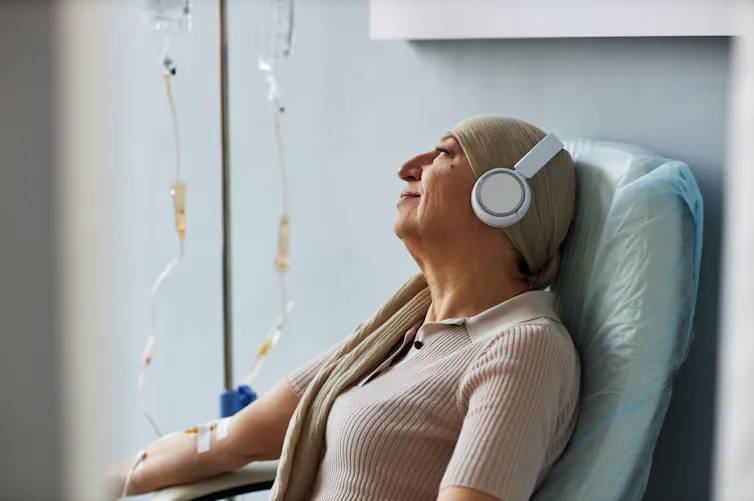
People receiving cancer care are at particularly high risk of harm associated with their health care.

In a recent study, we found CALD cancer patients in Australia had roughly a one-in-three risk of something going wrong during their cancer care. This is unacceptably high.
SeventyFour/Shutterstock

We reviewed medical records

We worked with four cancer services (two in New South Wales and two in Victoria) that provide care to high proportions of people from CALD backgrounds. These four cancer services offer a combination of care to patients in hospitals, clinics and in their homes.

We analysed de-identified medical records of people from CALD backgrounds who received care at any of the four cancer services during 2018. To identify CALD patients, we used information from their medical records including “country of birth”, “preferred language”, “language spoken at home” and “interpreter required”.

We reviewed a total of 628 medical records of CALD cancer patients. We found roughly one in three medical records (212 out of 628) had at least one patient safety event recorded. We defined a patient safety event as any event that could have or did result in harm to the patient as a result of the health care they receive. We also found 44 patient records had three or more safety events recorded over a 12-month period.

Medication-related safety events were common, such as the wrong medication type or dose being given to a patient. Sometimes the patients themselves took the wrong type or dose of a medication or stopped medication all together. We also observed a variety of other patient safety events such as falls, pressure ulcers and infections after surgery.

The number of incidents could even be higher than what we observed. We know from other research that not all patient safety events are documented.
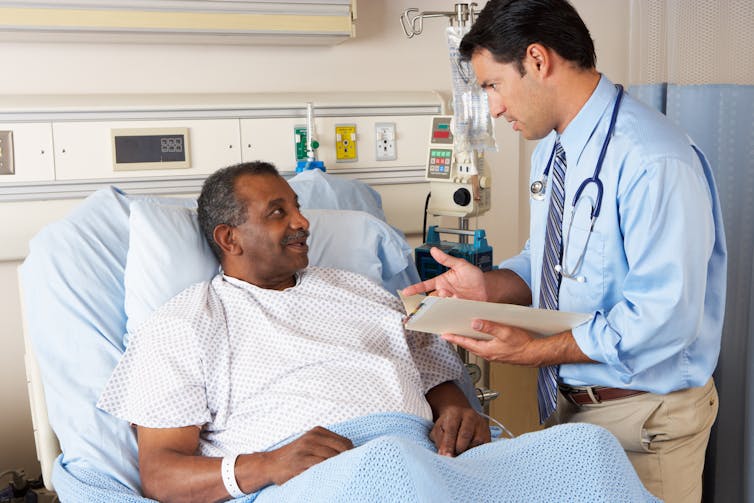
A man in a hospital bed is seen by a male doctor.
Our research looked at patient safety incidents among CALD patients at four Australian cancer services in 2018. Monkey Business Images/Shutterstock

We didn’t have a control group, which is the main limitation of our study. In other words, we didn’t examine medical records of patients from non-CALD backgrounds to compare how common patient safety events were between groups.

But looking at other data suggests the rate of incidents is much higher in CALD patients.

Studies over many years indicate around one in ten patients admitted to hospital experience a safety event.

One study from Norway found cancer patients have a 39% greater risk of experiencing adverse events in hospital when compared to other patients (24.2% compared to 17.4%).

Why is the risk of incidents so high for CALD patients?

We identified miscommunication as a key factor that put cancer patients from CALD backgrounds at risk.

For example, we observed from one patient’s notes that the patient didn’t take their medication because they were confused by the instructions given by different clinicians. This confusion might have stemmed from language barriers or health literacy issues.

In some medical records, we also saw interpreter requirements were unmet. For example, at the time of admission, assessment for language needs noted an interpreter was not required. However, later notes mentioned the patient had poor English or needed an interpreter.

Also, with the limited availability of interpreters, they’re often reserved for specialist appointments, and not used for “routine” tasks, such as during chemotherapy treatment. This may result in side effects from cancer medications not being properly identified and responded to, potentially leading to patient harm.

A young nurse talks with a senior woman.
Risks may increase if a patient needs an interpreter but doesn’t have one. THICHA SATAPITANON/Shutterstock

What can we do to improve things?

To make care safer, patients, their families and the clinicians who care for them should come together so that any solutions developed are practical, relevant, and informed by their combined experiences.

As an example, we developed a tool with consumers from CALD backgrounds and their clinicians that seeks to ensure that when patient medications are changed, there is common understanding between the clinician and the patient of their medication and care instructions. This includes recognising the side effects of the medications and who to contact if they have concerns.

This tool uses images and simple language to support common understanding of medication and care instructions. It takes into account specific cultural expectations and is available in different languages. It’s currently being evaluated in two cancer clinics.

To make cancer care safer for patients from CALD backgrounds, health systems and services will need to support and invest in strategies that are specifically targeted towards people from these backgrounds. This will ensure more equitable health solutions that improve the health of all Australians.

Ashfaq Chauhan, Research Fellow, Australian Institute of Health Innovation, Macquarie University; Melvin Chin, Senior Lecturer, School of Clinical Medicine, UNSW Sydney; Meron Pitcher, Honorary, Medicine, Dentistry and Health Sciences, The University of Melbourne, and Reema Harrison, Professor, Australian Institute of Health Innovation, Macquarie University

This article is republished from The Conversation under a Creative Commons license. Read the original article.

Don’t Forget…

Did you arrive here from our newsletter? Don’t forget to return to the email to continue learning!
Learn to Age Gracefully

Join the 98k+ American women taking control of their health & aging with our 100% free (and fun!) daily emails:

  • Artichoke vs Okra – Which is Healthier?

    10almonds is reader-supported. We may, at no cost to you, receive a portion of sales if you purchase a product through a link in this article.

    Our Verdict

    When comparing artichoke to okra, we picked the okra.

    Why?

    Both have their merits, but there is a winner in the end:

    In terms of macros, artichoke gets off to a good start with more fiber, carbs, and protein. The differences aren’t huge, but they’re there, so this is a nominal first-round win for artichoke.

    In the category of vitamins, artichoke has negligibly more of vitamins B5 and B9, while okra has a lot more of vitamins A, B1, B6, C, E, and K, winning this round by a huge margin.

    Looking at minerals, artichoke has more copper, iron, phosphorus, and potassium, while okra has more calcium, magnesium, manganese, selenium, and zinc, giving okra a modest win in this round.

    In other considerations, they’re both abundant in polyphenols, with nothing to strongly set one ahead of the other.

    Adding up the sections makes for an overall win for okra, but by all means do enjoy either or both, as diversity is best!

    Want to learn more?

    You might like:

    21 Most Beneficial Polyphenols & What Foods Have Them

    Enjoy!

    Share This Post

  • What’s Really Keeping You Awake? The Brain’s Role in Sleepless Nights

    10almonds is reader-supported. We may, at no cost to you, receive a portion of sales if you purchase a product through a link in this article.

    Dr. Tracey Marks, psychiatrist, explains:

    All in your head (which is the least helpful place for it to be when trying to sleep)

    Why You Can’t Sleep: sleeplessness often stems from a conflict between your brain’s sleep drive (powered by adenosine and melatonin) and wake drive (powered by orexin and serotonin), which are normally balanced by your circadian rhythm.

    About that tech: blue light gets a bad reputation, and indeed it suppresses melatonin, but this is quickly resolved once you turn it off. However, being accustomed to constant notifications triggers dopamine, keeping your brain in a heightened state of alertness, even if you’ve now put your phone aside, if you’re still expecting notifications.

    About your worries: worrying at night activates the brain’s stress response (HPA axis), releasing cortisol and adrenaline that override sleep signals—especially when you miss your natural sleep window and are trying to sleep at a slightly different time than you normally do.

    This can then become a self-perpetuating cycle, because after poor sleep, your brain can start associating your bed with stress, reinforcing insomnia through classical conditioning.

    Some advices that Dr. Marks gives include:

    • Follow natural sleep rhythms where possible, rather than trying to force something different.
    • Use paradoxical intention (stop trying so hard to sleep).
    • Practise calming techniques like box breathing (4 seconds breathing in, 4 seconds holding, 4 seconds breathing out, 4 seconds holding)

    Chronic insomnia (3+ nights/week for 3+ months) with significant daytime effects may require treatment like Cognitive Behavioral Therapy for Insomnia (CBT-I), so that’s a thing to bear in mind too.

    In short: sleep isn’t just about being tired—it’s about working with your brain’s systems, not against them.

    For more on all of this, enjoy:

    Click Here If The Embedded Video Doesn’t Load Automatically!

    Want to learn more?

    You might also like:

    How to Fall Asleep Faster: CBT-I Treatment For Insomnia

    Take care!

    Share This Post

  • Eggplant vs Pumpkin – Which is Healthier?

    10almonds is reader-supported. We may, at no cost to you, receive a portion of sales if you purchase a product through a link in this article.

    Our Verdict

    When comparing eggplant to pumpkin, we picked the pumpkin.

    Why?

    Both have their strong points!

    In terms of macros, eggplant starts off well with 6x the fiber for approximately the same carbs and protein, winning in this category.

    In the category of vitamins, eggplant has more of vitamins B3, B6, B9, and K, while pumpkin has more of vitamins A, B1, B2, B5, C, and E, winning in this round.

    Looking at minerals, eggplant has more magnesium and manganese, while pumpkin has more calcium, copper, iron, phosphorus, potassium, and zinc, winning another round.

    Adding up the sections makes an overall win for pumpkin, but by all means enjoy either or both, as fiber is great and so is plant diversity!

    Want to learn more?

    You might like:

    What’s Your Plant Diversity Score?

    Enjoy!

    Share This Post

  • What causes food cravings? And what can we do about them?

    10almonds is reader-supported. We may, at no cost to you, receive a portion of sales if you purchase a product through a link in this article.

    Many of us try to eat more fruits and vegetables and less ultra-processed food. But why is sticking to your goals so hard?

    High-fat, sugar-rich and salty foods are simply so enjoyable to eat. And it’s not just you – we’ve evolved that way. These foods activate the brain’s reward system because in the past they were rare.

    Now, they’re all around us. In wealthy modern societies we are bombarded by advertising which intentionally reminds us about the sight, smell and taste of calorie-dense foods. And in response to these powerful cues, our brains respond just as they’re designed to, triggering an intense urge to eat them.

    Here’s how food cravings work and what you can do if you find yourself hunting for sweet or salty foods.

    Fascinadora/Shutterstock

    What causes cravings?

    A food craving is an intense desire or urge to eat something, often focused on a particular food.

    We are programmed to learn how good a food tastes and smells and where we can find it again, especially if it’s high in fat, sugar or salt.

    Something that reminds us of enjoying a certain food, such as an eye-catching ad or delicious smell, can cause us to crave it.

    Three people holding a cone of french fries.
    Our brains learn to crave foods based on what we’ve enjoyed before. fon thachakul/Shutterstock

    The cue triggers a physical response, increasing saliva production and gastric activity. These responses are relatively automatic and difficult to control.

    What else influences our choices?

    While the effect of cues on our physical response is relatively automatic, what we do next is influenced by complex factors.
    Whether or not you eat the food might depend on things like cost, whether it’s easily available, and if eating it would align with your health goals.

    But it’s usually hard to keep healthy eating in mind. This is because we tend to prioritise a more immediate reward, like the pleasure of eating, over one that’s delayed or abstract – including health goals that will make us feel good in the long term.

    Stress can also make us eat more. When hungry, we choose larger portions, underestimate calories and find eating more rewarding.

    Looking for something salty or sweet

    So what if a cue prompts us to look for a certain food, but it’s not available?

    Previous research suggested you would then look for anything that makes you feel good. So if you saw someone eating a doughnut but there were none around, you might eat chips or even drink alcohol.

    But our new research has confirmed something you probably knew: it’s more specific than that.

    If an ad for chips makes you look for food, it’s likely a slice of cake won’t cut it – you’ll be looking for something salty. Cues in our environment don’t just make us crave food generally, they prompt us to look for certain food “categories”, such as salty, sweet or creamy.

    Food cues and mindless eating

    Your eating history and genetics can also make it harder to suppress food cravings. But don’t beat yourself up – relying on willpower alone is hard for almost everyone.

    Food cues are so powerful they can prompt us to seek out a certain food, even if we’re not overcome by a particularly strong urge to eat it. The effect is more intense if the food is easily available.

    This helps explain why we can eat an entire large bag of chips that’s in front of us, even though our pleasure decreases as we eat. Sometimes we use finishing the packet as the signal to stop eating rather than hunger or desire.

    Is there anything I can do to resist cravings?

    We largely don’t have control over cues in our environment and the cravings they trigger. But there are some ways you can try and control the situations you make food choices in.

    • Acknowledge your craving and think about a healthier way to satisfy it. For example, if you’re craving chips, could you have lightly-salted nuts instead? If you want something sweet, you could try fruit.
    • Avoid shopping when you’re hungry, and make a list beforehand. Making the most of supermarket “click and collect” or delivery options can also help avoid ads and impulse buys in the aisle.
    • At home, have fruit and vegetables easily available – and easy to see. Also have other nutrient dense, fibre-rich and unprocessed foods on hand such as nuts or plain yoghurt. If you can, remove high-fat, sugar-rich and salty foods from your environment.
    • Make sure your goals for eating are SMART. This means they are specific, measurable, achievable, relevant and time-bound.
    • Be kind to yourself. Don’t beat yourself up if you eat something that doesn’t meet your health goals. Just keep on trying.

    Gabrielle Weidemann, Associate Professor in Psychological Science, Western Sydney University and Justin Mahlberg, Research Fellow, Pyschology, Monash University

    This article is republished from The Conversation under a Creative Commons license. Read the original article.

    Don’t Forget…

    Did you arrive here from our newsletter? Don’t forget to return to the email to continue learning!

    Learn to Age Gracefully

    Join the 98k+ American women taking control of their health & aging with our 100% free (and fun!) daily emails:

  • The Low-Carb Fraud by Dr. T. Colin Campbell & Dr. Howard Jacobson

    10almonds is reader-supported. We may, at no cost to you, receive a portion of sales if you purchase a product through a link in this article.

    The first-named author is most well-known for “The China Study”, and the work here is consistent with that, albeit from the opposite angle.

    While critical of low-carb diets in general (as low-carb diets tend to be de facto low-fiber diets—they don’t have to be, but the way most people do them, they are*), it’s quite clear that one of the main purposes of this book was to serve as a rebuttal—refutation, even—of the paleo diet.

    *This is, as presented, the low-carb paradox. People promote low-carb diets because high-carb foods with minimal fiber will zip straight through the digestive system and set up camp in the liver and visceral fat, but the problem is that if a low-carb diet is pursued without adequate fiber (and usually with too much saturated fat), this will not be an improvement. Thus, per Drs. Campbell & Johnson, the answer is not avoiding carbs, but rather, prioritizing fiber (which almost always comes with carbs, while low-carb foods usually have quite little, or in the case of animal products, none).

    The style is old-school pop-science, but the science itself is sound, and referenced heavily with a proportional bibliography. Speaking of proportions, it’s worth mentioning that this book is one fifth the size of The China Study, making it a much quicker read.

    Bottom line: if you’re considering a low-carb diet and want to know the counterarguments without investing a lot of time into it, then this light book will present it for you clearly and in a well-sourced fashion.

    Click here to check out The Low-Carb Fraud, and enjoy the right carbs instead!

    Don’t Forget…

    Did you arrive here from our newsletter? Don’t forget to return to the email to continue learning!

    Learn to Age Gracefully

    Join the 98k+ American women taking control of their health & aging with our 100% free (and fun!) daily emails:

  • The Modern Art and Science of Mobility – by Aurélien Broussal-Derval

    10almonds is reader-supported. We may, at no cost to you, receive a portion of sales if you purchase a product through a link in this article.

    We’ve reviewed mobility books before, so what makes this one stand out?

    We’ll be honest: the illustrations are lovely.

    The science, the information, the exercises, the routines, the programsAll these things are excellent too, but these can be found in many a book.

    What can’t usually be found is very beautiful (yet no less clear) watercolor paintings and charcoal sketches as anatomical illustrations.

    There are photos too (also of high quality), but the artistry of the paintings and sketches is what makes the reader want to spend time perusing the books.

    At least, that’s what this reviewer found! Because it’s all very well having access to a lot of information (and indeed, I read so much), but making it enjoyable increases the chances of rereading it much more often.

    As for the rest of the content, the book’s information is divided in categories:

    1. Pain (what causes it, what it means, and how to manage it)
    2. Breathing (yes, a whole section devoted to this, and it is aligned heavily to posture also, as well as psychological state and the effect of stress on tension, inflammation, and more)
    3. Movement (this is mostly about kinds of movement and ranges of movement)
    4. Mobility (this is about aggregating movements as a fully mobile human)

    So, each builds on from the previous because any pain needs addressing before anything else, breathing (and with it, posture) comes next, then we learn about movement, then we bring it all together for mobility.

    Bottom line: this is a beautiful and comprehensive book that will make learning a joy

    Click here to check out The Modern Art and Science of Mobility, and learn and thrive!

    Don’t Forget…

    Did you arrive here from our newsletter? Don’t forget to return to the email to continue learning!

    Learn to Age Gracefully

    Join the 98k+ American women taking control of their health & aging with our 100% free (and fun!) daily emails: