
Broad Beans vs Sweetcorn – Which is Healthier?
10almonds is reader-supported. We may, at no cost to you, receive a portion of sales if you purchase a product through a link in this article.
Our Verdict
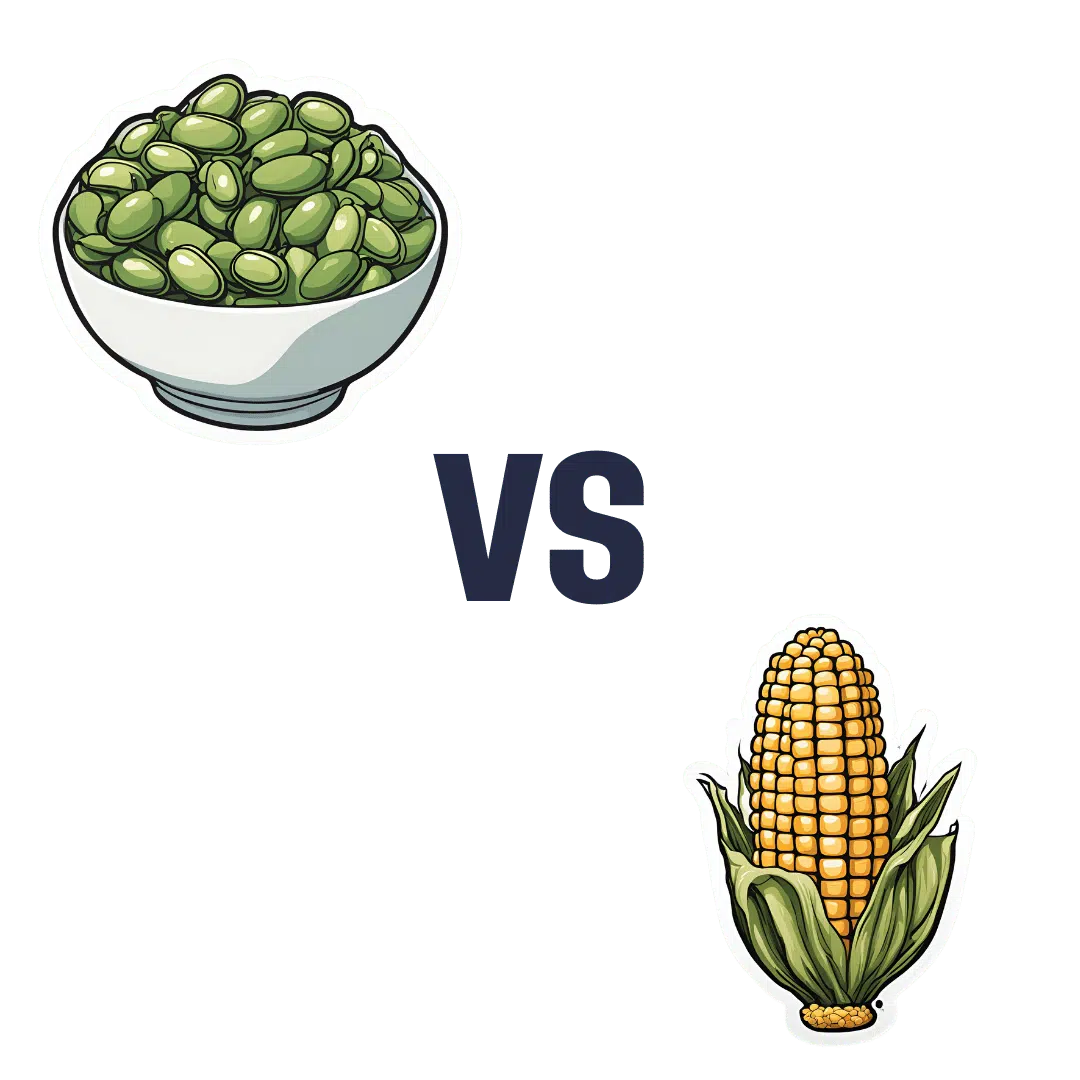
When comparing broad beans to sweetcorn, we picked the broad beans.
Why?
Firstly, you may be wondering: “aren’t broad beans fava beans?”, and yes, yes they are, but by convention, broad beans are the young green beans, while fava beans are the mature beans of the plant. Similar situation to the relationship between edamame and soybeans. And, in both cases, you’re more likely to put the young green beans in a salad, thus making the broad beans the more reasonable vegetable to compare to the sweetcorn. On which note…
In terms of macros, the broad beans have more protein and fiber, while the sweetcorn has more carbs. We call that a win for the beans.
Looking at the vitamins, the broad beans have (barely) more vitamin B6, while the sweetcorn has more of vitamins A, B1, B2, B5, B9, E, and choline. An easy win for the corn this time.
In the category of minerals, the situation is reversed: broad beans have more calcium, copper, iron, magnesium, manganese, phosphorus, potassium, selenium, and zinc, while sweetcorn is not higher in any minerals. So, a clear win for the beans.
Adding up the sections gives a 2:1 win for the beans over the corn, but by all means enjoy either or both—together is great, and diversity is good!
Want to learn more?
You might like to read:
What’s Your Plant Diversity Score?
Enjoy!
Don’t Forget…
Did you arrive here from our newsletter? Don’t forget to return to the email to continue learning!
Recommended
Learn to Age Gracefully
Join the 98k+ American women taking control of their health & aging with our 100% free (and fun!) daily emails:
-
The Happiness Cure – by Dr. Anders Hansen
10almonds is reader-supported. We may, at no cost to you, receive a portion of sales if you purchase a product through a link in this article.
The author, a psychiatrist, makes the argument that we should, and could, be happier—not all the time, and certainly not always “dialled up to eleven”, but definitely more than we are. This book explains how.
After an introductory couple of chapters about evolutionary psychology (illustrating where our fundamental emotions came from), he tackles the biggest enemies of happiness: anxiety and depression, each in a chapter of their own, before taking on a third beast, loneliness.
By offering reframes and new perspectives (because often we place too much or too little weight on the wrong things, due to an array of dysfunctional cognitive biases), he looks to help us to allow ourselves to feel the things we need to feel, and then continue being, most of the time, happy.
For Dr. Hansen, moderate happiness should be our default condition, punctuated by moments of greater happiness, and also by moments of unhappiness (e.g. anxiety, sadness, etc). He makes the argument that too many people spend a lot of time either wildly oscillating between emotional states, or else digging oneself further into an increasingly overwhelming state (usually: anxiety or depression), that can then be tricky to get out of, especially if trying the wrong way, e.g. by pursing happiness single-mindedly.
He also recommends the usual things that you might expect; exercise, getting good rest, and so forth, but mostly this book is not about that.
The style is very light and educational, clearly written for maximum comprehension, at the expense of precision (there are many small factual errors that do not detract from the actual thrust of the advice).
Bottom line: if you’d like to be happier, this book may help—especially by making it easier to identify why you’re not happy, since the obvious reasons are often not the fundamental reasons.
Click here to check out The Happiness Cure, and increase your happiness!
Share This Post
-
Buckwheat vs Rye – Which is Healthier?
10almonds is reader-supported. We may, at no cost to you, receive a portion of sales if you purchase a product through a link in this article.
Our Verdict
When comparing buckwheat to rye, we picked the buckwheat.
Why?
Both are good, wholegrain options for most people! On which note, yes, we are comparing whole groats* vs whole grains here, respectively.
*buckwheat is, you may remember, a flowering plant and not technically a grain or even a grass (and is very unrelated to wheat; it’s as closely related to wheat as a lionfish is to a lion).
In terms of macros, buckwheat has more protein, while rye has more carbs and fiber, the ratios of which mean that rye has the higher glycemic index. All in all, we’re calling this category a win for buckwheat on the basis of those things, but really, both are fine.
When it comes to vitamins, buckwheat has more of vitamins B1, B3, B6, B7, B9, K, and choline, while rye has more of vitamins B2, B5, and E. An easy win for buckwheat here.
In the category of minerals, buckwheat has more copper, calcium, iron, magnesium, phosphorus, potassium, and zinc, while rye has more manganese and selenium. Another clear win for buckwheat.
Lastly. it’s worth noting that while buckwheat does not contain gluten, rye does. So, if you’re avoiding gluten, buckwheat is the option to choose here for that reason too.
If you don’t have celiac disease, wheat allergy, gluten intolerance, or something like that, then rye is still very worthwhile; buckwheat may have won on numbers in each category, but rye wasn’t far behind on anything; the margins of difference were quite small today.
Still, buckwheat is the best all-rounder here!
Want to learn more?
You might like to read:
- Grains: Bread Of Life, Or Cereal Killer?
- Gluten: What’s The Truth?
- Eat More (Of This) For Lower Blood Pressure
Take care!
Share This Post
-
The Longevity Diet – by Dr. Valter Longo
10almonds is reader-supported. We may, at no cost to you, receive a portion of sales if you purchase a product through a link in this article.
Another book with “The New Science” in its subtitle, so, is this one a new science?
Yes and no; some findings are new, many are not, what really sets this book apart from many of its genre though is that rather than focusing on fighting aging, it focuses on retaining youth. While this may seem like one and the same thing, there is a substantive difference beyond the ideological, which is: while anti-aging research focuses on what causes people to suffer age-related decline and fights each of those things, Dr. Longo’s research focuses on what is predominant in youthful bodies, cells, DNA, and looks to have more of that. Looking in a slightly different place means finding slightly different things, and knowledge is power indeed.
Dr. Longo bases his research and focus on his “5 pillars of longevity”. We’ll not keep them a mystery; they are:
- Juventology research
- Epidemiology
- Clinical studies
- Centenarian studies
- Study of complex systems
The first there (juventology research) may sound like needless jargon, but it is the counterpoint of the field of gerontology, and is otherwise something that didn’t have an established name.
You may wonder why “clinical studies” gets a separate item when the others already include studies; this is because many studies when it comes to aging and related topics are population-based studies, cohort studies, observational studies, or (as is often the case) multiple of the above at once.
Of course, all this discussion of academia is not itself practical information for the reader (unless we happen to work in the field), but it is interesting and does give confidence in the conclusions upon which the practical parts of the book are based.
And what are they? As the title suggests, it’s about diet, and specifically, it’s about Dr. Longo’s “fast-mimicking diet”, which boasts the benefits of intermittent fasting without intermittent fasting. This hinges, of course, on avoiding metabolic overload, which can be achieved with a fairly simple diet governed by the principles outlined in this book, based on the research referenced.
In the category of subjective criticism, there is quite a bit of fluff, much of it self-indulgently autobiographical and very complimentary, but its presence does not take anything away from the excellent content contained in the book.
Bottom line: if you’d like a fresh perspective on regaining/retaining youthfulness, then this is a great book to read.
Click here to check out The Longevity Diet, and stay younger!
Share This Post
Related Posts
-
Getting Flexible, Starting As An Adult: How Long Does It Really Take?
10almonds is reader-supported. We may, at no cost to you, receive a portion of sales if you purchase a product through a link in this article.
Aleks Brzezinska didn’t start stretching until she was 21, and here’s what she found:
We’ll not stretch the truth
A lot of stretching programs will claim “do the splits in 30 days” or similar, and while this may occasionally be true, usually it’ll take longer.
Brzezinska started stretching seriously when she was 21, and made significant flexibility gains between the ages of 21 and 23 with consistent practice. Since then, she’s just maintained her flexibility.
There are facts that affect progress significantly, such as:
- Anatomy: body structure, age, and joint flexibility do influence flexibility; starting younger and/or having hypermobile joints does make it easier.
- Consistency: regular practice (2–3 times a week) is crucial, but avoid overdoing it, especially when sore.
- Lifestyle: weightlifting, running, and similar activities can tighten muscles, making flexibility harder to achieve.
- Hydration: staying hydrated is important for muscle flexibility.
She also recommends incorporating a variety of different stretching types, rather than just one method, for example passive stretching, active stretching, Proprioceptive Neuromuscular Facilitation (PNF) stretching, and mobility work.
For more on each of these, enjoy:
Click Here If The Embedded Video Doesn’t Load Automatically!
Want to learn more?
You might also like:
Jasmine McDonald’s Ballet Stretching Routine
Take care!
Don’t Forget…
Did you arrive here from our newsletter? Don’t forget to return to the email to continue learning!
Learn to Age Gracefully
Join the 98k+ American women taking control of their health & aging with our 100% free (and fun!) daily emails:
-
Anti-Inflammatory Pineapple Fried Rice
10almonds is reader-supported. We may, at no cost to you, receive a portion of sales if you purchase a product through a link in this article.
Fried rice is not most people’s go-to when one thinks of health food, but this one is. It’s packed with plenty of nutrients, many of which are anti-inflammatory, but the real star is the pineapple (with its high bromelain content and thus particularly potent benefits).
You will need
- 2½ cups cooked wholegrain basmati rice (you can use our Tasty Versatile Rice recipe if you don’t already have leftovers to use)
- 1 cup pineapple chunks
- ½ red onion, diced
- 1 red bell pepper, diced
- ½ cup sweetcorn
- ½ peas
- 3 green onions, chopped
- 2 serrano peppers, chopped (omit if you don’t care for heat)
- 2 tbsp coconut oil
- 1 tbsp grated fresh ginger
- 1 tbsp black pepper, coarse ground
Method
(we suggest you read everything at least once before doing anything)
1) Fry the red onion, serrano peppers, and ginger in the coconut oil over a medium heat, stirring frequently, for about 3 minutes.
2) Add the pineapple, bell pepper, sweetcorn, peas, and black pepper, stirring frequently, for about another 3 minutes.
3) Add the rice, stirring gently but thoroughly, until fully reheated and mixed in.
4) Serve, garnishing with the green onions.
Enjoy!
Want to learn more?
For those interested in some of the science of what we have going on today:
- Eat To Beat Inflammation
- Ginger Does A Lot More Than You Think
- Black Pepper’s Impressive Anti-Cancer Arsenal (And More)
- Bromelain vs Inflammation & Much More
Take care!
Don’t Forget…
Did you arrive here from our newsletter? Don’t forget to return to the email to continue learning!
Learn to Age Gracefully
Join the 98k+ American women taking control of their health & aging with our 100% free (and fun!) daily emails:
-
Blueberries vs Guava – Which is Healthier?
10almonds is reader-supported. We may, at no cost to you, receive a portion of sales if you purchase a product through a link in this article.
Our Verdict
When comparing blueberries to guava, we picked the guava.
Why?
Both have their merits! But…
In terms of macros, the guava has more than 2x the fiber for the same carbs, and nearly 3x the protein (not that this latter is much), winning easily in this category, mostly on account of the fiber.
In the category of vitamins, blueberries have a lot more vitamin K, while guava has a lot more of vitamins A, B1, B3, B5, B6, B7, B9, C, and E, winning this round by a country mile.
Looking at minerals, blueberries have more manganese, while guava has more calcium, copper, magnesium, phosphorus, potassium, selenium, and zinc, scoring another compelling victory for guava in this round.
In other considerations, like most berries, blueberries do have an abundance of polyphenols, rather more than guava, and thus win a round finally.
Adding up the sections makes for a clear overall win for guava, but by all means enjoy either or both, as blueberries’ polyphenol content is not to be overlooked, nor is all that vitamin K!
Want to learn more?
You might like:
21 Most Beneficial Polyphenols & What Foods Have Them
Enjoy!
Don’t Forget…
Did you arrive here from our newsletter? Don’t forget to return to the email to continue learning!
Learn to Age Gracefully
Join the 98k+ American women taking control of their health & aging with our 100% free (and fun!) daily emails:


