
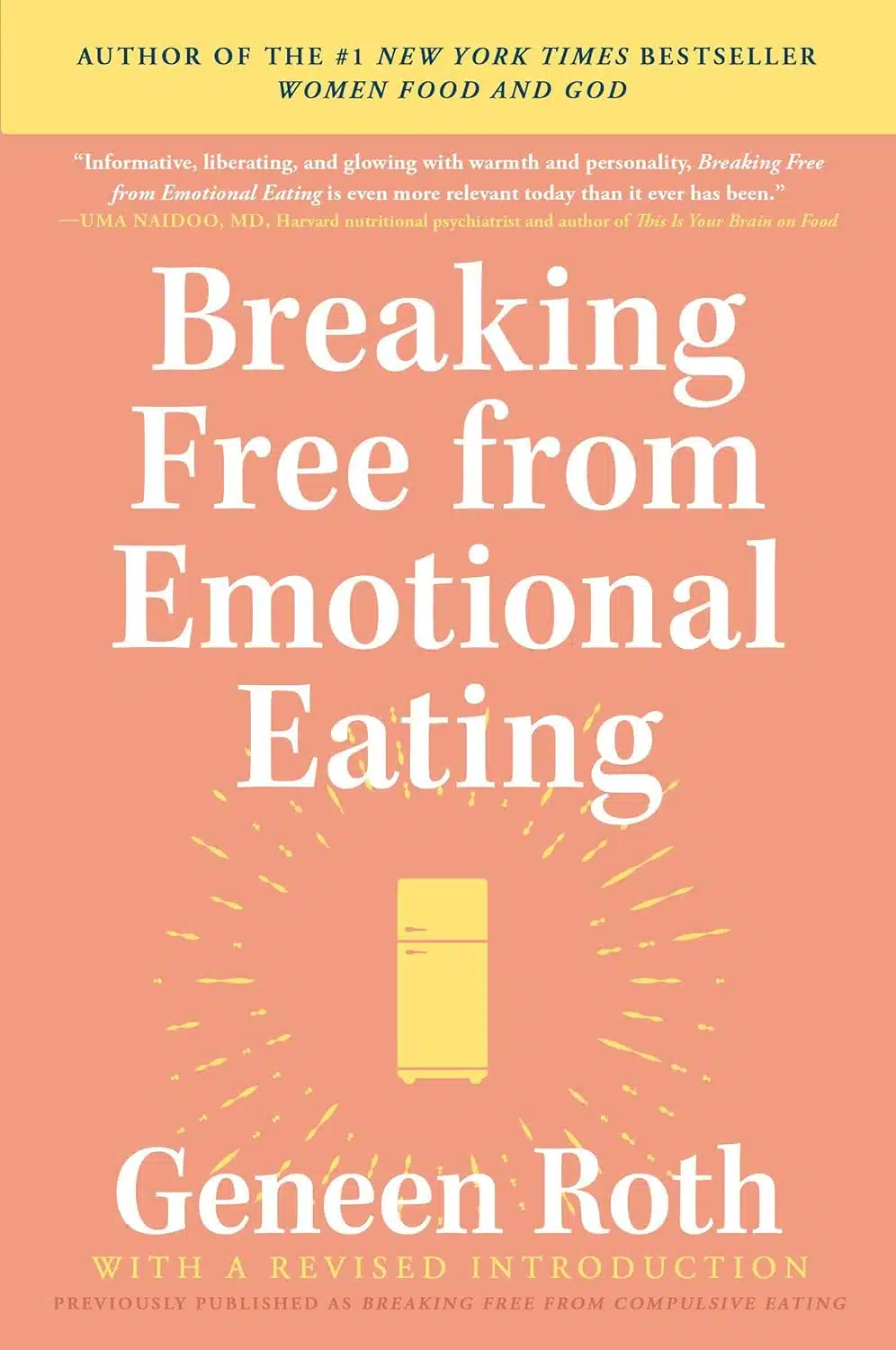
Breaking Free from Emotional Eating – Geneen Roth
10almonds is reader-supported. We may, at no cost to you, receive a portion of sales if you purchase a product through a link in this article.
The isn’t a book about restrictive dieting, or even willpower. Rather, it’s about making the unconscious conscious, and changing your relationship with food from being one of compulsion, to one of choice, wherein you also get the choice of saying “no”.
Roth takes us through the various ways in which life seems to conspire to take consciousness away from eating, from obvious distractions such as TV, to less obvious ones, like “it doesn’t count if you’re not sitting down”. She also tackles other psychological aspects, such as those people get from parents—which can be a big factor for many.
Importantly, she teaches us that when it comes to “have your cake and eat it”, you can also, in fact, have your cake and not eat it. That’s an option too. Its mere presence in our house is not the boss of us. However, overcoming the “this then that” automatic process that goes from having to eating, is something that Roth gives quite some attention to, offering a number of reframes to make it a lot easier.
The style is friendly, conversational, pop-science, and the format dates it a little—this is very much a book formatted the way pop-science books were formatted 20–50 years ago (the book itself is from 2003, for what it’s worth). However, a lack of modern format doesn’t take away from its very valuable insights, and if anything, the older format rather promotes reading a book from cover to cover, which can be beneficial.
Bottom line: if emotional or compulsive eating is something that you’ve found tricky to overcome, then this book can help make it a lot easier.
Don’t Forget…
Did you arrive here from our newsletter? Don’t forget to return to the email to continue learning!
Recommended
Learn to Age Gracefully
Join the 98k+ American women taking control of their health & aging with our 100% free (and fun!) daily emails:
-
Staying Strong: Tips To Prevent Muscle Loss With Age
10almonds is reader-supported. We may, at no cost to you, receive a portion of sales if you purchase a product through a link in this article.
Dr. Andrea Furlan, specialist in physical medicine and rehabilitation with 30 years of experience, has advice:
Fighting sarcopenia
Sarcopenia is so common as to be considered “natural”, but “natural” does not mean “obligatory” and it certainly doesn’t mean “healthy”. As for how to fight it?
You may be thinking “let us guess, is it eat protein and do resistance exercises? And yes it is, but that’s only part of it…
Firstly, she recommends remembering why you are doing this, or because understanding is key to compliance (i.e. your perfect diet and exercise program will mean nothing if you don’t actually do it, and you won’t do it enough to make it a habit, let alone keep it up, if the reasons aren’t clear in your mind).
Sarcopenia comes with an increased risk of falls, reduced physical capacity in general, resultant disability, social isolation, and depression. Of course, this is not a one-to-one equation; you will not necessarily become depressed the moment your muscle mass is below a certain percentage, but statistically speaking, the road to ruin is laid out clearly.
Secondly, she recommends being on the lookout for it. If you check your body composition regularly with a gadget, that’s great and laudable; if you don’t, then a) consider getting one (here’s an example product on Amazon), and b) watch out for decreased muscle strength, fatigue, reduced stamina, noticeable body shape changes with muscle loss and (likely) fat gain.
Thirdly, she recommends more than just regular resistance training and good protein intake. Yes, she recommends those things too, but also getting enough water (can’t rebuild the body without it), avoiding a sedentary lifestyle (sitting leads to atrophy of many supporting and stabilizing muscles, you know, the kind of muscles that don’t look flashy but stop you falling down), and getting good sleep—vital for all kinds of body maintenance, and muscle maintenance is no exception (there’s a reason bodybuilders sleep 9–12 hours daily when in a gaining phase; you don’t need to do that, but don’t skimp on your 7–9 hours, yes, really, even you, yes, at any age).
Lastly, she recommends continuing to learn about the topic, as otherwise it’s easy to go off-track.
For more information on all of the above and more, enjoy:
Click Here If The Embedded Video Doesn’t Load Automatically!
Want to learn more?
You might also like to read:
- Protein: How Much Do We Need, Really?
- Resistance Is Useful! (Especially As We Get Older)
- Resistance Beyond Weights
- HIIT, But Make It HIRT ← this is about high-intensity resistance training (HIRT); confusing the muscles like one confuses the heart in HIIT, which thus yields improved results
- Sleep: Yes, You Really Do Still Need It
Take care!
Share This Post
-
Ending Aging – by Dr. Aubrey de Grey
10almonds is reader-supported. We may, at no cost to you, receive a portion of sales if you purchase a product through a link in this article.
We know about how to slow aging. We know about diet, exercise, sleep, intermittent fasting, and other lifestyle tweaks to make. But how much can we turn back the clock, according to science?
Dr. Aubrey de Grey’s foundational principle is simple: the body is a biological machine, and aging is fundamentally an engineering problem.
He then outlines the key parts to that problem: the princple ways in which cells (and DNA) get damaged, and what we need to do about that in each case. Car tires get damaged over time; our approach is to replace them within a certain period of time so that they don’t blow out. In the body, it’s a bit similar with cells so that we don’t get cancer, for example.
The book goes into detail regards each of the seven main ways we accumulate this damage, and highlights avenues of research looking to prevent it, and in at least some cases, the measures already available to so.
Bottom line: if you want a hard science overview of actual rejuvenation research in biogerontology, this is a book that presents that comprehensively, without assuming prior knowledge.
Click here to check out Ending Aging and never stop learning!
Share This Post
-
Fight Diabetes With Vitamins & Antioxidants – by Dr. Kedar Prasad
10almonds is reader-supported. We may, at no cost to you, receive a portion of sales if you purchase a product through a link in this article.
You may be wondering what vitamins and antioxidants have to do with diabetes, which is primarily a metabolic disorder, and usually controlled (including: avoided/reversed) by macronutrient considerations, especially by adjusting the amounts of various kinds of carbs, fiber, and fats, and/or the patterns of eating those things.
Dr. Prasad makes the case that the proper combinations of vitamin and antioxidant supplements can greatly increase the effectiveness of standard medical treatments, to halt and reverse the progression of not only type 2 diabetes, but type 1, too.
Which is not to say that in the latter case your pancreas will perk up and stop fighting itself and start producing meaningful quantities of insulin—you’ll still need your insulin pump or injections—but it is to say that you can enjoy much more stable blood sugars and higher insulin sensitivity, which are of course both important things to have.
To demonstrate this, he reviews a lot of scientific literature for us, so much in fact that if you don’t love reading hard science, this book might be quite offputting for you, because the style is very academic, and while published to the wider public, most of the book reads like an extended scientific paper in book form, and indeed there are 23 pages of bibliography, which is quite a lot for a 240-page book.
While, as we say, most of the book is given over to hard science, on a practical note he does also give simple direct recommendations of how much to take of various supplements—and he does recommend supplementation, not relying on diet alone.
Bottom line: if you’d like a fresh take on diabetes avoidance/management that you probably haven’t read elsewhere, this book can provide that.
Click here to check out Fight Diabetes With Vitamins & Antioxidants, and do exactly that!
Share This Post
Related Posts
-
How Blood Pressure Works
10almonds is reader-supported. We may, at no cost to you, receive a portion of sales if you purchase a product through a link in this article.
Did you know? If you took out all your blood vessels and laid them end-to-end, you’d die (and the resultant testament to your odd way of dying would be 95,000 km long)?
That’s a silly (albeit true) fact, and as it turns out, not only is moving your blood around those 95,000 km of blood vessels quite a feat, but also, keeping the pressure constant while doing so is a truly remarkable accomplishment:
Under pressure
Your circulatory system contains about 95,000 kilometers of blood vessels, circulating roughly four to five liters of blood repeatedly to transport oxygen, glucose, and amino acids throughout your body, amounting to over 7,500 liters moved daily.
Now imagine if you had to move 7,500 liters along 95,000 km using cars, but with the caveat that you’re driving under the conditions of the 1994 movie “Speed”, that is to say, if you at any point get stuck in traffic, you die.
So, blood pressure must always be within a certain “Goldilocks zone”, to keep things moving without either stalling (heart failure) or exploding (hemorrhage), bearing in mind that a plaque rupture can create blood clots that block circulation, causing a heart attack if blood flow to your heart stops, or a stroke if blood flow to your brain is interrupted.
- How blood pressure works: blood pressure is the force blood exerts against vessel walls, peaking during systole when your heart contracts, and dropping during diastole when your heart rests between beats.
- Normal blood pressure range: a healthy reading is typically below 120/80 mmHg, with systolic pressure between 90–120 mmHg and diastolic pressure between 60–80 mmHg.
- What raises blood pressure: thicker blood, increased blood volume from salt-related water retention, and stress hormones like epinephrine and norepinephrine can all increase pressure by making blood harder to move, or narrowing vessels.
Happily, despite constant pressure and (hopefully) billions of heartbeats over a lifetime, healthy arteries are elastic and have evolved to handle these demands effectively.
We just have to keep them that way!
For more on all of this, enjoy:
Click Here If The Embedded Video Doesn’t Load Automatically!
Want to learn more?
You might also like:
What Most People Don’t Know About Blood Pressure
Take care!
Don’t Forget…
Did you arrive here from our newsletter? Don’t forget to return to the email to continue learning!
Learn to Age Gracefully
Join the 98k+ American women taking control of their health & aging with our 100% free (and fun!) daily emails:
-
Stop Walking on Eggshells – by Randi Kreger & Paul Mason
10almonds is reader-supported. We may, at no cost to you, receive a portion of sales if you purchase a product through a link in this article.
As you may gather from the title, the angle here is not “Borderline Personality Disorder is fine and dandy”, but nor is it something anyone chooses to have, and as such, importantly, this book’s advice is also not “and so you should immediately disown, divorce, defenestrate your partner”, either.
Rather, it has a balanced and compassionate approach that examines both the pitfalls and the possibilities, and provides the tools to make your relationship feel (and hopefully, actually be) safe for all concerned.
And yes, ending a relationship is always an option too, even if it can sometimes feel like it’s not, on account of how the relationships of people with BPD often have a lot of “near miss” situations, nearly ending but not quite, or (in the case of a partner who’s amenable to such), off-and-on relationships—either of which can make it seem like it’ll never truly be over.
First, though, the authors do look at a variety of ways of avoiding that outcome; making changes within oneself, setting boundaries and honing related skills, asserting your needs with confidence and clarity, and dealing with the lies, rumor-mongering, and accusations that often come with BPD. For that matter, the authors do also note that not all conflict is abuse (something that many forget), but on the flipside, how to tell when it actually is, too.
The style is very pop-science, light in tone albeit sometimes heavy in content.
Bottom line: if you or a loved one has BPD, or even just has a lot of the same symptoms as such, this book can be very helpful.
Click here to check out Stop Walking On Eggshells, and stop walking on eggshells!
Don’t Forget…
Did you arrive here from our newsletter? Don’t forget to return to the email to continue learning!
Learn to Age Gracefully
Join the 98k+ American women taking control of their health & aging with our 100% free (and fun!) daily emails:
-
Apples vs Oranges – Which is Healthier?
10almonds is reader-supported. We may, at no cost to you, receive a portion of sales if you purchase a product through a link in this article.
Our Verdict
When comparing apples to oranges, we picked the oranges.
Why?
In terms of macros, the two fruits are approximately equal (and indeed, on average, precisely equal in the most important metric, which is fiber). So, a tie here.
In the category of vitamins, apples are higher in vitamin K, while oranges are higher in vitamins A, B1, B2, B3, B5, B6, B7, B9, C, and choline. An easy win for oranges this time.
When it comes to minerals, apples have more iron and manganese, while oranges have more calcium, copper, magnesium, phosphorus, potassium, selenium, and zinc. Another easy win for oranges.
So, adding up the sections, a clear win for oranges. But, by all means, enjoy either or both! Diversity is good.
Want to learn more?
You might like to read:
From Apples to Bees, and High-Fructose Cs: Which Sugars Are Healthier, And Which Are Just The Same?
Take care!
Don’t Forget…
Did you arrive here from our newsletter? Don’t forget to return to the email to continue learning!
Learn to Age Gracefully
Join the 98k+ American women taking control of their health & aging with our 100% free (and fun!) daily emails:


