
More Reasons To Enjoy Seaweed
10almonds is reader-supported. We may, at no cost to you, receive a portion of sales if you purchase a product through a link in this article.

People think of seaweed as a plant, and the reality is… It might be. Ish. If we stretch the definition a certain way. It’s complicated. Seaweed can be a lot of different things but is usually some kind of composite of different kinds of algae which, when it comes to taxonomical classification, can be subject to vigorous debate. Taxonomists can agree they are all of the domain Eukaryota, but that doesn’t tell us much (it’s a classification that’s so broad as to include yeasts, jellyfish, sunflowers, octopodes, mushrooms, and you).
Learn more: A Deeper Dive Into Seaweed ← this one’s specifically about nori seaweed
So, what’s new?
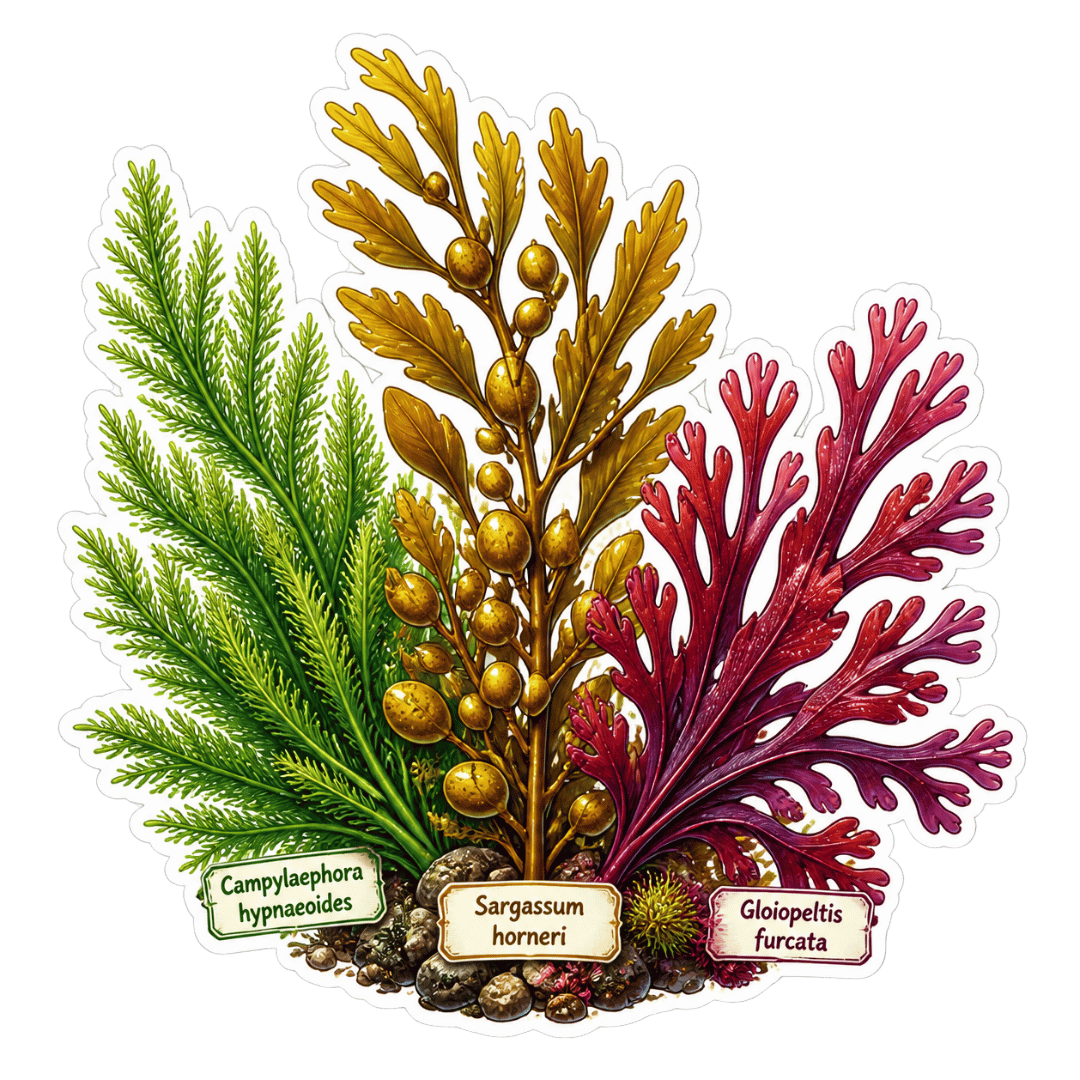
Researchers (Dr. Sakura Takahashi et al.) investigated how three Japanese edible seaweeds affect gut bacteria, short-chain fatty acids (SCFAs), and intestinal immunity, in a combination of studies ranging from petri cells and mice, to human trials.
Namely, the three species studied were:
- Campylaephora hypnaeoides
- Sargassum horneri
- Gloiopeltis furcata
Gut bacteria: all three seaweeds significantly altered gut microbiota composition in mice, increasing Akkermansia, Alloprevotella, Faecalibaculum, and certain Muribaculaceae bacteria while reducing several other bacterial groups.
Notably, humans do not usually have Muribaculaceae, so that one may be less relevant if you, dear reader, are not a mouse.
However! If you eat mice or mice droppings, then you might have those bacteria now. We don’t recommend it, though.
Short-chain fatty acids: seaweed consumption increased intestinal levels of acetate, propionate, and butyrate, which support gut health and influence metabolic and immune functions.
We wrote about that, here: The Orchid That Renovates Your Gut (Gently)
In particular, Campylaephora hypnaeoides produced the greatest increases in SCFAs and also promoted the growth of three beneficial Bifidobacterium species and two beneficial lactic acid bacteria, in human lab models.
Meanwhile, Campylaephora hypnaeoides and Gloiopeltis furcata increased immunoglobulin A (IgA), an antibody that helps protect the intestinal lining against pathogens.
You can read more about that, here: The Surprising Food Compound That Fixes Leaky Gut
And this is particularly important, on account of what we talk about in: Feed Your Gut Microbes, Or They Might Eat You Instead
You might be wondering about the human trial: 74 healthy adults enjoyed 30g of boiled Sargassum horneri daily for three weeks, resulting in a significant reduction in the Firmicutes-to-Bacteroidota bacterial ratio, which is considered good.
In short: edible seaweeds contain potentially beneficial prebiotic fibers that can alter gut bacteria, increase SCFA production, and stimulate intestinal immune responses!
You can read the paper in full, here: Japanese Edible Seaweeds Modulate the Gut Microbiota in Mice and Humans: Prebiotic Effects of Seaweed Polysaccharides
Want to try some?
We don’t sell it, but here for your convenience is an example product on Amazon, but we encourage you to find fresh seaweed locally if available (e.g. if you live in Kansas, probably it isn’t), or dried anywhere 😋
Enjoy!
Don’t Forget…
Did you arrive here from our newsletter? Don’t forget to return to the email to continue learning!
Recommended

Learn to Age Gracefully
Join the 98k+ American women taking control of their health & aging with our 100% free (and fun!) daily emails: