
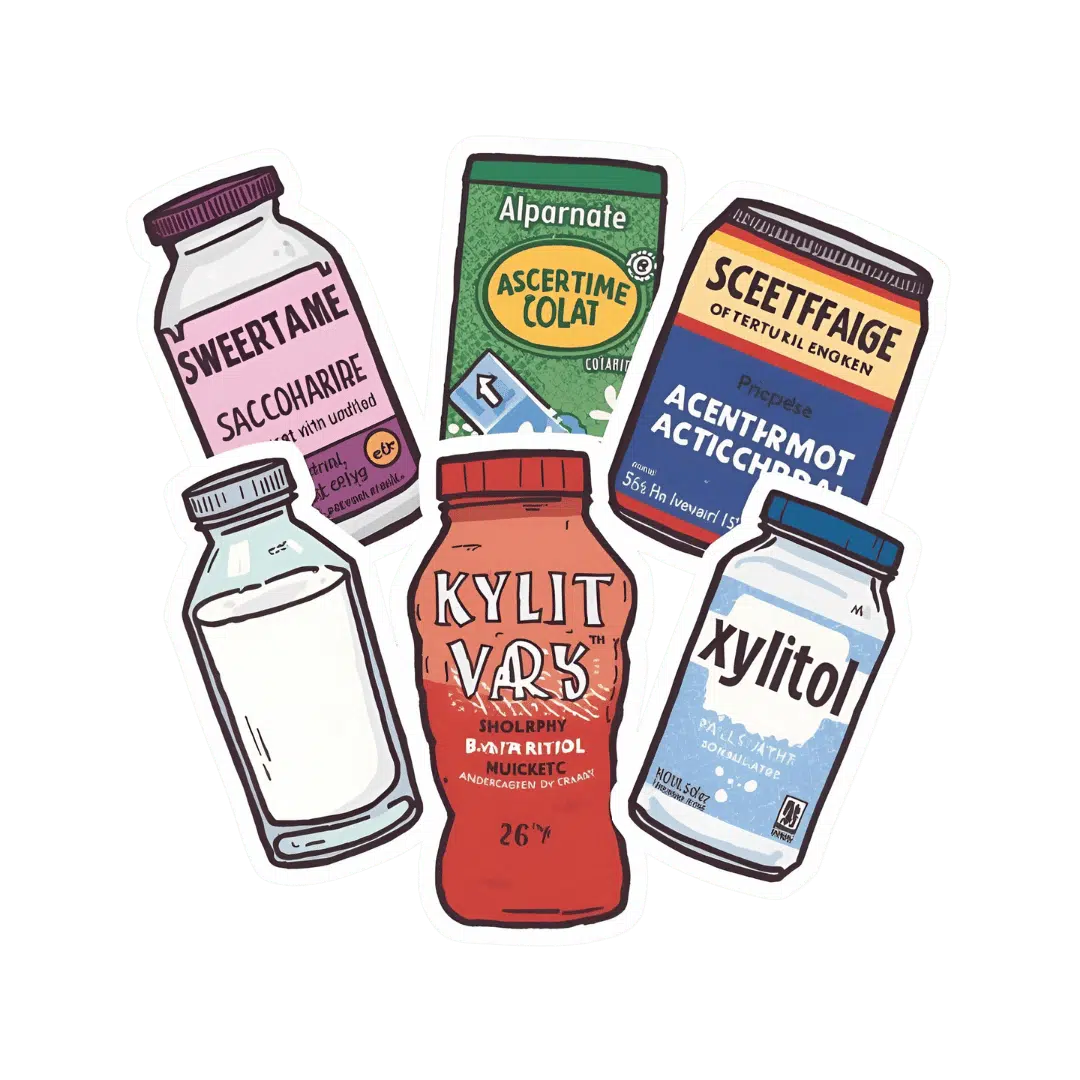
What’s The Healthiest Sweetener?
10almonds is reader-supported. We may, at no cost to you, receive a portion of sales if you purchase a product through a link in this article.

It’s Q&A Day at 10almonds!
Have a question or a request? We love to hear from you!
In cases where we’ve already covered something, we might link to what we wrote before, but will always be happy to revisit any of our topics again in the future too—there’s always more to say!
As ever: if the question/request can be answered briefly, we’ll do it here in our Q&A Thursday edition. If not, we’ll make a main feature of it shortly afterwards!
So, no question/request too big or small 😎
❝What sweetners are healthy and which will give us brain cancer etc?❞
Short answer: none are great, and the science is very mixed
More helpful answer: some are definitely better or worse than others, and there are strategies that can be employed to limit harm
Firstly, there is a problem with sweeteners for simply being sweet to the taste, so that’s going to bring down the overall healthiness of literally any sweetener.
The problem, in few words, is that we can build tolerance to sweetness, and thus we will gradually need more of it to get the same experience. This occurs especially in the case of artificial sweeteners, because many sugar substitutes are many times (in some cases, hundreds of times) sweeter than sugar. This leads to other sweet foods tasting more bland, causing people to crave sweeter and sweeter foods for the same satisfaction level.
With this in mind…
The World Health Organization has released a report offering guidance regards the use of sugar-free sweeteners.
In a nutshell, the guidance is: don’t
- Here’s the report itself: Use of non-sugar sweeteners: WHO guideline
- Here’s the WHO’s own press release about it: WHO advises not to use non-sugar sweeteners for weight control in newly released guideline
- And it was based on this huge systematic review: Health effects of the use of non-sugar sweeteners: a systematic review and meta-analysis
Let’s take some popular ones one-by-one
We answered a question about sugar a little while back:
Is Sugar The New Smoking? ← the answer is: no it isn’t, but it’s still very bad
For more detail on different kinds of sugars, though, see: From Apples to Bees, and High-Fructose Cs: Which Sugars Are Healthier, And Which Are Just The Same?
Sucralose is a popular one, because it’s “a sugar that isn’t processed as a sugar” (although as new research has discovered, it might be at least partially metabolized as sugar after all), and it does have other problems too:
- The Sucralose News: Scaremongering Or Serious? ← this is about genotoxicity, but the science is as yet unclear
- The Sweetener That Interferes With Hunger/Satiety Signals ← specifically, sucralose prolongs hunger, and can even boost cravings, which makes it excellent in culinary terms, but (for most people, at least) not fabulous for the health. Why “for most people”? Well, some people struggle with eating enough, so something that chemically tricks people into eating more could contextually be beneficial. But most people aren’t in that boat, and are more likely to have the opposite problem.
We’ve also talked about: The Fascinating Truth About Aspartame, Cancer, & Neurotoxicity
…which covers how the most popular beliefs about aspartame are myths, and in large part stemming from a single viral hoax chain letter in the 90s.
Erythritol is increasingly common these days, perhaps because of others getting negative press. It has its own specific issues:
Erythritol & Brain Damage: Is The Science As Scary As It Sounds?
…and the answer is that while erythritol was linked to a higher risk of heart attack, stroke, and early death in vivo, and in vitro, exposing brain blood vessel cells to erythritol levels similar to a typical sugar-free drink caused:
- increased reactive oxygen species (which age and inflame tissues)
- reduced nitric oxide (leading to less vessel relaxation)
- increased endothelin-1 (causing more vessel constriction)
- impaired production of t-PA (reducing the ability to break down clots)
…all of which increase stroke risk. That said, this latter study was about what happens in a petri dish, so it could be that it’s not what happens in a living human being; we don’t know yet. Either way, the higher risk of heart attack, stroke, and early death is compelling as that was from data in real live (prior to early death, anyway) humans, We talked about that here:
Xylitol vs Erythritol – Which is Healthier?
The answer we came to in that head-to-head was:
❝The one thing that sets them apart is their respective safety profiles. Xylitol is prothrombotic and associated with major adverse cardiac events (CI=95, adjusted hazard ratio=1.57, range=1.12-2.21). Erythritol is also prothrombotic and more strongly associated with major adverse cardiac events (CI=95, adjusted hazard ratio=2.21, range=1.20-4.07).
So, xylitol is bad and erythritol is worse, which means the relatively “healthier” is xylitol. We don’t recommend either, though.❞
(we showed studies for this, linked in the “This or That” page here)
As a quick aside: readers with good memories may recall that we’ve sometimes recommended xylitol for good oral health (it’s not just “not too bad as sweeteners go”, it actively does good things too; the crux is that it’s being used in the mouth (such as with xylitol-sweetened gum) but not actually ingested in meaningful amounts.
You can learn more about that here: Xylitol: Cavity Fighter Or Gut Disruptor? The Dose Makes the Poison
Now for some more positive news…
Stevia‘s mostly been found to be “not bad”, see: Stevia vs Acesulfame Potassium – Which is Healthier?
…which found that moderate consumption of stevia improves gut microdiversity, whereas acesulfame potassium harms gut microdiversity:
- The Effects of Stevia Consumption on Gut Bacteria: Friend or Foe?
- The Artificial Sweetener Acesulfame Potassium Affects the Gut Microbiome
Lastly, one we’re not aware of any downsides of beyond the sweetness tolerance spiral problem we mentioned up top…
Glycine is about as sweet as sugar (sucrose), but it’s an amino acid that’s important for a good number of things, including collagen synthesis:
So if you’re going to go with some kind of non-sugar sweetener, we’d recommend that 😎
Enjoy (in moderation though please, because of the sweetness tolerance problem)!
Don’t Forget…
Did you arrive here from our newsletter? Don’t forget to return to the email to continue learning!
Recommended
Learn to Age Gracefully
Join the 98k+ American women taking control of their health & aging with our 100% free (and fun!) daily emails: