
Are You Getting The Right Kinds Of Flavonoids?
10almonds is reader-supported. We may, at no cost to you, receive a portion of sales if you purchase a product through a link in this article.

First, a quick note on terms:
- Polyphenol: often simplified to “beneficial phytochemical”, but that’s misleading as there are many beneficial phytochemicals (naturally-occurring chemicals in plants) that do not meet the definition of “polyphenol”, which is very specifically: a compound containing more than one phenolic hydroxyl group
- Flavonoid: a class of polyphenolic secondary metabolites found in many plants, named for its association with yellow pigment (although the end result in appearance might not be yellow, depending on what else is present, but it’s present in the mix biochemically!). Flavonoids can also be further subcategorized into:
- Anthocyanidins
- Anthoxanthins
- Flavanones
- Flavanonols
- Flavans
- Isoflavonoids
- Flavonoid: a class of polyphenolic secondary metabolites found in many plants, named for its association with yellow pigment (although the end result in appearance might not be yellow, depending on what else is present, but it’s present in the mix biochemically!). Flavonoids can also be further subcategorized into:
…which can each be subcategorized further, but if we continue expanding the tree of possibilities each time, this page is going to get very long, so we’ll call it sufficient there for now!
However, this subcategorization isn’t only important to biologists who get excited about taxonomy; it has important health implications too.
For example, let’s remember when we wrote about how you can Fight Inflammation & Protect Your Brain, With Quercetin ← Quercetin is a flavonol (which, in turn, is a kind of anthoxanthin)!
Well, not really!
By this we mean it’s not one flavonol, but rather a stack of flavonols in a trenchcoat, and by “trenchcoat” we mean a vegetable or something.
In fact, in today’s “This or That” article, we mentioned that one of the items compared has “more polyphenols (most notably a wide range of flavonoids including multiple anthocyanins, luteolin, and 6 different kinds of quercetin)”. Because we’ve a little more room here and we’re writing about flavonoids, we’ll mention that the data we were looking at, looked like this:
- Flavonoids
- Anthocyanins
- Cyanidin 3-O-(6”-malonyl-glucoside)
- Cyanidin 3-O-glucoside
- Flavones
- Luteolin 7-O-glucuronide
- Flavonols
- Quercetin 3-O-(6″-malonyl-glucoside)
- Quercetin 3-O-(6″-malonyl-glucoside) 7-O-glucoside
- Quercetin 3-O-galactoside
- Quercetin 3-O-glucoside
- Quercetin 3-O-glucuronide
- Quercetin 3-O-rhamnoside
- Anthocyanins
…along with a lot of additional data that we won’t bore you with here, pertaining to mg/100g values, minimums and maximums, standard deviations, studies done, etc. The data table fills the screen and more.
So you see, even following the tree of possibilities down as far as quercetin yields 9 flavonoids including 6 kinds of quercetin present in that plant alone, and that’s a fairly modest list.
Why this matters for your health
Scientists (Dr. Alysha Thompson et al.) examined an uncontroversial topic, the connection between flavonoid intake and good health.
What was a little different from the norm, though, was that the study looked beyond flavonoid quantity, to also look at diversity of flavonoids.
They found that people who consumed a greater variety of flavonoids had much lower risks of death and major chronic diseases, independent of total quantity consumed.
This was a big (n=124,805) study, looking at UK adults aged 40+: participants were mostly women (56%), with 60% overweight or obese and 25% hypertensive.
Shocking nobody in this British population study, 67% of the total flavonoid consumption came from tea.
Which is a problem. Not because there’s anything wrong with tea (it’s a very healthful drink), but rather because very many people had it as their primary source of flavonoids, which isn’t very diverse; indeed, flavan-3-ols (mostly found in tea) made up 87% of total flavonoid intake.
Quantity vs Diversity
People who consumed the largest amounts of flavonoids (mostly from tea) often consumed the least diverse flavonoids (i.e. fewest kinds).
Which made the results all the starker, since those consuming a wider range of flavonoids got more from beneficial compounds like anthocyanins, flavanones, and proanthocyanidins—rather than just thearubigins from tea.
Notably, the people who did get more diversity of flavonoids tended to be healthier overall; they were also (as a matter of demographic information, since it’s there in the paper) more likely to be female, older, leaner, more physically active, better educated, and less likely to smoke.
This means that while previous recommendations focused on quantity (e.g. 400–600 mg/day of flavan-3-ols), this study suggests expanding to include as many different sources of flavonoids as reasonably possible.
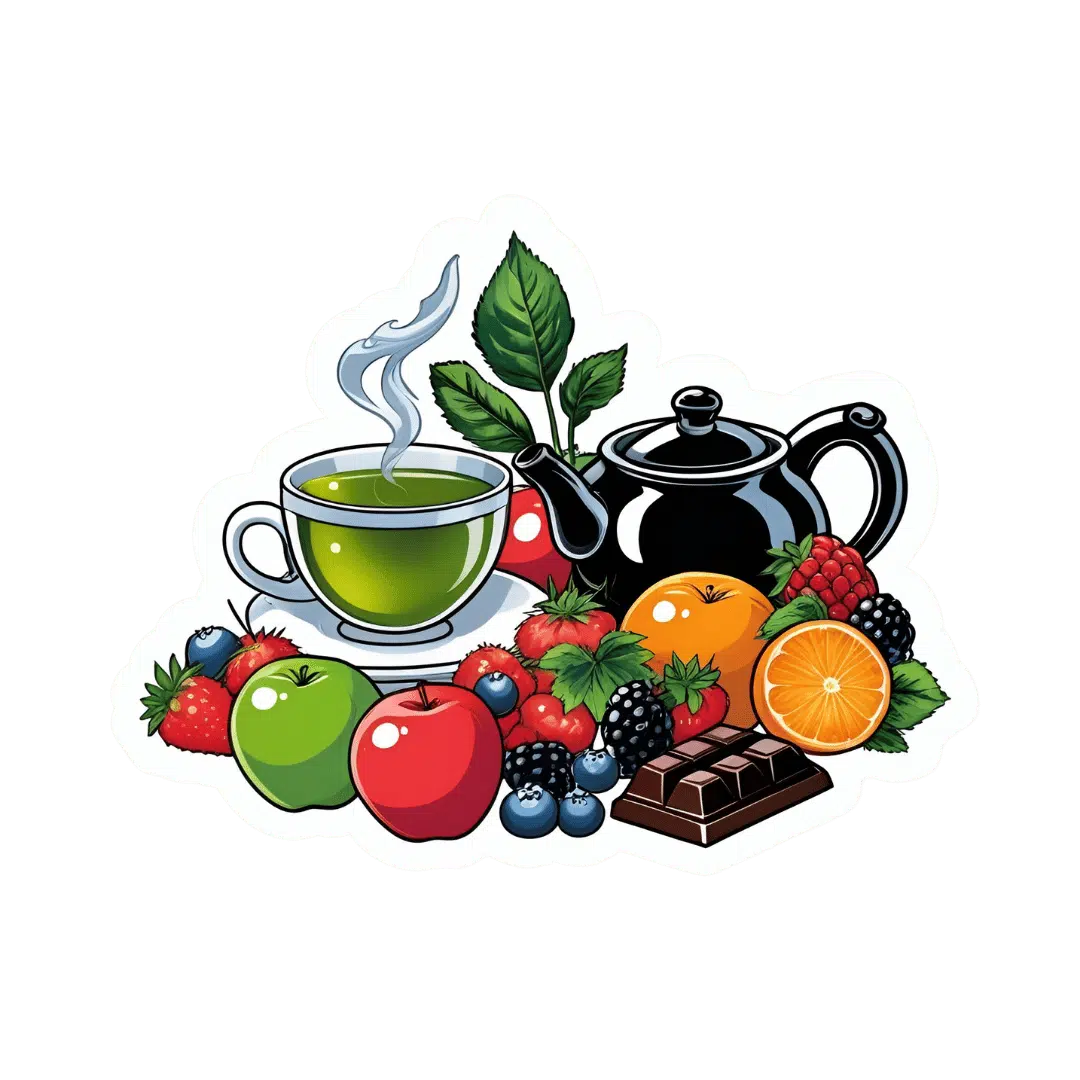
In particular, the researches found that top-scorers for diversity of flavonoids includes berries, apples, citrus fruits, so they’re best enjoyed alongside black and green teas (which are very good), and yes, even some dark chocolate if you like.
Note that written like that, it looks like 6 different sources. But for example, how many different kinds of flavonoid does a blueberry contain?
Well, we can’t give an exhaustive list because each one has to be tested for individually, but we can say that a partial list of different kinds of flavonoids contained in a blueberry looks like this:
- Cyanidin 3-O-(6”-acetyl-galactoside)
- Cyanidin 3-O-(6”-acetyl-glucoside)
- Cyanidin 3-O-arabinoside
- Cyanidin 3-O-galactoside
- Cyanidin 3-O-glucoside
- Delphinidin 3-O-(6”-acetyl-galactoside)
- Delphinidin 3-O-(6”-acetyl-glucoside)
- Delphinidin 3-O-arabinoside
- Delphinidin 3-O-galactoside
- Delphinidin 3-O-glucoside
- Malvidin 3-O-(6”-acetyl-galactoside)
- Malvidin 3-O-(6”-acetyl-glucoside)
- Malvidin 3-O-arabinoside
- Malvidin 3-O-galactoside
- Malvidin 3-O-glucoside
- Peonidin 3-O-(6”-acetyl-galactoside)
- Peonidin 3-O-(6”-acetyl-glucoside)
- Peonidin 3-O-arabinoside
- Peonidin 3-O-galactoside
- Peonidin 3-O-glucoside
- Petunidin 3-O-(6”-acetyl-galactoside)
- Petunidin 3-O-(6”-acetyl-glucoside)
- Petunidin 3-O-arabinoside
- Petunidin 3-O-galactoside
- Petunidin 3-O-glucoside
- (-)-Epicatechin
- Kaempferol 3-O-glucoside
- Myricetin 3-O-arabinoside
- Myricetin 3-O-rhamnoside
- Quercetin 3-O-acetyl-rhamnoside
- Quercetin 3-O-arabinoside
- Quercetin 3-O-galactoside
- Quercetin 3-O-glucoside
- Quercetin 3-O-xyloside
And there are plenty of other polyphenols in a blueberry too; that’s just the flavonoids, and not even an exhaustive list of those!
So, all this to say, diversity can be found easily, if you know where to look 😎
You can read the paper in full, here: High diversity of dietary flavonoid intake is associated with a lower risk of all-cause mortality and major chronic diseases
In summary…
The trick to getting the most health benefits out of flavonoids is not focusing on total quantity, but on diversity.
Want to learn more?
Check out:
- 21 Most Beneficial Polyphenols & What Foods Have Them ← including 9 different first-order categories of flavonoid, e.g. quercetin, kaempferol, etc, along with links to wherever we’ve done spotlight main features on each of them
- Which Tea Is Best, By Science? ← we compare and contrast the phytochemical properties of black, white, green, and red teas.
- Enjoy Bitter Foods For Your Heart & Brain ← it’s about the polyphenols, of which, mostly flavonoids, phenolic acids, and tannins
- And of course, for polyphenol diversity and more: What’s Your Plant Diversity Score?
Alternatively, for a middle-ground approach of targeting 16 most polyphenol delivering foods, see this super-dense arrangement:
Mediterranean Diet… In A Pill? ← it’s about plant extracts from 16 specific foods, and the polyphenols they deliver
Enjoy!
Don’t Forget…
Did you arrive here from our newsletter? Don’t forget to return to the email to continue learning!
Recommended

Learn to Age Gracefully
Join the 98k+ American women taking control of their health & aging with our 100% free (and fun!) daily emails: