

Do You Have Anosognosia?
10almonds is reader-supported. We may, at no cost to you, receive a portion of sales if you purchase a product through a link in this article.

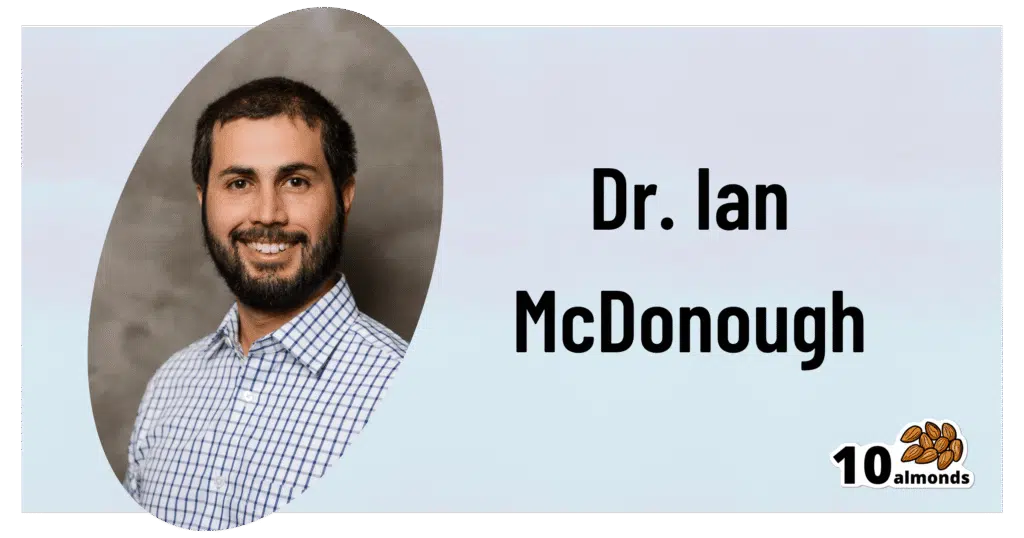
This is Dr. Ian McDonough. He’s a postdoctoral neuroscience research fellow and psychology professor, specializing in episodic memory, aging, and biomarkers of pre-clinical Alzheimer’s disease.
What does he want us to know?
As we get older, most of us tend to have fairly accurate perceptions of our financial abilities, and this awareness tends to improve with age and experience—until cognitive decline begins.
This was brought to light by a study he led, that analyzed 10 years of data from 2,802 older adults (age 65+). Participants rated their perceived ability in tasks like making change and paying bills, then performed actual financial tasks to test their competence.
Older adults in their 70s were better able to predict their financial performance than younger “older adults”, which the researchers noted was probably because…
❝It does seem people get better with time. So, by the time you get to your 70s, as long as you maintain your cognition decently well, you’re able to predict your financial ability slightly better. It’s almost like you do learn as you get more and more experience, especially as you retire, and you’re dealing with Social Security, Medicaid, Medicare and all those types of things that have to do with finances.❞
~ Dr. Ian McDonough
However! Cognitive decline disrupts this accuracy; people with cognitive decline (especially if progressing to dementia) often lose insight into their financial abilities, believing they’re more competent than they are—due to a condition called anosognosia, where one is unaware of one’s own cognitive impairment.
Which is reasonable, really. The very mental faculties that would normally clue us in to noticing our decline in a certain area, have been hit by the cognitive decline too.
This becomes a problem, because it then leaves people more vulnerable to suffering financial losses, either by maladministration of their affairs, or by falling prey to scams.
You can find the paper here: Relationship Between Perceived and Objective Financial Abilities Among Older Adults: Results From the Advanced Cognitive Training for Independent and Vital Elderly Cohort
What should we do about it?
According to Dr. McDonough,
❝Our research suggests that there is a critical window of time after people begin to experience cognitive decline during which they are still aware of their financial abilities. We believe that this is when people can take action to secure their finances and develop systems to protect themselves from fraud❞
We wrote about this a little before, in the context of planning around an Alzheimer’s diagnosis: Alzheimer’s: The Bad News And The Good
We also covered the topic of a “Living Will”, to enact if you are no longer considered able to advocate for yourself, here: Managing Your Mortality: When Planning Is a Matter of Life and Death ← while the title does not herald a cheerful prognosis, we promise we do also talk about living wills and such too!
This may particularly important in people with Parkinson’s disease, because of The Meds That Impair Decision-Making
Delegating to others is an obvious (and often reasonable) solution, but it can come with problems, because of such things as:
- Transitions in financial autonomy and risk for financial elder abuse, and
- Coping with Age-related Threats to Role Identity: Older Couples and the Management of Household Money
However, there are other options! For example:
Short version: it works! You can read a pop-science rendering of things, here:
Wondering how good your cognitive abilities are, and what that means in terms of dementia risk?
It’s actually quite identifiable, if one knows what things “count” and what things don’t:
Is It Dementia? Spot The Signs (Because None Of Us Are Immune)
Take care!
Don’t Forget…
Did you arrive here from our newsletter? Don’t forget to return to the email to continue learning!
Recommended

Learn to Age Gracefully
Join the 98k+ American women taking control of their health & aging with our 100% free (and fun!) daily emails: