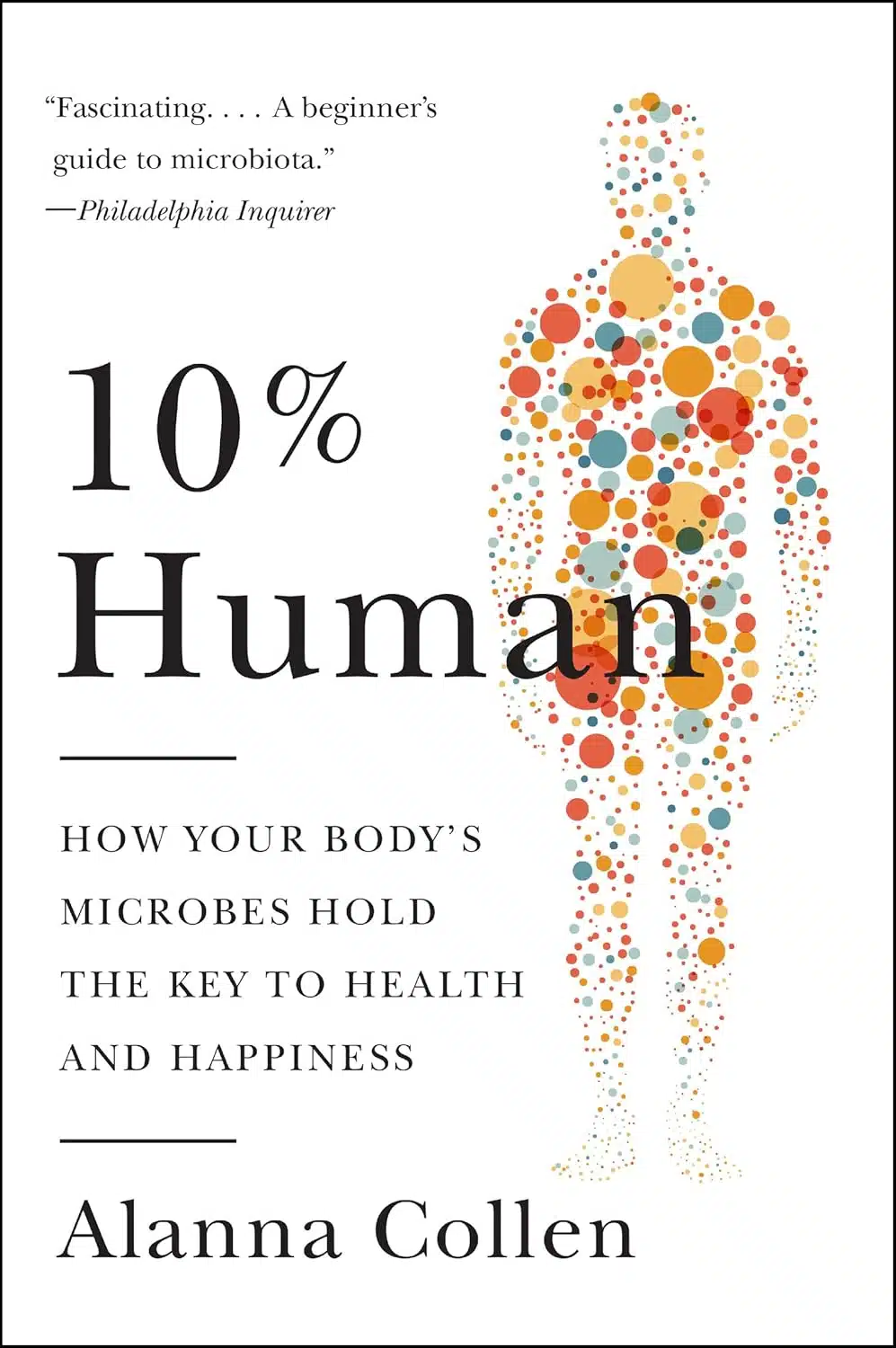
10% Human – by Dr. Alanna Collen

10almonds is reader-supported. We may, at no cost to you, receive a portion of sales if you purchase a product through a link in this article.

The title, of course, is a nod to how by cell count, we are only about 10% human, and the other 90% are assorted microbes.

Dr. Collen starts with the premise that “all diseases begin in the gut” which is perhaps a little bold, but as a general rule of thumb, the gut is, in fairness, implicated in most things—even if not being the cause, it generally plays at least some role in the pathogenesis of disease.

The book talks us through the various ways that our trillions of tiny friends (and some foes) interact with us, from immune-related considerations, to nutrient metabolism, to neurotransmitters, and in some cases, direct mind control, which may sound like a stretch but it has to do with the vagus nerve “gut-brain highway”, and how microbes have evolved to tug on its strings just right. Bearing in mind, most of these microbes have very short life cycles, which means evolution happens for them so much more rapidly than it does for us—something that Dr. Collen, with her PhD in evolutionary biology, has plenty to say about.

There is a practical element too: advice on how to avoid the many illnesses that come with having our various microbiomes (it’s not just the gut!) out of balance, and how to keep everything working together as a team.

The style is quite light pop-science and, once we get past the first chapter (which is about the history of the field), quite a pleasant read as Dr. Collen has an enjoyable and entertaining tone.

Bottom line: if you’d like to understand more about all the things that come together to make us functionally 100% human, then this book is an excellent guide to that.

Click here to check out 10% Human, and learn about how we interact with ourselves!

Don’t Forget…

Did you arrive here from our newsletter? Don’t forget to return to the email to continue learning!

Learn to Age Gracefully

Join the 98k+ American women taking control of their health & aging with our 100% free (and fun!) daily emails:

  • Knee Cracking & Popping: Should You Be Worried?

    10almonds is reader-supported. We may, at no cost to you, receive a portion of sales if you purchase a product through a link in this article.

    Dr. Tom Walters (Doctor of Physical Therapy) explains about what’s going on behind our musical knees, and whether or not this synovial symphony is cause for concern.

    When to worry (and when not to)

    If the clicking/cracking/popping/etc does not come with pain, then it is probably being caused by the harmless movement of fluid within the joints, in this case specifically the patellofemoral joint, just behind the kneecap.

    As Dr. Walters says:

    ❝It is extremely important that people understand that noises from the knee are usually not associated with pathology and may actually be a sign of a healthy, well-lubricated joint. let’s be careful not to make people feel bad about their knee noise as it can negatively influence how they view their body!❞

    On the other hand, there is also such a thing as patellofemoral joint pain syndrome (PFPS), which is very common, and involves pain behind the kneecap, especially upon over-stressing the knee(s).

    In such cases, it is good to get that checked out by a doctor/physiotherapist.

    Dr. Walters advises us to gradually build up strength, and not try for too much too quickly. He also advises us to take care to strengthen our glutes in particular, so our knees have adequate support. Gentle stretching of the quadriceps and soft tissue mobilization with a foam roller, are also recommended, to reduce tension on the kneecap.

    For more on these things and especially about the exercises, enjoy:

    Click Here If The Embedded Video Doesn’t Load Automatically!

    Want to learn more?

    You might like to read:

    How To Really Take Care Of Your Joints

    Take care!

    Share This Post

  • Viruses, Bacteria, Allergens: One Nasal Spray To Stop Them All

    10almonds is reader-supported. We may, at no cost to you, receive a portion of sales if you purchase a product through a link in this article.

    …and in the airways, fight them!

    Scientists unveil a “universal vaccine”

    Vaccines save millions of lives every year:

    Since vaccines are not without their popular misunderstanders, we have written a little about that, here: Vaccine Mythbusting

    However, they have limitations. Most notably, because they work by showing your immune system a recognizable piece of a specific pathogen, such as the spike protein of COVID, this runs into difficulties when viruses mutate, so surface antigens change, which is why COVID boosters, annual flu shots, and similar vaccines sometimes need updating.

    Researchers (Dr. Mengyun Hu et al.) found a way to create a broad protection against many respiratory threats.

    How it does that, in technical terms: the formulation GLA-3M-052-LS+OVA combines toll-like receptor 4 and 7/8 ligands with ovalbumin to recruit memory CD4+ and CD8+ T cells into your lungs and keep alveolar macrophages in a heightened defensive state.

    Translating from sciencese: instead of targeting a specific antigen from one pathogen, the nasal spray boosts your lungs’ integrated innate and adaptive immune responses to provide broad protection.

    Dr. Hu (what a cool name) and her team will be doing human trials soon, but the results so far from mouse studies are very promising:

    • Against viruses: vaccinated mice enjoyed a 700-fold reduction in lung viral levels after SARS-CoV-2 exposure, avoided severe weight loss, and all survived*.
    • Against bacteria: vaccinated mice were also protected for about 3 months against Staphylococcus aureus and Acinetobacter baumannii, both common causes of hospital-acquired pneumonia.
    • Against allergies: when exposed to house dust mite allergens, vaccinated mice developed a much weaker Th2 response (which in this context, is good) and maintained clear airways compared with unvaccinated mice.

    *This is a big difference from what happened in unvaccinated mice, because while the unvaccinated mice had initially healthy immune systems, those unvaccinated immune systems had no instructions about what to do, and thus:

    ❝The immune system becomes so ready and so alert that it can launch the typical adaptive responses—virus-specific T cells and antibodies—in as little as three days, compared with about 2 weeks in unvaccinated mice❞

    ~ Dr. Violetta Horton, professor of microbiology and immunology, and colleague of Dr. Hu collaborating on this study

    If it’s successful in human trials:

    • It’s expected to require just two nasal doses
    • It could replace multiple seasonal respiratory vaccines
    • It should seriously boost rapid protection during future pandemics

    You can find the study itself, here: Mucosal vaccination in mice provides protection from diverse respiratory threats

    Want to do more meanwhile?

    You might want to check out: Beyond Supplements: The Real Immune-Boosters! ← most people don’t know these things and the huge difference they make

    And for that matter: Why Some People Get Sick More (And How To Not Be One Of Them) ← for a very prophylactic approach

    Take care!

    Share This Post

  • Don’t Miss This Early Warning Sign Of Physical Decline (Better To Fix It Now)

    10almonds is reader-supported. We may, at no cost to you, receive a portion of sales if you purchase a product through a link in this article.

    It’s about balance. The first sign might be that you find you fail “can you stand on one leg for 30 seconds with your eyes closed” test.

    Safety tip: try it with your eyes open first, then try it with one eye closed, then try it with both eyes closed.

    Soon after failing that test, the problem can look like regularly grabbing furniture, chair arms, walls, or people for stability, which usually indicates a loss of leg strength, balance, and confidence.

    More Stability is the answer

    While training your balance is worthwhile, stability is the most important aspect. Consequently, there are exercise can be done that don’t depend a lot on balance, that will help it:

    Farmer’s carry exercise: this builds total-body strength (in particular: your stabilizing muscles) and removes reliance on your hands for support; walk slowly while holding light weights (e.g. dumbbells, or water carriers) for 30–60 seconds, rest, and repeat thrice, 2–3 times per week.

    Side lunge: step to the side and bend the knee to strengthen glutes and quads, improve control and balance, and reduce fall risk; adjust depth and add weights if needed; do 10–15 reps per leg, 3 sets, 2x per week.

    Sit-to-stand progressions: you can start easy and work up, if necessary, by doing 1) mini squats: slight bends without full sitting to start building leg strength 2) sit to stand: lower yourself slowly to the chair, then stand without using your hands 3) weighted sit to stand: same as above, but holding a weight to increase difficulty (and without using the weight as a counterbalance! Hold it close to your chest). Do 10–15 reps, 3 sets, a few times weekly.

    For more on all of this plus visual demonstrations, enjoy:

    Click Here If The Embedded Video Doesn’t Load Automatically!

    Want to learn more?

    You might also like:

    90% Of People Over 50 Fail This Balance Test. Will You? ← also includes some more specifically balance-developing exercises

    Take care!

    Share This Post

  • STI rates are increasing among midlife and older adults. We need to talk about it

    10almonds is reader-supported. We may, at no cost to you, receive a portion of sales if you purchase a product through a link in this article.

    Globally, the rates of common sexually transmissible infections (STIs) are increasing among people aged over 50. In some cases, rates are rising faster than among younger people.

    Recent data from the United States Centers for Disease Control and Prevention shows that, among people aged 55 and older, rates of gonorrhoea and chlamydia, two of the most common STIs, more than doubled between 2012 and 2022.

    Australian STI surveillance data has reflected similar trends. Between 2013 and 2022, there was a steady increase in diagnoses of chlamydia, gonorrhoea and syphilis among people aged 40 and older. For example, there were 5,883 notifications of chlamydia in Australians 40 plus in 2013, compared with 10,263 in 2022.

    A 2020 study of Australian women also showed that, between 2000 and 2018, there was a sharper increase in STI diagnoses among women aged 55–74 than among younger women.

    While the overall rate of common STIs is highest among young adults, the significant increase in STI diagnoses among midlife and older adults suggests we need to pay more attention to sexual health across the life course.

    Fit Ztudio/Shutterstock

    Why are STI rates rising among older adults?

    STI rates are increasing globally for all age groups, and an increase among midlife and older people is in line with this trend.

    However, increases of STIs among older people are likely due to a combination of changing sex and relationship practices and hidden sexual health needs among this group.

    The “boomer” generation came of age in the 60s and 70s. They are the generation of free love and their attitude to sex, even as they age, is quite different to that of generations before them.

    Given the median age of divorce in Australia is now over 43, and the internet has ushered in new opportunities for post-separation dating, it’s not surprising that midlife and older adults are exploring new sexual practices or finding multiple sexual partners.

    A middle-aged couple cooking.
    People may start new relationships later in life. Tint Media/Shutterstock

    It’s also possible midlife and older people have not had exposure to sexual health education in school or do not relate to current safe sex messages, which tend to be directed toward young people. Condoms may therefore seem unnecessary for people who aren’t trying to avoid pregnancy. Older people may also lack confidence negotiating safe sex or accessing STI screening.

    Hidden sexual health needs

    In contemporary life, the sex lives of older adults are largely invisible. Ageing and older bodies are often associated with loss of power and desirability, reflected in the stereotype of older people as asexual and in derogatory jokes about older people having sex.

    With some exceptions, we see few positive representations of older sexual bodies in film or television.

    Older people’s sexuality is also largely invisible in public policy. In a review of Australian policy relating to sexual and reproductive health, researchers found midlife and older adults were rarely mentioned.

    Sexual health policy generally targets groups with the highest STI rates, which excludes most older people. As midlife and older adults are beyond childbearing years, they also do not feature in reproductive health policy. This means there is a general absence of any policy related to sex or sexual health among midlife or older adults.

    Added to this, sexual health policy tends to be focused on risk rather than sexual wellbeing. Sexual wellbeing, including freedom and capacity to pursue pleasurable sexual experiences, is strongly associated with overall health and quality of life for adults of all ages. Including sexual wellbeing as a policy priority would enable a focus on safe and respectful sex and relationships across the adult life course.

    Without this priority, we have limited knowledge about what supports sexual wellbeing as people age and limited funding for initiatives to engage with midlife or older adults on these issues.

    One man, working in a home office, talking happily to another man.
    Midlife and older adults may have limited knowledge about STIs. Southworks/Shutterstock

    How can we support sexual health and wellbeing for older adults?

    Most STIs are easily treatable. Serious complications can occur, however, when STIs are undiagnosed and untreated over a long period. Untreated STIs can also be passed on to others.

    Late diagnosis is not uncommon as some STIs can have no symptoms and many people don’t routinely screen for STIs. Older, heterosexual adults are, in general, less likely than other groups to seek regular STI screening.

    For midlife or older adults, STIs may also be diagnosed late because some doctors do not initiate testing due to concerns they will cause offence or because they assume STI risk among older people is negligible.

    Many doctors are reluctant to discuss sexual health with their older patients unless the patient explicitly raises the topic. However, older people can be embarrassed or feel awkward raising matters of sex.

    Resources for health-care providers and patients to facilitate conversations about sexual health and STI screening with older patients would be a good first step.

    To address rising rates of STIs among midlife and older adults, we also need to ensure sexual health promotion is targeted toward these age groups and improve accessibility of clinical services.

    More broadly, it’s important to consider ways to ensure sexual wellbeing is prioritised in policy and practice related to midlife and older adulthood.

    A comprehensive approach to older people’s sexual health, that explicitly places value on the significance of sex and intimacy in people’s lives, will enhance our ability to more effectively respond to sexual health and STI prevention across the life course.

    Jennifer Power, Associate Professor and Principal Research Fellow, Australian Research Centre in Sex, Health and Society, La Trobe University

    This article is republished from The Conversation under a Creative Commons license. Read the original article.

    Don’t Forget…

    Did you arrive here from our newsletter? Don’t forget to return to the email to continue learning!

    Learn to Age Gracefully

    Join the 98k+ American women taking control of their health & aging with our 100% free (and fun!) daily emails:

  • At The Heart Of Women’s Health

    10almonds is reader-supported. We may, at no cost to you, receive a portion of sales if you purchase a product through a link in this article.

    A woman’s heart is a particular thing

    For the longest time (and still to a large degree now), “women’s health” is assumed to refer to the health of organs found under a bikini. But there’s a lot more to it than that. We are whole people, with such things as brains and hearts and more.

    Today (Valentine’s Day!) we’re focusing on the heart.

    A quick recap:

    We’ve talked previously about some of these sex differences when it comes to the heart, for example:

    Heart Attack: His & Hers (Be Prepared!)

    …but that’s fairly common knowledge at least amongst those who are attentive to such things, whereas…

    Statins: His & Hers?

    …is much less common knowledge, especially with the ways statins are more likely to make things worse for a lot of women (not all though; see the article for some nuance about that).

    We also talked about:

    What Menopause Does To The Heart

    …which is well worth reading too!

    A question:

    Why are women twice as likely to die from a heart attack as their age-equivalent male peers? Women develop heart disease later, but die from it sooner. Why is that?

    That’s been a question scientists have been asking (and tentatively answering, as scientists do—hypotheses, theories, conclusions even sometimes) for 20 years now. Likely contributing factors include:

    • A lack of public knowledge of the different symptoms
    • A lack of confidence of bystanders to perform CPR on a woman
    • A lack of public knowledge (including amongst prescribers) about the sex-related differences for statins
    • A lack of women in cardiology, comparatively.
    • A lack of attention to it, simply. Men get heart disease earlier, so it’s thought of as a “man thing”, by health providers as much as by individuals. Men get more regular cardiovascular check-ups, women get a mammogram and go.

    Statistically, women are much more likely to die from heart disease than breast cancer:

    • Breast cancer kills around 0.02% of us.
    • Heart disease kills one in three.

    And yet…

    ❝In a nationwide survey, only 22% of primary care doctors and 42% of cardiologists said they feel extremely well prepared to assess cardiovascular risks in women.

    We are lagging in implementing risk prevention guidelines for women.

    A lot of women are being told to just watch their cholesterol levels and see their doctor in a year. That’s a year of delayed care.❞

    ~ Dr. Gina Lundberg

    Source: The slowly evolving truth about heart disease and women

    (there’s a lot more in that article than we have room for in ours, so do check it out!)

    Some good news:

    The “bystanders less likely to feel confident performing CPR on a woman” aspect may be helped by the deployment of new automatic external defibrillator, that works from four sides instead of one.

    It’s called “double sequential external defibrillation”, and you can learn about it here:

    A new emergency procedure for cardiac arrests aims to save more lives—here’s how it works

    (it’s in use already in Canada and Aotearoa)

    Gentlemen-readers, thank you for your attention to this one even if it was mostly not about you! Maybe someone you love will benefit from being aware of this

    On a lighter note…

    Since it’s Valentine’s Day, a little more on affairs of the heart…

    Is chocolate good for the heart? And is it really an aphrodisiac?

    We answered these questions and more in our previous main feature:

    Chocolate & Health: Fact or Fiction?

    Enjoy!

    Don’t Forget…

    Did you arrive here from our newsletter? Don’t forget to return to the email to continue learning!

    Learn to Age Gracefully

    Join the 98k+ American women taking control of their health & aging with our 100% free (and fun!) daily emails:

  • The Off-Button For Your Brain

    10almonds is reader-supported. We may, at no cost to you, receive a portion of sales if you purchase a product through a link in this article.

    The Off-Button For Your Brain

    We evolved our emotions for our own benefit as a species. Even the “negative” ones:

    • Stress keeps us safe by making sure we take important situations seriously
    • Anger keeps us safe by protecting us from threats
    • Disgust keeps us safe by helping us to avoid things that might cause disease
    • Anxiety keeps us safe by ensuring we don’t get complacent
    • Guilt keeps us safe by ensuring we can function as a community
    • Sadness keeps us safe by ensuring we value things that are important to us, and learn to become averse to losing them
    • …and so on

    But that’s not always useful. What was once a very good response to a common source of fear (for example, a sabre-toothed tiger) is no longer a helpful response to a modern source of fear (for example, an important interview).

    Sometimes it’s good to take the time and energy to process our feelings and the event(s) that prompted those feelings. Sometimes, we don’t have that luxury.

    For example, if you are stressed about your workload? Then staying awake half the night thinking about it is only going to make your problems worse the next day.

    So, how to switch that off, or at least put a pause on it?

    The human mind tends to have a “negative bias”, evolved for our own protection. If something is “good enough”, we don’t need to worry about it, so we move on to the next thing, until we find something that is a problem, then we dwell on that. That’s not always helpful, and the good news is, there’s a way to flip the switch on this process:

    Identifying the positive, and releasing the rest

    This exercise can be done when you’re trying to sleep, or at any time you need a calmer, quieter mind.

    Take a moment to notice whatever you’re experiencing.

    If it’s something that feels good, or neutral, identify it with a single word. For example:

    • Warmth
    • Soft
    • Security
    • Smile
    • Peace

    If it’s something that feels bad, then instead of identifying it, simply say (or think) to yourself “release”.

    You can’t fight bad feelings with force, and you can’t “just not think about them”, but you can dismiss them as soon as they arrive and move onto the next thing. So where your train of thought may previously have been:

    It’s good to be in bed ➔ I have eight hours to sleep before my meeting ➔ Have I done everything I was supposed to? ➔ I hope that what I’ve done is good enough ➔ [Mentally rehearsing how the meeting might go] ➔ [various disaster preparations] ➔ What am I even going to wear? ➔ Ugh I forgot to do the laundry ➔ That reminds the electricity bill is due ➔ Etc

    Now your train of thought may be more like:

    Relief ➔ Rest ➔ But my meeti—release ➔ If I—release ➔ soft ➔ comfort ➔ release ➔ pillow ➔ smile ➔ release ➔ [and before you know it you’re asleep]

    And if you do this in a situation where you’re not going to sleep? Same process, just a more wakeful result, for example, let’s move the scene to an office where your meeting will shortly take place:

    Five minutes to go ➔ What a day ➔ Ok, I’d better clear my head a bit ➔ release ➔ release ➔ breath ➔ light ➔ chair ➔ what if—release ➔ prepared ➔ ready ➔ calm ➔ [and before you know it you’re impressing your work associate with your calm preparedness]

    In summary:

    If you need to stop a train of thought, this method may help. Especially if you’re in a situation where you can’t use some external distraction to keep you from thinking about the bad thing!

    You’re probably still going to have to deal with the Bad Thing™ at some point—you’ve just recognized that now isn’t the time for that. Mentally postpone that so that you will be well-rested when you choose to deal with the Bad Thing™ later at your convenience.

    So remember: identify the positive (with a single word), and anything else, just release.

    Don’t Forget…

    Did you arrive here from our newsletter? Don’t forget to return to the email to continue learning!

    Learn to Age Gracefully

    Join the 98k+ American women taking control of their health & aging with our 100% free (and fun!) daily emails: