
Why do I get headaches when I exercise, even when I drink lots of water?
10almonds is reader-supported. We may, at no cost to you, receive a portion of sales if you purchase a product through a link in this article.
Getting a headache during or after exercise can be seriously frustrating – especially if you have kept hydrated to try and stop them from happening.
But why do these headaches occur? And does keeping hydrated make any difference?
What are exercise headaches?
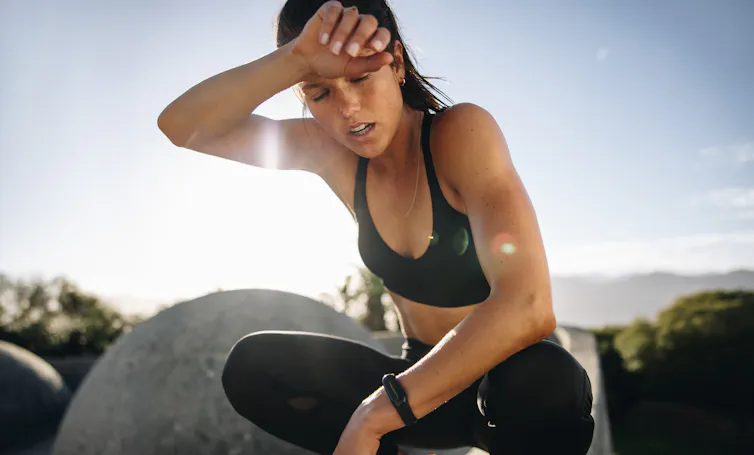
Exercise headaches (also known as “exertional headaches”) are exactly what they sound like: headaches that occur either during, or after, exercise.
French doctor Jules Tinel first reported these headaches in the medical literature in 1932 and they’ve been a regular point of discussion since.
Exercise headaches commonly present as a throbbing pain on both sides of the head. They most often occur after strenuous exercise – although what is considered “strenuous” can differ between people, depending on their fitness levels. They can last anywhere from a few minutes to a couple of days.
Exercise headaches are thought to impact about 12% of adults, although this number varies from 1% all the way up to 26% across individual studies.
In most circumstances, these headaches are harmless and will resolve on their own, over time. Some research suggests you will stop getting them after a few months of starting a new type of workout.
But while they are usually harmless, they can sometimes signal an underlying condition that requires medical attention.
What causes exercise headaches?
Despite a good amount of research looking at exertional headaches, we don’t know their exact cause, but we do think we know why they occur.
The leading theory suggests they are caused by changes in blood flow to the brain. During intense exercise, blood vessels in the brain dilate, increasing blood flow and pressure, leading to pain.
Because long-term exercise improves our cardiovascular health, including our ability to dilate and constrict our blood vessels, this theory makes sense when we consider that exercise headaches tend to resolve themselves over time. This might explain why research suggests fitter people are less likely to get exercise headaches.
People with migraines appear more likely to experience exercise headaches, which are thought to be caused by this same mechanism.
Does heat and dehydration cause exercise headaches?
There is evidence suggesting that exercise headaches are more likely to occur in the heat.
Your brain cannot dissipate heat by sweating like the rest of your body can. So when it’s hot, your body has to increase blood flow to the brain to help bring down its temperature, which can increase pressure.
Similarly, exercise headaches also seem to get worse, and occur more often, when people are dehydrated.
However, we are not sure why this happens. Some research has shown that dehydration results in increased strain during exercise. As such, dehydration might not necessarily cause the headache, but make it more likely to occur.
Red flags: when to see a doctor
Most exercise headaches resolve themselves after a few hours and result in no lasting negative effects.
In some rare instances, they could be sign of something more serious occurring in the brain, such as a subarachnoid haemorrhage (a bleed between the brain and the tissues that cover it), reversible cerebral vasoconstriction syndrome (a spasming of blood vessels), cervical artery dissection (or tear), intracranial hypertension (pressure in the brain), or an infection.
See a doctor to rule out anything serious if:
- it’s your first exercise headache
- the headache is severe and sudden (also known as a thunderclap headache)
- it’s accompanied by other symptoms such as vision changes, confusion, or sensations of weakness
- you experience a stiff neck, nausea, or vomiting with your headache
- it lasts for more than 24 hours and doesn’t seem to be getting better.
Can you prevent exercise headaches?
There is no surefire way to prevent exercise headaches.
But a recent review suggests that ensuring you’re adequately hydrated and gradually warm-up to your desired exercise intensity can make them less likely to occur.
Beyond this, you may wish to keep your exercise intensity in a light-to moderate range for a couple of months. This will give your cardiovascular system some time to adapt before trying more strenuous exercise, hopefully reducing the likelihood of getting exercise headaches at all.
Exercise headaches are annoying, but are generally harmless and should subside on their own over time.
Hunter Bennett, Lecturer in Exercise Science, University of South Australia
This article is republished from The Conversation under a Creative Commons license. Read the original article.
Don’t Forget…
Did you arrive here from our newsletter? Don’t forget to return to the email to continue learning!
Recommended
Learn to Age Gracefully
Join the 98k+ American women taking control of their health & aging with our 100% free (and fun!) daily emails:
-
Best Salt for Neti Pots?
10almonds is reader-supported. We may, at no cost to you, receive a portion of sales if you purchase a product through a link in this article.
❓ Q&A With 10almonds Subscribers!
Q: What kind of salt is best for neti pots?
A: Non-iodised salt is usually recommended, but really, any human-safe salt is fine. By this we mean for example:
- Sodium chloride (like most kitchen salts),
- Potassium chloride (as found in “reduced sodium” kitchen salts), or
- Magnesium sulfate (also known as epsom salts).
Share This Post
-
Hot And Sour Shiitake Soup
10almonds is reader-supported. We may, at no cost to you, receive a portion of sales if you purchase a product through a link in this article.
This is a popular, easy, and delicious soup that nonetheless is not found in many western kitchens, despite being enjoyed in restaurants/take-out. Best of all, making it at home means that you know all the ingredients, can account for quality, and also can customize it per your preferences (i.e. how much heat/sourness you like).
You will need
- 3 cups shiitake mushrooms, sliced
- 3 cups bok choy, chopped
- 2 cups cherry tomatoes, quartered
- 1 cup carrot, grated
- 3 spring onions, chopped
- 2 shallots, sliced lengthways
- 2 serrano chilis (or similar), sliced thinly
- 2 tbsp apple cider vinegar
- 1 tbsp lemon juice
- 1 tbsp fresh ginger, sliced into 1″ strips
- 1 tsp black pepper, coarse ground
- ½ bulb garlic, crushed
- 6 cups low-sodium vegetable stock. Ideally you will have made it yourself from vegetable cuttings that you saved in the freezer until you had enough to make stock from, but if that’s not an option, then low-sodium vegetable stock cubes can be purchased and used.
- Garnish: ¼ cup (or 4 tbsp) cilantro, chopped, or if you have the soap gene, then this time we recommend chopped basil as the subsitution
Method
(we suggest you read everything at least once before doing anything)
1) Put the ginger in a big pot with the stock; cover and simmer for about 20 minutes (otherwise the ginger flavor will remain mostly concentrated in the ginger strips).
2) Bring it to a boil and add the bok choy, mushrooms, shallots, chili peppers, and the carrot; simmer for another 5 minutes
3) Add the remaining ingredients except for the garnish, and simmer for another 5 minutes
4) Serve, adding the garnish
Enjoy!
Want to learn more?
For those interested in some of the science of what we have going on today:
- The (Longevity) Magic of Mushrooms
- Our Top 5 Spices: How Much Is Enough For Benefits?
- An Apple (Cider Vinegar) A Day…
- Enjoy Bitter/Hot/Sour/Pungent Foods For Your Heart & Brain
- Brain Food? The Eyes Have It!
- Some Surprising Truths About Hunger And Satiety
Take care!
Share This Post
-
Bamboo Shoots vs Cucumber – Which is Healthier?
10almonds is reader-supported. We may, at no cost to you, receive a portion of sales if you purchase a product through a link in this article.
Our Verdict
When comparing bamboo shoots to cucumber, we picked the bamboo shoots.
Why?
This one’s quite clear-cut:
In terms of macros, bamboo has more than 4x the fiber and more than 4x the protein, for slightly more carbs. A clear win for bamboo.
In the category of vitamins, bamboo has more of vitamins B1, B2, B3, B6, B9, B9, C, and E, while cucumber has more of vitamins A, B5, and K. Another easy win for bamboo.
When it comes to minerals, bamboo has more copper, iron, manganese, phosphorus, potassium, selenium, and zinc, while cucumber has more magnesium. One more win for bamboo.
Adding up the sections makes a clear overall win for bamboo, but by all means enjoy either or both; diversity is good!
Want to learn more?
You might like:
What’s Your Plant Diversity Score?
Enjoy!
Share This Post
Related Posts
-
An Elegant Defense – by Matt Richtel
10almonds is reader-supported. We may, at no cost to you, receive a portion of sales if you purchase a product through a link in this article.
In a way, Richtel got the best and worst of the publication date lottery. This book, which he’d obviously been working on for however long, was published in March 2020. Yes, that March 2020. So, it obviously got a huge boost in sales that launced it to bestseller status, and/but it doesn’t actually discuss COVID at all.
What it does discuss, is—as one might expect—the immune system. Or really, the immune systems, plural, several systems working alongside each other. How we got to have such, how our immune functions work, where all the various immune cells come from and what part they play. What pathogens can do to fight and/or confuse (or even co-opt) our immune response, and what modern medicine can do to counteract the pathogens’ anti-countermeasure countermeasures. And how it can still go wrong.
The “Four Lives” promised in the subtitle are stories, and Richtel explains the immune system through specific people’s specific battles. In particular, a friend of his who had quite a remarkable battle against cancer, which was of course terrible for him, but illustrative for us.
The style of the book is very readably journalistic. The author is a Pulitzer-winning NYT journalist, and not normally a science writer. Here at 10almonds, “we like big bibliographies and we cannot lie”, and we didn’t get to enjoy that in this case. The book contained no bibliography (nor appropriate inline citations, nor equivalent footnotes). Maybe a future addition will include this.
Bottom line: there’s a lot of “science for the lay reader” here. While the lack of references is a big oversight, the book does give a very good overview of what both sides (immune response and pathogenic invasion) bring to the battle of your body.
Click here to check out Elegant Defense, and demystify immunology!
Don’t Forget…
Did you arrive here from our newsletter? Don’t forget to return to the email to continue learning!
Learn to Age Gracefully
Join the 98k+ American women taking control of their health & aging with our 100% free (and fun!) daily emails:
-
Mung Beans vs Peas – Which is Healthier?
10almonds is reader-supported. We may, at no cost to you, receive a portion of sales if you purchase a product through a link in this article.
Our Verdict
When comparing mung beans to peas, we picked the mung beans.
Why?
The peas are good, but the mung beans are better:
In terms of macros, the mung beans have more protein, carbs, and fiber, making them the clear winner in this category.
In the category of vitamins, mung beans have more of vitamins B5, B9, E, and choline, while peas have more of vitamins A, B1, B2, B6, C, and K, making a marginal win for peas here.
When it comes to minerals, mung beans have more calcium, copper, iron, magnesium, manganese, phosphorus, potassium, selenium, and zinc, while peas are not higher in any mineral. An overwhelming win for mung beans in this round.
Adding up the sections makes for a clear overall win for mung beans, but by all means enjoy either or both; peas are good too!
Want to learn more?
You might like:
Plant vs Animal Protein: Head to Head
Enjoy!
Don’t Forget…
Did you arrive here from our newsletter? Don’t forget to return to the email to continue learning!
Learn to Age Gracefully
Join the 98k+ American women taking control of their health & aging with our 100% free (and fun!) daily emails:
-
Can’t Start Tasks? Try This Now!
10almonds is reader-supported. We may, at no cost to you, receive a portion of sales if you purchase a product through a link in this article.
Oftentimes, we know what we need to do, and might even find it’s easy once we get going, but getting started is all-too-easily procrastinated.
So, how to get past this, when “just do it” isn’t working?
When it’s time to get going
These tips are by and for people with ADHD, who typically have particular difficulty with this, but can help most people regardless:
- Overwhelmed? Choose three priority tasks to focus on instead of trying to do everything at once—just don’t get stuck in deciding which three!
- No sense of urgency? Use a Pomodoro timer to help give the task time boundaries; scheduling breaks in the same way can also help.
- The task isn’t appealing? Pair the task with rewards like snacks, music, or a cozy setup (this approach is called “temptation bundling”).
- The task feels daunting? Break it into smaller steps and/or use tools like WikiHow to reduce how much you need to plan ahead, and enable you to do it step by step.
- Too many barriers? Clear obstacles such as clutter, missing supplies, or noise to make starting easier. But watch out! Lest you end up renovating your house while avoiding the original task. So, to preclude this derailment, set a clearly-defined parameter for what you’re going to do before the task, and when that’s done, switch to the task before embarking on any sidequests that occurred to you along the way.
For more on each of these, enjoy:
Click Here If The Embedded Video Doesn’t Load Automatically!
Want to learn more?
You might also like:
Get Past Executive Dysfunction
Take care!
Don’t Forget…
Did you arrive here from our newsletter? Don’t forget to return to the email to continue learning!
Learn to Age Gracefully
Join the 98k+ American women taking control of their health & aging with our 100% free (and fun!) daily emails:


