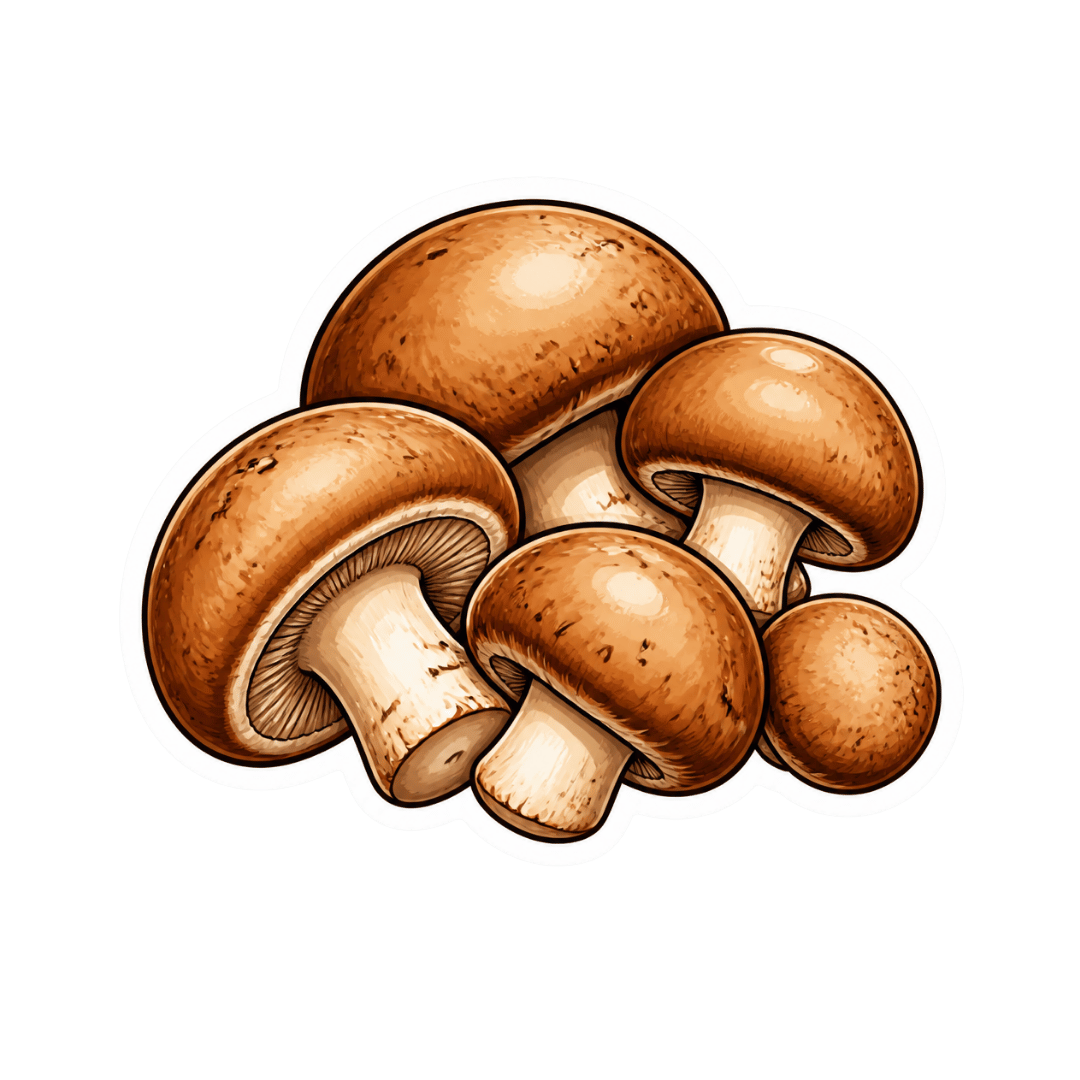
What Mushrooms (The Ordinary Kind!) Do To Your Brain
10almonds is reader-supported. We may, at no cost to you, receive a portion of sales if you purchase a product through a link in this article.

Spoiler: good things!
It’s about ergothioneine (ET), and we’ve written about this before in its broader aspect rather than focusing on its effects on the brain:
The Magic Of Mushrooms: “The Longevity Vitamin” (That’s Not A Vitamin)
When we last wrote about it, all we said about its brain health impacts was that as general rule of thumb, “what’s good for the heart is good for the brain” is almost always true, and it appears to be so in this case too, per:
❝Ergothioneine crosses the blood–brain barrier and has been reported to have beneficial effects in the brain. In this study, we discuss the cytoprotective and neuroprotective properties of ergotheioneine, which may be harnessed for combating neurodegeneration and decline during aging.❞
Source: Ergothioneine: A Stress Vitamin with Antiaging, Vascular, and Neuroprotective Roles?
So, what’s so special about it?
One of the reasons it can be argued to be a vitamin is because observational studies have linked lower blood ET levels with mild cognitive impairment, poorer cognition, frailty, Parkinson’s disease, and more.
Indeed, in a longitudinal study of 470 people, lower ET levels were associated with faster declines in global cognition, attention, memory, locomotor function, and language. Lower levels in people with mild cognitive impairment were also associated with a greater likelihood of progressing to Alzheimer’s disease:
Meanwhile, in lab studies, ET protected neurons against cell death by reducing reactive oxygen species (ROS), improved the survival of human brain endothelial cells exposed to oxidative stress, and reduced behavioral and cognitive deficits in mouse models of Alzheimer’s and Parkinson’s disease. In experimental Parkinson’s disease models, it also protected dopamine-producing neurons, reduced α-synuclein aggregation, and increased lifespan.
See:
- Ergothioneine Suppresses Amyloid β-Induced Tau Phosphorylation and Cytotoxicity by Inactivating Glycogen Synthase Kinase-3β in Cultured Neurons
- Ergothioneine exerts neuroprotective effects in Parkinson’s disease: Targeting α-synuclein aggregation and oxidative stress
- Ergothioneine-Mediated Neuroprotection of Human iPSC-Derived Dopaminergic Neurons
But those are in-vitro studies or studies with non-human animals, so what of living breathing humans humans?
There’s quite a lot of research that’s been done, now! Short-term supplementation studies have reported improvements in subjective sleep quality and sleeping difficulties; for example, a 16-week trial involving people with subjective memory complaints found a temporary improvement in composite memory among participants receiving the higher dose, while another 12-week trial using mushroom extract tablets containing ET reported improvements in verbal memory among healthy participants and people with suspected mild cognitive impairment.
You can read about these in full, here: Ergothioneine: A Natural Antioxidant Claimed to Prevent Neurodegeneration ← an uninspiring title for what’s actually an interesting research review that comes to very positive conclusions, per:
❝Cellular and animal experiments, as well as human epidemiological and interventional data, strongly suggest that ET is an interesting natural neuroprotective agent for preventing and slowing PD progression. ET is thus a promising candidate for prophylaxis and therapy of neurodegenerative diseases, especially since it seems safe for human consumption, and its chemical stability facilitates its storage and delivery. The published data suggest that ET supplementation can be broadly recommended for the general population, especially older adults, to prevent, delay, and limit neurodegeneration. ET can be taken as a dietary supplement or as a component of functional foods. The consumption of mushrooms, both fresh and processed (especially dried), can be a reasonable choice.❞
Want to get some?
You can just eat a portion of mushrooms per day! But if you don’t fancy that, it is available as a supplement in convenient 1/day capsule form too.
We don’t sell it, but for your convenience, here is an example product on Amazon
Enjoy!
Don’t Forget…
Did you arrive here from our newsletter? Don’t forget to return to the email to continue learning!

Learn to Age Gracefully
Join the 98k+ American women taking control of their health & aging with our 100% free (and fun!) daily emails: