
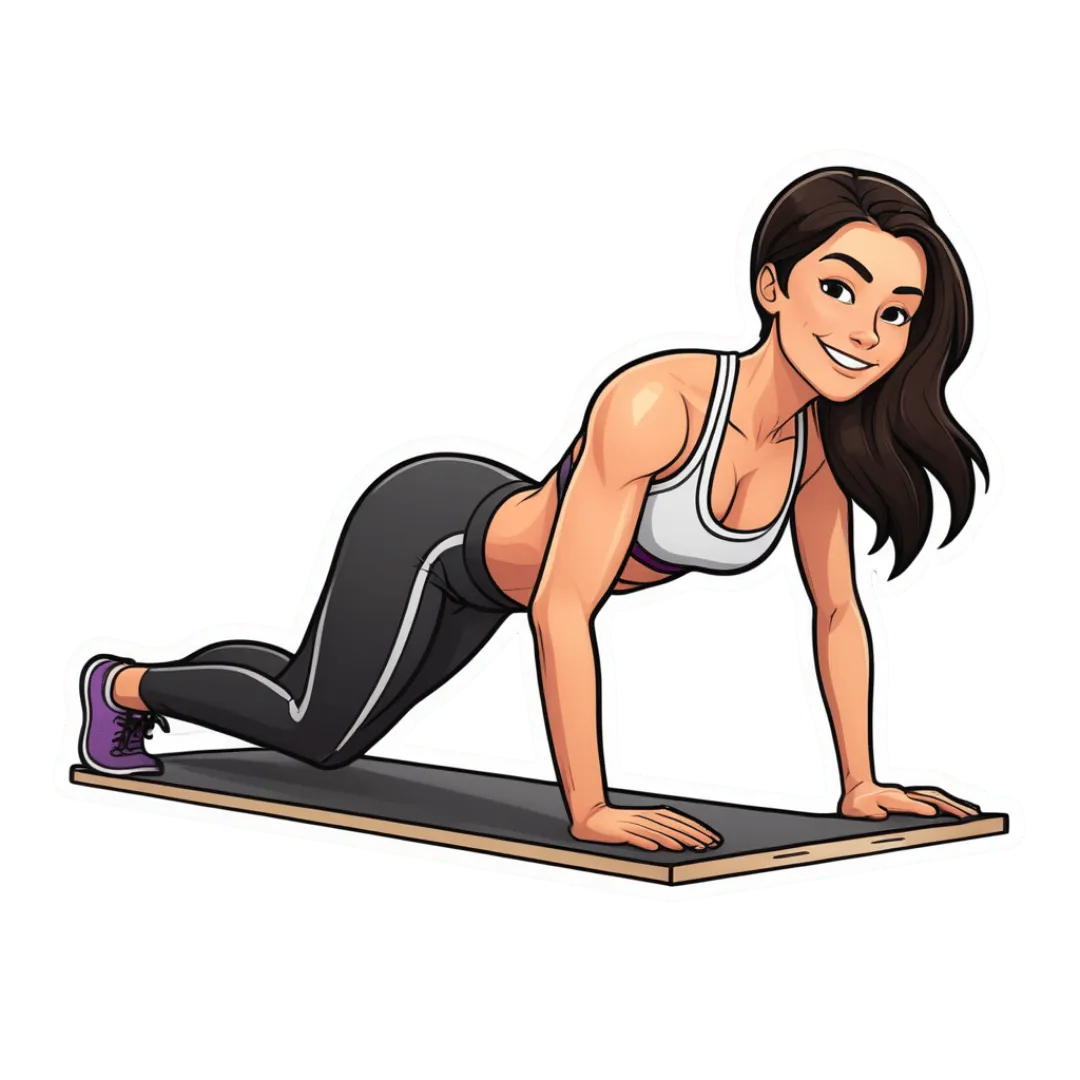
How to Start Calisthenics (Beginner Guide From Zero)
10almonds is reader-supported. We may, at no cost to you, receive a portion of sales if you purchase a product through a link in this article.
You don’t have to start with one-finger handstands while doing the splits in the air, even if that’s your end goal.
Here’s a genuinely beginner-friendly step-by-step guide to getting started in calisthenics:
As easy as…
Calisthenics is, first and foremost, simply bodyweight training like push-ups, squats, and handstands, and as such, it doesn’t require weights, a gym, or much space. You can train anywhere using minimal space and household items like a couch for incline push-ups, so lack of equipment isn’t a barrier.
Impressive skills like handstands or planches are more reasonable as long-term goals, so for now, focus on basic movements, rather than comparing yourself to advanced athletes who’ve been doing it every day for the past many years.
First of all, step zero: starting calisthenics simply means moving your body, so you can begin immediately without waiting for the “perfect” time or setup.
And now…
- Assess your level: test how many push-ups or squats you can do, or how long you can hold a plank or dead hang, to establish your current ability.
- Treat results as information: your starting point isn’t a judgment, and any level—whether beginner or advanced—is fine so long as you do begin.
- Set specific goals: use small, measurable targets like one push-up, a 10-second plank, or a 20-second dead hang, instead of vague goals like “get stronger.”
- Progress gradually: once you reach a goal, increase it incrementally to keep the progress going.
- Choose a routine: either do fixed training days or a flexible weekly target, but pick a structure that matches your own real-life habits.
- Prioritize consistency: regular effort matters more than perfection, and while missing a session doesn’t mean failure, missing more is starting to look like a pattern, so correct it as soon as you can!
- Use short sessions if needed: even brief workouts throughout your day are effective, and infinitely better than doing nothing.
- Avoid doing too much: going all out too early can lead to excessive soreness or injury, which slows progress.
- Avoid overplanning: excessive planning can delay action, so it’s better to start now, simply, and adjust as you go.
- Don’t quit early: skill development can take weeks, months, or years, so persistence will continue to be key.
For more on all of this plus some visual demonstrations, enjoy:
Click Here If The Embedded Video Doesn’t Load Automatically!
Want to learn more?
You might also like:
What Difference Can 30 Days Of Calisthenics Make, Really?
Take care!
Don’t Forget…
Did you arrive here from our newsletter? Don’t forget to return to the email to continue learning!
Recommended
Learn to Age Gracefully
Join the 98k+ American women taking control of their health & aging with our 100% free (and fun!) daily emails:
-
How to live a long and healthy life, according to the ancients
10almonds is reader-supported. We may, at no cost to you, receive a portion of sales if you purchase a product through a link in this article.
Just like in the modern world, people in ancient times wanted to know how to live a long and healthy life.
Greeks and Romans heard fantastic tales of far-away peoples living to well beyond 100.
Greek essayist Lucian (about 120–180 CE) writes:
Indeed, there are even whole nations that are very long-lived, like the Seres [Chinese], who are said to live 300 years: some attribute their old age to the climate, others to the soil and still others to their diet, for they say that this entire nation drinks nothing but water. The people of Athos are also said to live 130 years, and it is reported that the Chaldeans live more than 100, using barley bread to preserve the sharpness of their eyesight.
Greek essayist Lucian had lots to say about how to live a long and healthy life, as did ancient doctors. Library of Congress, Washington DC/Wikimedia This is how they thought this could happen.
Whatever the truth of these tales, many ancient Greeks and Romans wanted a long and healthy life.
Tyler Bell/Museo Archeologico Nazionale di Napoli/Wikimedia, CC BY-SA An ancient doctor’s perspective
Ancient doctors were interested in what people who lived long lives were doing every day and how this might have helped.
The Greek physician Galen (129–216 CE), for example, discusses two people he knew personally in Rome who lived to old age.
First, there is a grammarian (someone who studies and teaches grammar) called Telephus, who lived to almost 100.
According to Galen, Telephus ate just three times a day. His diet was simple:
gruel boiled in water mixed with raw honey of the best quality, and this alone was enough for him at the first meal. He also dined at the seventh hour or a little sooner, taking vegetables first and next tasting fish or birds. In the evening, he used to eat only bread, moistened in wine that had been mixed.
Galen also tells us Telephus had some bathing habits that might seem unusual to us today. Telephus preferred to be massaged with olive oil every day and only have a bath a few times a month:
He was in the habit of bathing twice a month in winter and four times a month in summer. In the seasons between these, he bathed three times a month. On the days he didn’t bathe, he was anointed around the third hour with a brief massage.
Second, there was an old doctor named Antiochus, who lived into his 80s.
According to Galen, Antiochus also had a simple diet.
In the morning, Antiochus usually ate toasted bread with honey. Then, at lunch, he would eat fish, but usually only fish “from around the rocks and those from the deep sea”. For dinner, he would eat “either gruel with oxymel [a mix of vinegar and honey] or a bird with a simple sauce”.
Alongside this simple diet, Antiochus went for a walk every morning. He also liked to be driven in a chariot, or had his slaves carry him in a chair around the city.
Galen also said Antiochus “performed the exercises suitable for an old man”:
There is one thing you should do for old people in the early morning as an exercise: after massage with oil, next get them to walk about and carry out passive exercises without becoming fatigued, taking into account the capacity of the old person.
Galen concludes that Antiochus’ routine probably contributed to his good health well into advanced age:
Looking after himself in old age in this way, Antiochus continued on until the very end, unimpaired in his senses and sound in all his limbs.
Galen stresses that Telephus and Antiochus had some obvious things in common. They ate just a few times a day; their diet was of wild meats, whole grains, bread and honey; and they kept active every day.
An eye exam is under way. But there was more to staying healthy in ancient times. Rabax63/Wikimedia, CC BY-SA What can you do?
Not all of us can live to 100 or more, as the Greeks and Romans were well aware.
However, Lucian offers us some consolation in his essay On Octogenarians:
On every soil and in every climate people who observe the proper exercise and the diet most suitable for health have been long-lived.
Lucian advised that we should imitate the lifestyles of people who have lived long and healthy lives if we want to do the same.
So, if you lived in Rome in the 2nd century CE, people like Telephus and Antiochus, who had a simple diet and kept active all their lives, would be good role models.
Konstantine Panegyres, Lecturer in Classics and Ancient History, The University of Western Australia
This article is republished from The Conversation under a Creative Commons license. Read the original article.
Share This Post
-
An Elegant Defense – by Matt Richtel
10almonds is reader-supported. We may, at no cost to you, receive a portion of sales if you purchase a product through a link in this article.
In a way, Richtel got the best and worst of the publication date lottery. This book, which he’d obviously been working on for however long, was published in March 2020. Yes, that March 2020. So, it obviously got a huge boost in sales that launced it to bestseller status, and/but it doesn’t actually discuss COVID at all.
What it does discuss, is—as one might expect—the immune system. Or really, the immune systems, plural, several systems working alongside each other. How we got to have such, how our immune functions work, where all the various immune cells come from and what part they play. What pathogens can do to fight and/or confuse (or even co-opt) our immune response, and what modern medicine can do to counteract the pathogens’ anti-countermeasure countermeasures. And how it can still go wrong.
The “Four Lives” promised in the subtitle are stories, and Richtel explains the immune system through specific people’s specific battles. In particular, a friend of his who had quite a remarkable battle against cancer, which was of course terrible for him, but illustrative for us.
The style of the book is very readably journalistic. The author is a Pulitzer-winning NYT journalist, and not normally a science writer. Here at 10almonds, “we like big bibliographies and we cannot lie”, and we didn’t get to enjoy that in this case. The book contained no bibliography (nor appropriate inline citations, nor equivalent footnotes). Maybe a future addition will include this.
Bottom line: there’s a lot of “science for the lay reader” here. While the lack of references is a big oversight, the book does give a very good overview of what both sides (immune response and pathogenic invasion) bring to the battle of your body.
Click here to check out Elegant Defense, and demystify immunology!
Share This Post
-
Alpha, beta, theta: what are brain states and brain waves? And can we control them?
10almonds is reader-supported. We may, at no cost to you, receive a portion of sales if you purchase a product through a link in this article.
There’s no shortage of apps and technology that claim to shift the brain into a “theta” state – said to help with relaxation, inward focus and sleep.
But what exactly does it mean to change one’s “mental state”? And is that even possible? For now, the evidence remains murky. But our understanding of the brain is growing exponentially as our methods of investigation improve.
Brain-measuring tech is evolving
Currently, no single approach to imaging or measuring brain activity gives us the whole picture. What we “see” in the brain depends on which tool we use to “look”. There are myriad ways to do this, but each one comes with trade-offs.
We learnt a lot about brain activity in the 1980s thanks to the advent of magnetic resonance imaging (MRI).
Eventually we invented “functional MRI”, which allows us to link brain activity with certain functions or behaviours in real time by measuring the brain’s use of oxygenated blood during a task.
We can also measure electrical activity using EEG (electroencephalography). This can accurately measure the timing of brain waves as they occur, but isn’t very accurate at identifying which specific areas of the brain they occur in.
Alternatively, we can measure the brain’s response to magnetic stimulation. This is very accurate in terms of area and timing, but only as long as it’s close to the surface.
What are brain states?
All of our simple and complex behaviours, as well as our cognition (thoughts) have a foundation in brain activity, or “neural activity”. Neurons – the brain’s nerve cells – communicate by a sequence of electrical impulses and chemical signals called “neurotransmitters”.
Neurons are very greedy for fuel from the blood and require a lot of support from companion cells. Hence, a lot of measurement of the site, amount and timing of brain activity is done via measuring electrical activity, neurotransmitter levels or blood flow.
We can consider this activity at three levels. The first is a single-cell level, wherein individual neurons communicate. But measurement at this level is difficult (laboratory-based) and provides a limited picture.
As such, we rely more on measurements done on a network level, where a series of neurons or networks are activated. Or, we measure whole-of-brain activity patterns which can incorporate one or more so-called “brain states”.
According to a recent definition, brain states are “recurring activity patterns distributed across the brain that emerge from physiological or cognitive processes”. These states are functionally relevant, which means they are related to behaviour.
Brain states involve the synchronisation of different brain regions, something that’s been most readily observed in animal models, usually rodents. Only now are we starting to see some evidence in human studies.
Various kinds of states
The most commonly-studied brain states in both rodents and humans are states of “arousal” and “resting”. You can picture these as various levels of alertness.
Studies show environmental factors and activity influence our brain states. Activities or environments with high cognitive demands drive “attentional” brain states (so-called task-induced brain states) with increased connectivity. Examples of task-induced brain states include complex behaviours such as reward anticipation, mood, hunger and so on.
In contrast, a brain state such as “mind-wandering” seems to be divorced from one’s environment and tasks. Dropping into daydreaming is, by definition, without connection to the real world.
We can’t currently disentangle multiple “states” that exist in the brain at any given time and place. As mentioned earlier, this is because of the trade-offs that come with recording spatial (brain region) versus temporal (timing) brain activity.
Brain states vs brain waves
Brain state work can be couched in terms such as alpha, delta and so forth. However, this is actually referring to brain waves which specifically come from measuring brain activity using EEG.
EEG picks up on changing electrical activity in the brain, which can be sorted into different frequencies (based on wavelength). Classically, these frequencies have had specific associations:
- gamma is linked with states or tasks that require more focused concentration
- beta is linked with higher anxiety and more active states, with attention often directed externally
- alpha is linked with being very relaxed, and passive attention (such as listening quietly but not engaging)
- theta is linked with deep relaxation and inward focus
- and delta is linked with deep sleep.
Brain wave patterns are used a lot to monitor sleep stages. When we fall asleep we go from drowsy, light attention that’s easily roused (alpha), to being relaxed and no longer alert (theta), to being deeply asleep (delta).
Can we control our brain states?
The question on many people’s minds is: can we judiciously and intentionally influence our brain states?
For now, it’s likely too simplistic to suggest we can do this, as the actual mechanisms that influence brain states remain hard to detangle. Nonetheless, researchers are investigating everything from the use of drugs, to environmental cues, to practising mindfulness, meditation and sensory manipulation.
Controversially, brain wave patterns are used in something called “neurofeedback” therapy. In these treatments, people are given feedback (such as visual or auditory) based on their brain wave activity and are then tasked with trying to maintain or change it. To stay in a required state they may be encouraged to control their thoughts, relax, or breathe in certain ways.
The applications of this work are predominantly around mental health, including for individuals who have experienced trauma, or who have difficulty self-regulating – which may manifest as poor attention or emotional turbulence.
However, although these techniques have intuitive appeal, they don’t account for the issue of multiple brain states being present at any given time. Overall, clinical studies have been largely inconclusive, and proponents of neurofeedback therapy remain frustrated by a lack of orthodox support.
Other forms of neurofeedback are delivered by MRI-generated data. Participants engaging in mental tasks are given signals based on their neural activity, which they use to try and “up-regulate” (activate) regions of the brain involved in positive emotions. This could, for instance, be useful for helping people with depression.
Another potential method claimed to purportedly change brain states involves different sensory inputs. Binaural beats are perhaps the most popular example, wherein two different wavelengths of sound are played in each ear. But the evidence for such techniques is similarly mixed.
Treatments such as neurofeedback therapy are often very costly, and their success likely relies as much on the therapeutic relationship than the actual therapy.
On the bright side, there’s no evidence these treatment do any harm – other than potentially delaying treatments which have been proven to be beneficial.
Susan Hillier, Professor: Neuroscience and Rehabilitation, University of South Australia
This article is republished from The Conversation under a Creative Commons license. Read the original article.
Share This Post
Related Posts
-
The Couple’s Guide to Thriving with ADHD – by Melissa Orlov and Nancie Kohlenberger
10almonds is reader-supported. We may, at no cost to you, receive a portion of sales if you purchase a product through a link in this article.
ADHD (what a misleadingly-named condition) is most often undiagnosed in adults, especially older adults, and has far-reaching effects. This book explores those!
Oftentimes ADHD is not a deficit of attention, it’s just a lack of choice about where one’s attention goes. And the H? It’s mostly not what people think it is. The diagnostic criteria have moved far beyond the original name.
But in a marriage, ADHD symptoms such as wandering attention, forgetfulness, impulsiveness, and a focus on the “now” to the point of losing sight of the big picture (the forgotten past and the unplanned future), can cause conflict.
The authors write in a way that is intended for the ADHD and/or non-ADHD partner to read, and ideally, for both to read.
They shine light on why people with or without ADHD tend towards (or away from) certain behaviours, what miscommunications can arise, and how to smooth them over.
Best of all, an integrated plan for getting you both on the same page, so that you can tackle anything that arises, as the diverse team (with quite different individual strengths) that you are.
Bottom line: if you or a loved one has ADHD symptoms, this book can help you navigate and untangle what can otherwise sometimes get a little messy.
Click here to check out The Couple’s Guide to Thriving with ADHD, and learn how to do just that!
Don’t Forget…
Did you arrive here from our newsletter? Don’t forget to return to the email to continue learning!
Learn to Age Gracefully
Join the 98k+ American women taking control of their health & aging with our 100% free (and fun!) daily emails:
-
Healthy Brain, Happy Life – by Dr. Wendy Suzuki
10almonds is reader-supported. We may, at no cost to you, receive a portion of sales if you purchase a product through a link in this article.
We talked about Dr. Wendy Suzuki’s research in the category of exercise and brain-benefits in our main feature the other day. But she has more to say than we can fit into an article!
This book chronicles her discoveries, through her work in memory and neuroplasticity, to her discoveries about exercise, and her dive into broader neurology-based mental health. So what does neurology-based mental health look like?
The answer is: mitigating brain-busters such as stress and anxiety, revitalizing a fatigued brain, boosting creativity, and other such benefits.
Does she argue that exercise is a cure-all? No, not quite. Sometimes there are other things she’s recommending (such as in her chapter on challenging the neurobiology of the stress response, or her chapter on meditation and the brain).
The writing style is mostly casual, interspersed with occasional mini-lectures (complete with diagrams and other illustrations), and is very readable and informative throughout.
Bottom line: if you’d like the more in-depth details of Dr. Suzuki’s work, this book is a very accessible way to get 320 pages of that!
Click here to check out Healthy Brain, Happy Life, and give yours the best!
Don’t Forget…
Did you arrive here from our newsletter? Don’t forget to return to the email to continue learning!
Learn to Age Gracefully
Join the 98k+ American women taking control of their health & aging with our 100% free (and fun!) daily emails:
-
Applesauce vs Cranberry Sauce – Which is Healthier?
10almonds is reader-supported. We may, at no cost to you, receive a portion of sales if you purchase a product through a link in this article.
Our Verdict
When comparing applesauce to cranberry sauce, we picked the applesauce.
Why?
It mostly comes down to the fact that apples are sweeter than cranberries:
In terms of macros, they are both equal on fiber (both languishing at a paltry 1.1g/100g), and/but cranberry sauce has 4x the carbs, of which, more than 3x the sugar. Simply, cranberry sauce recipes invariably have a lot of added sugar, while applesauce recipes don’t need that. So this is a huge relative win for applesauce (we say “relative” because it’s still not great, but cranberry sauce is far worse).
In the category of vitamins, applesauce has more of vitamins B1, B2, B5, B6, B9, and C, while cranberry sauce has more of vitamins E, K, and choline. A more moderate win for applesauce this time.
When it comes to minerals, applesauce has more calcium, copper, magnesium, phosphorus, and potassium, while cranberry sauce has more iron, manganese, and selenium. Another moderate win for applesauce.
Since we’ve discussed relative amounts rather than actual quantities, it’s worth noting that neither sauce is a good source of vitamins or minerals, and neither are close to just eating the actual fruits. Just, cranberry sauce is the relatively more barren of the two.
While cranberries famously have some UTI-fighting properties, you cannot usefully gain this benefit from a sauce that (with its very high sugar content and minimal fiber) actively feeds the very C. albicans you are likely trying to kill.
All in all, a pitiful show of nutritional inadequacy from these two products today, but one is relatively less bad than the other, and that’s the applesauce.
Want to learn more?
You might like to read:
From Apples to Bees, and High-Fructose Cs: Which Sugars Are Healthier, And Which Are Just The Same?
Enjoy!
Don’t Forget…
Did you arrive here from our newsletter? Don’t forget to return to the email to continue learning!
Learn to Age Gracefully
Join the 98k+ American women taking control of their health & aging with our 100% free (and fun!) daily emails:


