
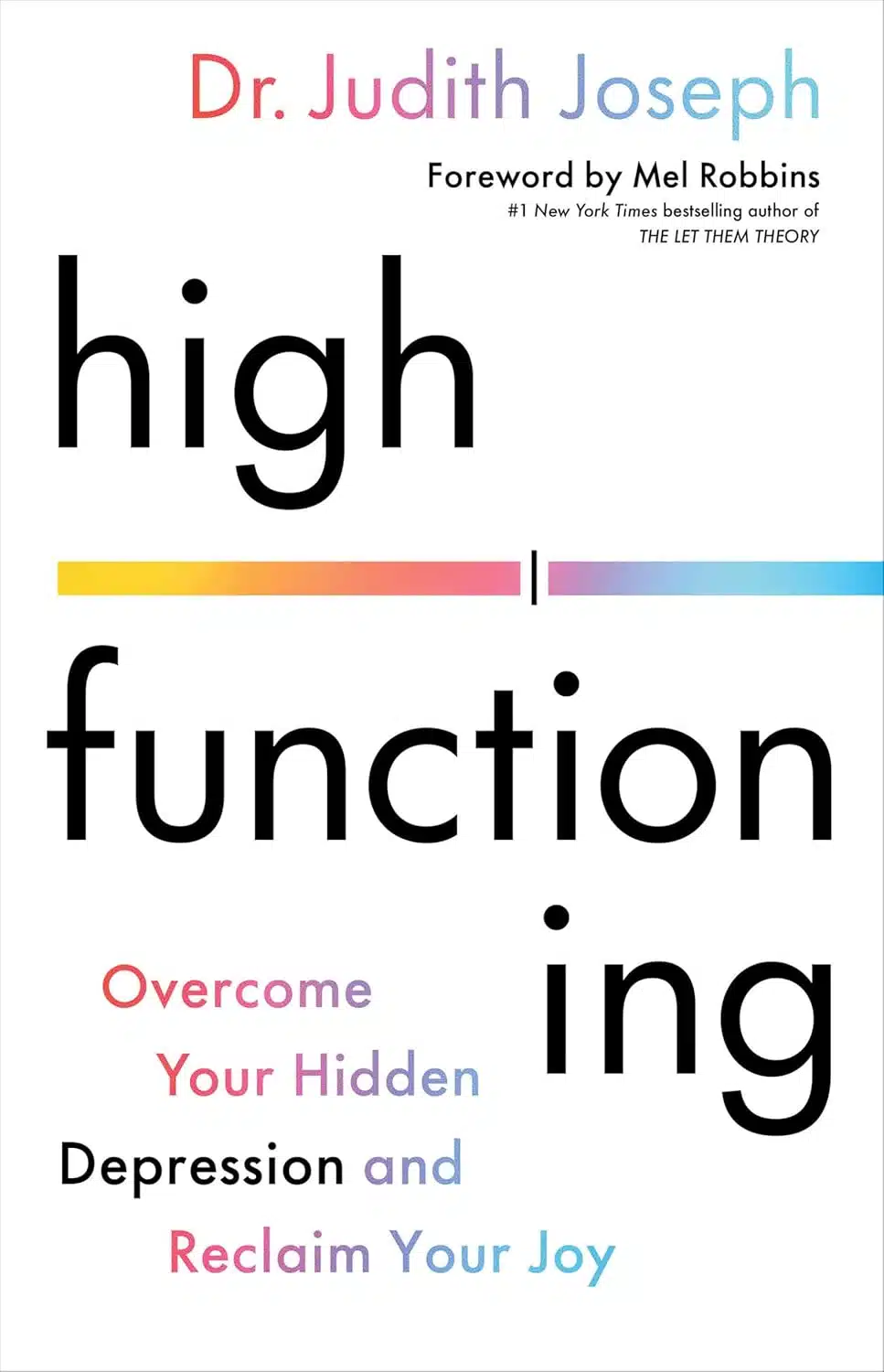
High Functioning – by Dr. Judith Joseph
10almonds is reader-supported. We may, at no cost to you, receive a portion of sales if you purchase a product through a link in this article.
Sometimes, depression doesn’t cause life to come grinding to a halt. Instead, it just results in being dead on the inside while going through the motions of life. The thing is… That’s not great either.
So, this book looks to help the reader break out of that, and back into actually living.
The route that Dr. Joseph outlines involves what she calls “the 5 Vs”, which are:
- Validation: acknowledge and accept your emotions about past traumas and present pain
- Venting: let out the frustrations and anxious energy bottled up inside
- Values: identify the purpose and priorities that matter most
- Vitals: slow down to listen to your brain and body and monitor the six vital signs of emotional functioning
- Vision: plan for and celebrate successes, milestones, and everyday joy
…however, there’s a little more to it than a 5-point plan, and each of those waymarkers involves learning and putting things into practice. To this end, each of them gets a chapter.
Around this, we also learn about critical things such as realistic self-evaluation, trauma, anhedonia, self-sabotage, and—upon having implemented those 5 Vs—how to then continue forwards in one’s continuing healing journey.
The style is fairly light self-help pop-science, despite covering sometimes heavy topics. There are personal aspects to it (Dr. Joseph telling parts of her own story), and references to hard science too (bibliography at the back).
Bottom line: if you struggle with depressive tendencies, and/but it doesn’t necessarily look like it to others from the outside, then this book is quite likely the one for you.
Click here to check out High Functioning, and do better than merely functioning!
Don’t Forget…
Did you arrive here from our newsletter? Don’t forget to return to the email to continue learning!
Recommended
Learn to Age Gracefully
Join the 98k+ American women taking control of their health & aging with our 100% free (and fun!) daily emails:
-
The Real Reason Most Women Don’t Lose Belly Fat
10almonds is reader-supported. We may, at no cost to you, receive a portion of sales if you purchase a product through a link in this article.
Notwithstanding the title, this does also go for men too, by the way—while hormones count, they count differently. People with an estrogen-based metabolism (so usually: women) will usually have more body fat, which can make it harder to get visible muscletone, for those who want that. But people with a testosterone-based metabolism (so usually: men) will have different fat storage patterns, and belly-fat is more testosterone-directed than estrogen-directed (estrogen will tend to put it more to the thighs, butt, back, breasts, etc).
So the advice here is applicable to all…
Challenges and methods
The biggest barrier to success: many people give up when results are not immediate, especially if our body has been a certain way without change for a long time.
- “Oh, I guess it’s just genetics”
- “Oh, I guess it’s just age”
- “Oh, I guess it’s just because of [chronic condition]”
…and such things can be true! And yet, in each of the cases, persisting is still usually what the body needs.
So, should we give ourselves some “tough love” and force ourselves through discomfort?
Yes and no, Lefkowith says. It is important to be able to push through some discomfort, but it’s also important that whatever we’re doing should be sustainable—which means we do need to push, while also allowing ourselves adequate recovery time, and not taking unnecessary risks.
In particular, she advises to:
- remember that at least half the work is in the kitchen not the gym, and to focus more on adding protein than reducing calories
- enjoy a regular but varied core exercise routine
- stimulate blood flow to stubborn areas, which can aid in fat mobilization
- focus on getting nutrient-dense foods
- prioritize recovery and strategic rest
For more details on these things and more, enjoy:
Click Here If The Embedded Video Doesn’t Load Automatically!
Want to learn more?
You might also like to read:
Visceral Belly Fat: What It Is & How To Lose It
Take care!
Share This Post
-
Sweet Spot for Brain Health – by Dr. Sui Wong
10almonds is reader-supported. We may, at no cost to you, receive a portion of sales if you purchase a product through a link in this article.
At 10almonds we often mention that “what’s good for the heart is good for the brain”, but at least in part, it’s because (as this book makes very clear), “what’s good for the blood is good for the brain”. After all, our brain uses about 25% of our energy, and that energy is delivered there by the blood. And if it doesn’t get enough nutrients, oxygen, etc, and detritus isn’t taken away, then problems happen.
Dr. Wong discusses Alzheimer’s as heavily driven by metabolic problems such as diabetes and even pre-diabetes, and sets out to put in our hands the guidebook to not only not doing that, but also, actually making sure our brain gets proper nourishment without delivering that as intermittent sugar spikes because we opted for a something with very fast-acting carbs to perk us up energetically.
More than most books on the topic, she talks a lot about the neurobiology of glucose metabolism, so that’s something that really sets this book apart from many of its genre.
The style is narrative, explaining the body’s processes in a clear fashion, without skimping on science. There are definitely words that your average layperson might not know, but they’re explained as we go, and there are frequent recaps of what we learned previously, making for ultimately easy reading.
After all the information is given, there’s also a guided “12-week challenge” with a theme-of-the-week for each week, to integrate a new lifestyle adjustment each week in a progressive fashion so that without needing to drastically change many things at once, we get where we need to be in terms of healthy habits.
Bottom line: if you’d like to do right by your brain and while you’re at it say goodbye to blood sugar highs and lows, then this book is an excellent guide for that.
Click here to check out Sweet Spot For Brain Health, and enjoy a consistently-energized brain!
Share This Post
-
Top 10 Early Warning Signs Of Dementia
10almonds is reader-supported. We may, at no cost to you, receive a portion of sales if you purchase a product through a link in this article.
What’s a harmless momentary mind-blank, and what’s a potential warning sign of dementia? Dementia Careblazers, a dementia care organization, has input:
The signs
With the caveat that this is a list of potential warning signs, not a diagnostic tool, the 10 signs are:
- Memory loss: e.g. forgetting important or well-learned information, such as one’s home address
- Challenges in planning or solving problems: e.g. difficulty with tasks such as paying bills (for organizational rather than financial reasons), following recipes, or managing medications
- Difficulty completing familiar tasks: e.g. trouble remembering rules of a familiar game, or directions to a familiar place
- Confusion with place or time: e.g. forgetting where one is, or making mistakes with the date, season, or other time-related details. Note that anyone can be momentarily unsure of today’s date, but if someone thinks it’s 1995, probably something wrong is not quite right. Similarly, being wrong about who is the current national leader is often used as a test, too—assuming countries with enough political stability to not have five different national leaders in the past four years, including one who did not outlast a lettuce *side-eyeing the UK*
- Trouble understanding visual images and spatial relationships: e.g. increased clumsiness, difficulty parking, or bumping into objects
- New problems with speaking or writing: e.g. losing track in conversations, or struggling to find the right words
- Misplacing things: e.g. losing items and being unable to retrace one’s steps to find them
- Decreased or poor judgment: e.g. falling for scams, giving out too much information or money without investigating appropriately first
- Withdrawal from social activities or hobbies: e.g. losing interest in activities one used to enjoy or avoiding social interactions
- Changes in mood and personality: e.g. increased irritability, anxiety, or other noticeable changes in behavior and personality
For more information on each of these, enjoy:
Click Here If The Embedded Video Doesn’t Load Automatically!
Want to learn more?
You might also like to read:
Dementia: Spot The Signs (Because None Of Us Are Immune)
Take care!
Share This Post
Related Posts
-
I Know I Should Exercise, But… – by Dr. Diana Hill & Katy Bowman
10almonds is reader-supported. We may, at no cost to you, receive a portion of sales if you purchase a product through a link in this article.
We all have plenty of reasons not to exercise, and most of them are not very original reasons, let alone unique to us. This book helps the reader put those aside, and actually get moving.
This is not, however, just a funny book of excuses and come-backs. Dr. Hill is a psychologist, and the main tool at hand here is Acceptance & Commitment Therapy (ACT). Bowman, meanwhile, is a biomechanics scientist (so, she knows all about moving one’s body).
In fact, this one’s pretty serious from the get-go, asking such questions as “how do you want to show up in the world with the limited time you have?” and “would you walk into the grocery store differently if you knew it was the very last time you’d be able to do so, and if so, what would change?”
The “44 reasons” mentioned in the subtitle are arranged into 7 chapters, by theme (lack of motivation, lack of time, embarrassment, discomfort, distraction, hostile environment, social issues), and are a lot more varied than you might expect, ranging from the mundane “I hate to sweat” to the very different situation of “I’m grieving, and feel like I’m carrying around a load of bricks”.
Bottom line: unless you really are already living your movement-full best life of your dreams, then there really is something for everyone here, which means it will improve your life.
Click here to check out I Know I Should Exercise, But…, and move with joy!
Don’t Forget…
Did you arrive here from our newsletter? Don’t forget to return to the email to continue learning!
Learn to Age Gracefully
Join the 98k+ American women taking control of their health & aging with our 100% free (and fun!) daily emails:
-
How Does Fat Actually Leave The Body? Where Does It Go?
10almonds is reader-supported. We may, at no cost to you, receive a portion of sales if you purchase a product through a link in this article.
Fat loss is often misunderstood, with many believing it simply “vanishes” through exercise, is simply excreted in solid form in the bathroom, or materially disappears when converted for energy. However, the principle of conservation of mass plays out here, in that the mass in fat doesn’t disappear—it changes its arrangement:
In and out
Fat is composed of carbon, hydrogen, and oxygen atoms, with an example common form of fat in the body being C55H104O6. That’s a lot of Cs and Hs, and a few Os.
When fat leaves the body, it has been primarily converted into carbon dioxide (CO2) and water (H2O).
According to a 2014 study by the University of South Wales, 84% of the mass of fat exits the body as CO2 exhaled through breathing, while 16% leaves as water through sweat, urine, and other bodily fluids (all of which contain H2O).
You’ll notice there are a lot more Os going out, proportionally, than we originally had in the C55H104O6. For this reason, the process requires oxygen intake; for every 10 kilograms of fat burned, by simple mathematics the body needs around 29 kilograms of oxygen.
Physical activity plays a crucial role in fat loss. When the body exerts itself, it naturally switches to a higher oxygen metabolism necessary for fat breakdown. This effect is amplified during intermittent fasting, which boosts human growth hormone (HGH), a hormone that aids in fat metabolism.
However, simply hyperventilating won’t work; exercise is essential to activate these processes—otherwise it’s just a case of oxygen in, oxygen out, without involving the body’s chemical energy reserves.
Consequently, one of the best diet-and-exercise combinations for fat loss is intermittent fasting with high-intensity interval training.
And, as for what to eat, this video says raw vegan, but honestly, that’s not scientific consensus. However, a diet rich in unprocessed (or minimally processed) fruits and vegetables definitely is where it’s at, with the plant-heavy Mediterranean diet generally scoring highest—which can be further improved by skipping the mammals to make it pesco-Mediterranean. Current scientific consensus does not give any extra benefits for also omitting moderate consumption of fish and fermented dairy products, so include those if you want, or skip those if you prefer.
For more on all of this, enjoy:
Click Here If The Embedded Video Doesn’t Load Automatically!
Want to learn more?
You might also like to read:
Are You A Calorie-Burning Machine? (Calorie Mythbusting)
Take care!
Don’t Forget…
Did you arrive here from our newsletter? Don’t forget to return to the email to continue learning!
Learn to Age Gracefully
Join the 98k+ American women taking control of their health & aging with our 100% free (and fun!) daily emails:
-
Seven Things To Do For Good Lung Health!
10almonds is reader-supported. We may, at no cost to you, receive a portion of sales if you purchase a product through a link in this article.
YouTube Channel Wellness Check is challenging us all to do the following things. They’re framing it as a 30-day challenge, but honestly, there’s nothing here that isn’t worth doing for life
Here’s the list:
- Stop smoking (of course, smoking is bad for everything, but the lungs are one of its main areas of destruction)
- Good posture (a scrunched up chest is not the lungs’ best operating conditions!)
- Regular exercise (exercising your body in different ways exercises your lungs in different ways!)
- Monitor air quality (some environments are much better/worse than others, but don’t underestimate household air quality threats either)
- Avoid respiratory infections (shockingly, COVID is not great for your lungs, nor are the various other respiratory infections available)
- Check your O2 saturation levels (pulse oximeters like this one are very cheap to buy and easy to use)
- Prevent mucus and phlegm from accumulating (these things are there for reasons; the top reason is trapping pathogens, allergens, and general pollutants/dust etc; once those things are trapped, we don’t want that mucus there any more!)
Check out the video itself for more detail on each of these items:
Click Here If The Embedded Video Doesn’t Load Automatically!
Want to know more?
You might like our article about COPD:
Why Chronic Obstructive Pulmonary Disease (COPD) Is More Likely Than You Think
Take care!
Don’t Forget…
Did you arrive here from our newsletter? Don’t forget to return to the email to continue learning!
Learn to Age Gracefully
Join the 98k+ American women taking control of their health & aging with our 100% free (and fun!) daily emails:


