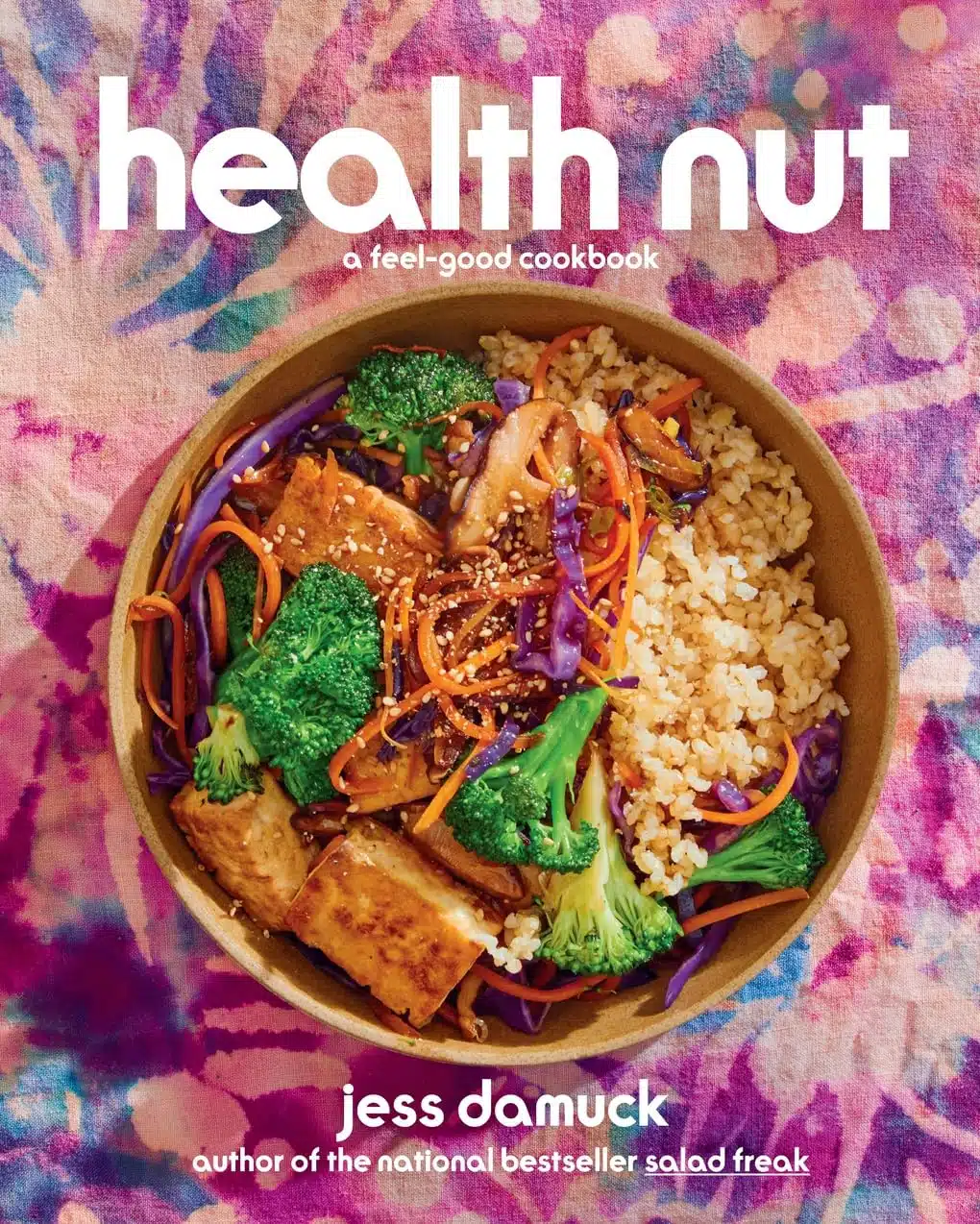
Health Nut: A Feel-Good Cookbook – by Jess Damuck

10almonds is reader-supported. We may, at no cost to you, receive a portion of sales if you purchase a product through a link in this article.

The author is a classically trained chef (worked with Martha Stewart for a long time!), and while health is the focus here, it’s not the be-all-and-end-all, so there’s a lot of attention given to pleasure also. Which, after all, is not a zero-sum game—we can have both!

So, the title and subtitle together sum up the ethos of the book pretty well.

The recipes themselves are divided into categories by meal-type, snacks, desserts, etc. They’re varied enough to suit most moods and seasons, as well as being equally appropriate for cooking for one, or a family, or entertaining. Many (but not all) of the recipes are vegan, though where they’re not, the substitutions are mostly easy and obvious, or explained, or else alternative recipes are given (for example a vegan “tuna” recipe).

In terms of complexity, these are not very complex, yet include everything they need to to make things interesting. That said, the ingredients are also not obscure, and should be easy to find in any reasonably well-stocked supermarket.

One small downside is that many of the recipes are not illustrated, but the instructions are clear enough that this isn’t really a problem, in this reviewer’s opinion.

Bottom line: if you’d like to broaden your kitchen repertoire with plants-forward cooking from an accomplished chef, then this is a good book for that.

Click here to check out Health Nut, and enjoy the feel-good food!

Don’t Forget…

Did you arrive here from our newsletter? Don’t forget to return to the email to continue learning!

Learn to Age Gracefully

Join the 98k+ American women taking control of their health & aging with our 100% free (and fun!) daily emails:

  • Planning Ahead For Better Sleep

    10almonds is reader-supported. We may, at no cost to you, receive a portion of sales if you purchase a product through a link in this article.

    Sleep: 6 Dimensions And 24 Hours!

    A woman with dark hair, planning ahead for better sleep, against a white background.

    This is Dr. Lisa Matricciani, a sleep specialist from the University of South Australia, where she teaches in the School of Health Sciences.

    What does she want us to know?

    Healthy sleep begins before breakfast

    The perfect bedtime routine is all well and good, but we need to begin much earlier in the day, Dr. Matricciani advises.

    Specifically, moderate to vigorous activity early in the day plays a big part.

    Before breakfast is best, but even midday/afternoon exercise is associated with better sleep at night.

    Read more: Daytime Physical Activity is Key to Unlocking Better Sleep

    Plan your time well to sleep—but watch out!

    Dr. Matricciani’s research has also found that while it’s important to plan around getting a good night’s sleep (including planning when this will happen), allocating too much time for sleep results in more restless sleep:

    ❝Allocating more time to sleep was associated with earlier sleep onsets, later sleep offsets, less efficient and more consistent sleep patterns for both children and adults.❞

    ~ Dr. Lisa Matricciani et al.

    Read more: Time use and dimensions of healthy sleep: A cross-sectional study of Australian children and adults

    (this was very large study involving 1,168 children and 1.360 adults, mostly women)

    What counts as good sleep quality? Is it just efficiency?

    It is not! Although that’s one part of it. You may remember our previous main feature:

    The 6 Dimensions Of Sleep (And Why They Matter)

    Dr. Matricciani agrees:

    ❝Everyone knows that sleep is important. But when we think about sleep, we mainly focus on how many hours of sleep we get, when we should also be looking at our sleep experience as a whole❞

    ~ Dr. Lisa Matricciani

    Read more: Trouble sleeping? You could be at risk of type 2 diabetes

    That’s not a cheery headline, but here’s her paper about it:

    Multidimensional Sleep and Cardiometabolic Risk Factors for Type 2 Diabetes: Examining Self-Report and Objective Dimensions of Sleep

    And no, we don’t get a free pass on getting less sleep / less good quality sleep as we get older (alas):

    Why You Probably Need More Sleep

    So, time to get planning for the best sleep!

    Enjoy videos?

    Here’s how 7News Australia broke the news of Dr. Matricciani’s more recent work:

    !

    Rest well!

    Share This Post

  • Insomnia Decoded – by Dr. Audrey Porter

    10almonds is reader-supported. We may, at no cost to you, receive a portion of sales if you purchase a product through a link in this article.

    We’ve written about sleep books before, so what makes this one different? Its major selling point is: most of the focus isn’t on the things that everyone already knows.

    Yes, there’s a section on sleep hygiene and yes it’ll tell you to cut the caffeine and alcohol, but most of the advice here is beyond that.

    Rather, it looks at finding out (if you don’t already know for sure) what is keeping you from healthy sleep, be it environmental, directly physical, or psychological, and breaking out of the stress-sleep cycle that often emerges from such.

    The style is light and conversational, but includes plenty of science too; Dr. Porter knows her stuff.

    Bottom line: if you feel like you know what you should be doing, but somehow life keeps conspiring to stop you from doing it, then this is the book that could help you break out that cycle.

    Click here to check out Insomnia Decoded, and get regular healthy sleep!

    Share This Post

  • Are plant-based burgers really bad for your heart? Here’s what’s behind the scary headlines

    10almonds is reader-supported. We may, at no cost to you, receive a portion of sales if you purchase a product through a link in this article.

    We’re hearing a lot about ultra-processed foods and the health effects of eating too many. And we know plant-based foods are popular for health or other reasons.

    So it’s not surprising new research out this week including the health effects of ultra-processed, plant-based foods is going to attract global attention.

    And the headlines can be scary if that research and the publicity surrounding it suggests eating these foods increases your risk of heart disease, stroke or dying early.

    Here’s how some media outlets interpreted the research. The Daily Mail ran with:

    Vegan fake meats are linked to increase in heart deaths, study suggests: Experts say plant-based diets can boost health – but NOT if they are ultra-processed

    The New York Post’s headline was:

    Vegan fake meats linked to heart disease, early death: study

    But when we look at the study itself, it seems the media coverage has focused on a tiny aspect of the research, and is misleading.

    So does eating supermarket plant-based burgers and other plant-based, ultra-processed foods really put you at greater risk of heart disease, stroke and premature death?

    Here’s what prompted the research and what the study actually found.

    Nina Firsova/Shutterstock

    Remind me, what are ultra-processed foods?

    Ultra-processed foods undergo processing and reformulation with additives to enhance flavour, shelf-life and appeal. These include everything from packet macaroni cheese and pork sausages, to supermarket pastries and plant-based mince.

    There is now strong and extensive evidence showing ultra-processed foods are linked with an increased risk of many physical and mental chronic health conditions.

    Although researchers question which foods should be counted as ultra-processed, or if all of them are linked to poorer health, the consensus is that, generally, we should be eating less of them.

    We also know plant-based diets are popular. These are linked with a reduced risk of chronic health conditions such as heart disease and stroke, cancer and diabetes. And supermarkets are stocking more plant-based, ultra-processed food options.

    How about the new study?

    The study looked for any health differences between eating plant-based, ultra-processed foods compared to eating non-plant based, ultra-processed foods. The researchers focused on the risk of cardiovascular disease (such as heart disease and stroke) and deaths from it.

    Plant-based, ultra-processed foods in this study included mass-produced packaged bread, pastries, buns, cakes, biscuits, cereals and meat alternatives (fake meats). Ultra-processed foods that were not plant-based included milk-based drinks and desserts, sausages, nuggets and other reconstituted meat products.

    The researchers used data from the UK Biobank. This is a large biomedical database that contains de-identified genetic, lifestyle (diet and exercise) and health information and biological samples from half a million UK participants. This databank allows researchers to determine links between this data and a wide range of diseases, including heart disease and stroke.

    They used data from nearly 127,000 people who provided details of their diet between 2009 and 2012. The researchers linked this to their hospital records and death records. On average, the researchers followed each participant’s diet and health for nine years.

    Rows of packaged bread on supermarket shelf
    Plant-based, ultra-processed foods included in this study included packaged supermarket bread. doublelee/Shutterstock

    What did the study find?

    With every 10% increase of total energy from plant-sourced, ultra-processed foods there was an associated 5% increased risk of cardiovascular disease (such as heart disease or stroke) and a 12% higher risk of dying from cardiovascular disease.

    But for every 10% increase in plant-sourced, non-ultra-processed foods consumed there was an associated 7% lower risk of cardiovascular disease and a 13% lower risk of dying from cardiovascular disease.

    The researchers found no evidence for an association between all plant-sourced foods (whether or not they were ultra-processed) and either an increased or decreased risk of cardiovascular disease or dying from it.

    This was an observational study, where people recalled their diet using questionnaires. When coupled with other data, this can only tell us if someone’s diet is associated with a particular risk of a health outcome. So we cannot say that, in this case, the ultra-processed foods caused the heart disease and deaths from it.

    Why has media coverage focused on fake meats?

    Much of the media coverage has focused on the apparent health risks associated with eating fake meats, such as sausages, burgers, nuggets and even steaks.

    These are considered ultra-processed foods. They are made by deconstructing whole plant foods such as pea, soy, wheat protein, nuts and mushrooms, and extracting the protein. They are then reformulated with additives to make the products look, taste and feel like traditional red and white meats.

    However this was only one type of plant-based, ultra-processed food analysed in this study. This only accounted for an average 0.2% of the dietary energy intake of all the participants.

    Compare this to bread, pastries, buns, cakes and biscuits, which are other types of plant-based, ultra-processed foods. These accounted for 20.7% of total energy intake in the study.

    Plant-based foods such as burgers and sausages in trays
    This image was at the top of the media release. Screenshot/Imperial

    It’s hard to say why the media focused on fake meat. But there is one clue in the media release issued to promote the research.

    Although the media release did not mention the words “fake meat”, an image of plant-based burgers, sausages and meat balls or rissoles featured prominently.

    The introduction of the study itself also mentions plant-sourced, ultra-processed foods, such as sausages, nuggets and burgers.

    So it’s no wonder people can be confused.

    Does this mean fake meats are fine?

    Not necessarily. This study analysed the total intake of plant-based, ultra-processed foods, which included fake meats, albeit a very small proportion of people’s diets.

    From this study alone we cannot tell if there would be a different outcome if someone ate large amounts of fake meats.

    In fact, a recent review of fake meats found there was not enough evidence to determine their impact on health.

    We also need more recent data to reflect current eating patterns of fake meats. This study used dietary data collected from 2009 to 2012, and fake meats have become more popular since.

    What if I really like fake meat?

    We have known for a while that ultra-processed foods can harm our health. This study tells us that regardless if an ultra-processed food is plant-based or not, it may still be harmful.

    We know fake meat can contain large amounts of saturated fats (from coconut or palm oil), salt and sugar.

    So like other ultra-processed foods, they should be eaten infrequently. The Australian Dietary Guidelines currently recommends people should only consume foods like this sometimes and in small amounts.

    Are some fake meats healthier than others?

    Check the labels and nutrition information panels. Look for those lowest in fat and salt. Burgers and sausages that are a “pressed cake” of minced ingredients such as nuts, beans and vegetables will be preferable to reformulated products that look identical to meat.

    You can also eat whole plant-based protein foods such as legumes. These include beans, lentils, chickpeas and soy beans. As well as being high in protein and fibre, they also provide essential nutrients such as iron and zinc. Using spices and mushrooms alongside these in your recipes can replicate some of the umami taste associated with meat.

    Evangeline Mantzioris, Program Director of Nutrition and Food Sciences, Accredited Practising Dietitian, University of South Australia

    This article is republished from The Conversation under a Creative Commons license. Read the original article.

    Share This Post

  • Less Common Oral Hygiene Options

    10almonds is reader-supported. We may, at no cost to you, receive a portion of sales if you purchase a product through a link in this article.

    Less Common Alternatives For Oral Hygiene!

    You almost certainly brush your teeth. You might use mouthwash. A lot of people floss for three weeks at a time, often in January.

    There are a lot of options for oral hygiene; variations of the above, and many alternatives too. This is a big topic, so rather than try to squeeze it all in one, this will be a several-part series.

    Tooth soap

    The idea here is simplicity, and brushing with as few ingredients as possible. Soap cleans your teeth the same way it cleans your (sometimes compositionally quite similar—enamel and all) dishes, without damaging them.

    We’d love to link to some science here, but alas, it appears to have not yet been done—at least, we couldn’t find any!

    You can make your own tooth soap if you are feeling confident, or you might prefer to buy one ready-made (here’s an example product on Amazon, with various flavor options)

    Oil pulling

    We are getting gradually more scientific now; there is science for this one… But the (scientific) reviews are mixed:

    Wooley et al., 2020, conducted a review of extant studies, and concluded:

    ❝The limited evidence suggests that oil pulling with coconut oil may have a beneficial effect on improving oral health and dental hygiene❞

    Source: The effect of oil pulling with coconut oil to improve dental hygiene and oral health: A systematic review

    The “Science-Based Medicine” project was less positive in its assessment, and declared that all and any studies that found oil pulling to be effective were a matter of researcher/publication bias. We would note that SBM is a private project and is not without its own biases, but for balance, here is what they had to offer:

    SBM | Oil Pulling Your Leg

    A more rounded view seems to be that it is a good method for cleaning your teeth if you don’t have better options available (whereby, “better options” is “almost any other method”).

    One final consideration, which the above seemed not to consider, is:

    If you have sensitive teeth/gums, oil-pulling is the gentlest way of cleaning them, and getting them back into sufficient order that you can comfortably use other methods.

    Want to try it? You can use any food-grade oil (coconut oil or olive oil are common choices).

    Chewing stick

    Not just any stick—a twig of the Salvadora persica tree. This time, there’s lots of science for it, and it’s uncontroversially effective:

    ❝A number of scientific studies have demonstrated that the miswak (Salvadora persica) possesses antibacterial, anti-fungal, anti-viral, anti-cariogenic, and anti-plaque properties.

    Several studies have also claimed that miswak has anti-oxidant, analgesic, and anti-inflammatory effects. The use of a miswak has an immediate effect on the composition of saliva.

    Several clinical studies have confirmed that the mechanical and chemical cleansing efficacy of miswak chewing sticks are equal and at times greater than that of the toothbrush❞

    ~ Hague et al.

    Read in full: A review of the therapeutic effects of using miswak (Salvadora Persica) on oral health

    And about the efficacy vs using a toothbrush, here’s an example:

    Comparative effect of chewing sticks and toothbrushing on plaque removal and gingival health

    Want to try the miswak stick? Here’s an example product on Amazon.

    Enjoy!

    Don’t Forget…

    Did you arrive here from our newsletter? Don’t forget to return to the email to continue learning!

    Learn to Age Gracefully

    Join the 98k+ American women taking control of their health & aging with our 100% free (and fun!) daily emails:

  • How To Boost Your Memory Immediately (Without Supplements)

    10almonds is reader-supported. We may, at no cost to you, receive a portion of sales if you purchase a product through a link in this article.

    How To Boost Your Memory (Without Supplements)

    While we do recommend having a good diet and taking advantage of various supplements that have been found to help memory, that only gets so much mileage. With that in mind…

    First, how good is your memory? Take This 2-Minute Online Test

    Now, that was a test of short term memory, which tends to be the most impactful in our everyday life.

    It’s the difference between “I remember the address of the house where I grew up” (long-term memory) and “what did I come to this room to do?” (short-term memory / working memory)

    First tip:

    When you want to remember something, take a moment to notice the details. You can’t have a madeleine moment years later if you wolfed down the madeleines so urgently they barely touched the sides.

    This goes for more than just food, of course. And when facing the prospect of age-related memory loss in particular, people tend to be afraid not of forgetting their PIN code, but their cherished memories of loved ones. So… Cherish them, now! You’ll struggle to cherish them later if you don’t cherish them now. Notice the little details as though you were a painter looking at a scene for painting. Involve more senses than just sight, too!

    If it’s important, relive it. Relive it now, relive it tomorrow. Rehearsal is important to memory, and each time you relive a memory, the deeper it gets written into your long-term memory until it becomes indelible to all but literal brain damage.

    Second tip:

    Tell the story of it to someone else. Or imagine telling it to someone else! (You brain can’t tell the difference)

    And you know how it goes… Once you’ve told a story a few times, you’ll never forget it later. Isn’t your life a story worth telling?

    Many people approach memory like they’re studying for a test. Don’t. Approach it like you’re preparing to tell a story, or give a performance. We are storytelling creatures at heart, whether or not we realize it.

    What do you do when you find yourself in a room and wonder why you went there? (We’ve all been there!) You might look around for clues, but if that doesn’t immediately serve, your fallback will be retracing your steps. Literally, physically, if needs be, but at least mentally. The story of how you got there is easier to remember than the smallest bit of pure information.

    What about when there’s no real story to tell, but we still need to remember something?

    Make up a story. Did you ever play the game “My granny went to market” as a child?

    If not, it’s a collaborative memory game in which players take turns adding items to a list, “My granny went to market and bought eggs”, My granny went to market and bought eggs and milk”, “my granny went to market and bought eggs and milk and flour” (is she making a cake?), “my granny went to market and bought eggs and milk and flour and shoe polish” (what image came to mind? Use that) “my granny went to market and bought eggs and milk and flour and shoe polish and tea” (continue building the story in your head), and so on.

    When we actually go shopping, if we don’t have a written list we may rely on the simple story of “what I’m going to cook for dinner” and walking ourselves through that story to ensure we get the things we need.

    This is because our memory thrives (and depends!) on connections. Literal synapse connections in the brain, and conceptual contextual connections in your mind. The more connections, the better the memory.

    Now imagine a story: “I went to Stonehenge, but in the background was a twin-peaked mountain blue. I packed a red suitcase, placing a conch shell inside it, when suddenly I heard a trombone, and…” Ring any bells? These are example items from the memory test earlier, though of course you may have seen different things in a different order.

    So next time you want to remember things, don’t study as though for a test. Prepare to tell a story!

    Try going through the test again, but this time, ignore their instructions because we’re going to use the test differently than intended (we’re rebels like that). Don’t rush, and don’t worry about the score this time (or even whether or not you saw a given image previously), but instead, build a story as you go. We’re willing to bet that after it, you can probably recite most of the images you saw in their correct order with fair confidence.

    Here’s the link again: Take The Same Test, But This Time Make It Story-Worthy!

    Again, ignore what it says about your score this time, because we weren’t doing that this time around. Instead, list the things you saw.

    What you were just able to list was the result of you doing story-telling with random zero-context images while under time pressure.

    Imagine what you can do with actual meaningful memories of your ongoing life, people you meet, conversations you have!

    Just… Take the time to smell the roses, then rehearse the story you’ll tell about them. That memory will swiftly become as strong as any memory can be, and quickly get worked into your long-term memory for the rest of your days.

    Don’t Forget…

    Did you arrive here from our newsletter? Don’t forget to return to the email to continue learning!

    Learn to Age Gracefully

    Join the 98k+ American women taking control of their health & aging with our 100% free (and fun!) daily emails:

  • Senior Meetup Groups Combating Loneliness

    10almonds is reader-supported. We may, at no cost to you, receive a portion of sales if you purchase a product through a link in this article.

    It’s Q&A Day at 10almonds!

    Have a question or a request? You can always hit “reply” to any of our emails, or use the feedback widget at the bottom!

    In cases where we’ve already covered something, we might link to what we wrote before, but will always be happy to revisit any of our topics again in the future too—there’s always more to say!

    As ever: if the question/request can be answered briefly, we’ll do it here in our Q&A Thursday edition. If not, we’ll make a main feature of it shortly afterwards!

    So, no question/request too big or small

    “I would like to read more on loneliness, meetup group’s for seniors. Thank you”

    Well, 10almonds is an international newsletter, so it’s hard for us to advise about (necessarily: local) meetup groups!

    But a very popular resource for connecting to your local community is Nextdoor, which operates throughout the US, Canada, Australia, and large parts of Europe including the UK.

    In their own words:

    Get the most out of your neighborhood with Nextdoor

    It’s where communities come together to greet newcomers, exchange recommendations, and read the latest local news. Where neighbors support local businesses and get updates from public agencies. Where neighbors borrow tools and sell couches. It’s how to get the most out of everything nearby. Welcome, neighbor.

    Curious? Click here to check it out and see if it’s of interest to you

    Don’t Forget…

    Did you arrive here from our newsletter? Don’t forget to return to the email to continue learning!

    Learn to Age Gracefully

    Join the 98k+ American women taking control of their health & aging with our 100% free (and fun!) daily emails: