
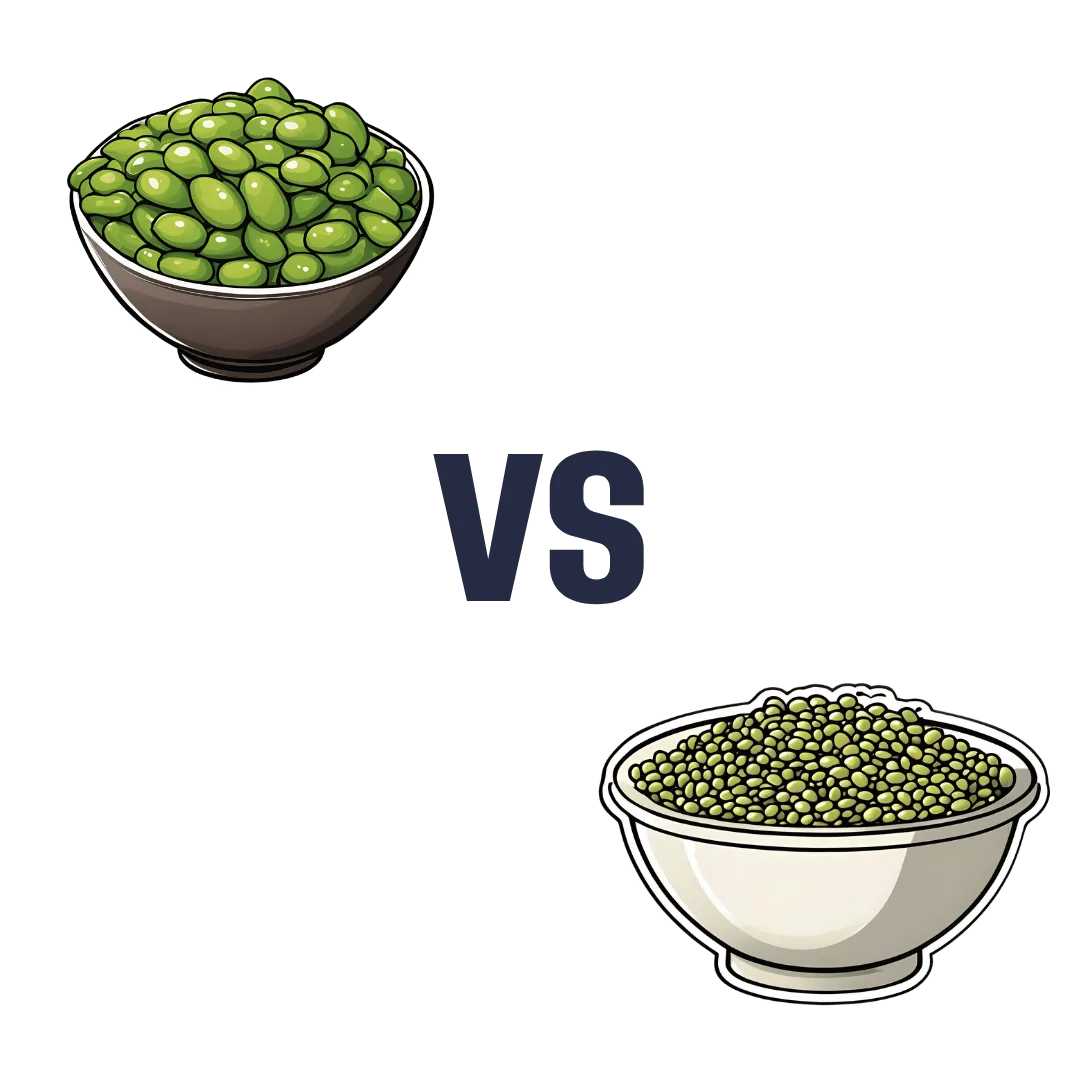
Edamame vs Mung Beans – Which is Healthier?
10almonds is reader-supported. We may, at no cost to you, receive a portion of sales if you purchase a product through a link in this article.
Our Verdict
When comparing edamame to mung beans, we picked the edamame.
Why?
In terms of macros, edamame has a little more protein while mung beans have a little more fiber for notably more carbs, so all things considered, we’ll call this category either a tie, or a subjective win for edamame.
In the category of vitamins, edamame has more of vitamins A, B1, B2, B6, B9, C, E, K, and choline, while mung beans have more of vitamins B3 and B5; a clear win for edamame.
When it comes to minerals, edamame has more calcium, copper, iron, magnesium, manganese, phosphorus, potassium, and zinc, while mung beans have more selenium. Another easy for edamame.
Looking at phytochemicals, edamame has more polyphenols of various kinds (mostly isoflavonoids), so wins this round too.
Adding up the sections makes for a clear overall win for edamame, but do enjoy either or both; mung beans are great too; they just don’t look it when standing next to edamame!
Want to learn more?
You might like:
Plant vs Animal Protein: Head to Head
Enjoy!
Don’t Forget…
Did you arrive here from our newsletter? Don’t forget to return to the email to continue learning!
Recommended
Learn to Age Gracefully
Join the 98k+ American women taking control of their health & aging with our 100% free (and fun!) daily emails:
-
Fiber Fueled – by Dr. Will Bulsiewicz
10almonds is reader-supported. We may, at no cost to you, receive a portion of sales if you purchase a product through a link in this article.
We generally know that for gut health we should eat fiber, but what of the balances of different sorts of fiber?
That’s one of the main things that make this book stand out—fostering diversity in our microbiome by fostering diversity in our diet. Specifically, diversity of fiber-containing foods.
The book is part “science made easy for the lay reader”, and part recipe book. The recipes come with shopping lists and a meal planner, though we would recommend to use those as a guide rather than to try to adhere perfectly to them.
In particular, this reviewer would encourage much more generous use of healthful seasonings… and less reliance on there being leftovers several days later (tasty food gets gone quickly in this house!)
As for the science, the feel of this is more like reading a science-based observational documentary with explanations, than of reading a science textbook. Studies are mentioned in passing, but not dissected in any detail, and the focus is more on getting the key learnings across.
Bottom line: if you’d like to boost not just the amount, but also the diversity, of fiber in your diet, and reap the gut-health rewards, this book is a great guide for that!
Click here to get your copy of “Fiber Fueled” from Amazon today!
Share This Post
-
Natural Tips for Falling Asleep
10almonds is reader-supported. We may, at no cost to you, receive a portion of sales if you purchase a product through a link in this article.
Questions and Answers at 10almonds
Have a question or a request? You can always hit “reply” to any of our emails, or use the feedback widget at the bottom!
This newsletter has been growing a lot lately, and so have the questions/requests, and we love that! In cases where we’ve already covered something, we might link to what we wrote before, but will always be happy to revisit any of our topics again in the future too—there’s always more to say!
As ever: if the question/request can be answered briefly, we’ll do it here in our Q&A Thursday edition. If not, we’ll make a main feature of it shortly afterwards!
So, no question/request too big or small
How to get to sleep at night as fast and as naturally as possible? Thank you!
We’ll definitely write more on that! You might like these articles we wrote already, meanwhile:
- Beating The Insomnia Blues ← this one is general advice and tips
- Time For Some Pillow Talk ← this one compares and reviews some popular sleep apps
- Insomnia? High Blood Pressure? Try these! ← this one tackles the matter from a dietary angle
Share This Post
-
How To Ease Neck Pain At Home
10almonds is reader-supported. We may, at no cost to you, receive a portion of sales if you purchase a product through a link in this article.
Dr. Bang is offering exercises to alleviate neck pain, which pain can be a real… Well, if only there were a good phrase for expressing how troublesome pain in that part of the body can be.
To be clear, he’s a doctor of chiropractic, not a medical doctor, but his advice has clearly been helping people alleviate pain, so without further ado, he advises the following things:
- Taking the head and neck slowly and carefully through the full range of motion available
- Contracting the neck muscles while repeating the above exercise, three times each way
- Backing off a little if it hurts at any point, but noting where the limits lie
- Repeating again the range of motion exercise, this time adding gentle resistance
- Holding each end of this for twenty seconds before releasing and doing the other side, three times each way
- Finally, stabilizing the head centrally and pushing into one’s hands, as an isometric strengthening exercise
He demonstrates each part clearly in this short (5:58) video:
Click Here If The Embedded Video Doesn’t Load Automatically!
Want to know more about chiropractic?
You might like our previous main feature:
Is Chiropractic All It’s Cracked Up To Be?
Take care!
Share This Post
Related Posts
-
Can You Be Fat AND Fit?
10almonds is reader-supported. We may, at no cost to you, receive a portion of sales if you purchase a product through a link in this article.
The short answer is “yes“.
And as for what that means for your heart and/or all-cause mortality risk: it’s just as good as being fit at a smaller size, and furthermore, it’s better than being less fit at a smaller size.
Here’s the longer answer:
The science
A research team did a systematic review looking at multiple large cohort studies examining the associations between:
- Cardiorespiratory fitness and cardiovascular disease risk
- Cardiorespiratory fitness and all-cause mortality
- BMI and cardiovascular disease risk
- BMI and all-cause mortality
However, they also took this further, and tabulated the data such that they could also establish the cardiovascular disease mortality risk and all-cause mortality risk of:
- Unfit people with “normal” BMI
- Unfit people with “overweight” BMI
- Unfit people with “obese” BMI
- Fit people with “normal” BMI
- Fit people with “overweight” BMI
- Fit people with “obese” BMI
Before we move on, let’s note for the record that BMI is a woeful system in any case, for enough reasons to fill a whole article:
Now, with that in mind, let’s get to the results:
What they found
For cardiovascular disease mortality risk of unfit people specifically, compared to fit people of “normal” BMI:
- Unfit people with “normal” BMI: 2.04x higher risk.
- Unfit people with “overweight” BMI: 2.58x higher risk.
- Unfit people with “obese” BMI: 3.35x higher risk
So here we can see that if you are unfit, then being heavier will indeed increase your CVD mortality risk.
For all-cause mortality risk of unfit people specifically, compared to fit people of “normal” BMI:
- Unfit people with “normal” BMI: 1.92x higher risk.
- Unfit people with “overweight” BMI: 1.82x higher risk.
- Unfit people with “obese” BMI: 2.04x higher risk
This time we see that if you are unfit, then being heavier or lighter than “overweight” will increase your all-cause mortality risk.
So, what about if you are fit? Then being heavier or lighter made no significant difference to either CVD mortality risk or all-cause mortality risk.
Fit individuals, regardless of weight category (normal, overweight, or obese), had significantly lower mortality risks compared to unfit individuals in any weight category.
Note: not just “compared to unfit individuals in their weight category”, but compared to unfit individuals in any weight category.
In other words, if you are obese and have good cardiorespiratory fitness, you will (on average) live longer than an unfit person with “normal” BMI.
You can find the paper itself here, if you want to examine the data and/or method:
Cardiorespiratory fitness, body mass index and mortality: a systematic review and meta-analysis
Ok, so how do I improve the kind of fitness that they measured?
They based their cardiorespiratory fitness on VO2 Max, which scientific consensus holds to be a good measure of how efficiently your body can use oxygen—thus depending on your heart and lungs being healthy.
If you use a fitness tracker that tracks your exercise and your heart rate, it will estimate your VO2 Max for you—to truly measure the VO2 Max itself directly, you’ll need a lot more equipment; basically, access to a lab that tests this. But the estimates are fairly accurate, and so good enough for most personal purposes that aren’t hard-science research.
Next, you’ll want to do this:
53 Studies Later: The Best Way to Improve VO2 Max
Take care!
Don’t Forget…
Did you arrive here from our newsletter? Don’t forget to return to the email to continue learning!
Learn to Age Gracefully
Join the 98k+ American women taking control of their health & aging with our 100% free (and fun!) daily emails:
-
Passion Fruit vs Pomegranate – Which is Healthier?
10almonds is reader-supported. We may, at no cost to you, receive a portion of sales if you purchase a product through a link in this article.
Our Verdict
When comparing passion fruit to pomegranate, we picked the passion fruit.
Why?
Both of these fruits have beaten a lot of other contenders, so it’s time to pit them against each other:
In terms of macros, passion fruit has more protein, carbs, and fiber, the ratio of which meaning also that passion fruit has the lower glycemic index. So, we say passion fruit wins on macros.
In the category of vitamins, things are more even; passion fruit has more of vitamins A, B2, B3, B6, and C, while pomegranate has more of vitamins B1, B5, B9, E, and K. In light of this 5:5 tie, and since passion fruit’s overall vitamin coverage is better (in terms of meeting RDA needs) but pomegranate’s vitamins are often in shorter supply in diet, we’re calling it a tie on vitamins.
Looking at minerals, passion fruit has more calcium, iron, magnesium, phosphorus, potassium, and selenium, while pomegranate has more copper, manganese, and zinc. That’s already an easy 6:3 win for passion fruit, before we even consider the fact that passion fruit’s minerals’ margin of difference is greater too.
Adding up the sections makes for a clear overall win for passion fruit, but by all means do enjoy either or both, as diversity is best!
Want to learn more?
You might like to read:
What’s Your Plant Diversity Score?
Take care!
Don’t Forget…
Did you arrive here from our newsletter? Don’t forget to return to the email to continue learning!
Learn to Age Gracefully
Join the 98k+ American women taking control of their health & aging with our 100% free (and fun!) daily emails:
-
Plums vs Strawberries – Which is Healthier?
10almonds is reader-supported. We may, at no cost to you, receive a portion of sales if you purchase a product through a link in this article.
Our Verdict
When comparing plums to strawberries, we picked the strawberries.
Why?
Both are great! Absolutely top-tier fruits. However, even within the top tier, there are distinctions:
In terms of of macros, plums have more carbs while strawberries have more fiber; we’ll take the extra fiber for the win here.
In the category of vitamins, plums have more of vitamins A, B1, B2, and K, while strawberries have more of vitamins B6, B9, C, E, and choline, thus scoring a marginal win for strawberries in this round.
When it comes to minerals, plums have (slightly) more copper, while strawberries have more calcium, iron, magnesium, manganese, phosphorus, selenium, and zinc. One more win for strawberries.
In terms of phytochemicals, plums have a higher total mass of polyphenols, and so win this round, although strawberries scored well too.
Adding up the sections makes for an overall win for strawberries, but by all means enjoy either or both; diversity is good!
Want to learn more?
You might like:
Top 8 Fruits That Prevent & Kill Cancer
Enjoy!
Don’t Forget…
Did you arrive here from our newsletter? Don’t forget to return to the email to continue learning!
Learn to Age Gracefully
Join the 98k+ American women taking control of their health & aging with our 100% free (and fun!) daily emails:


