
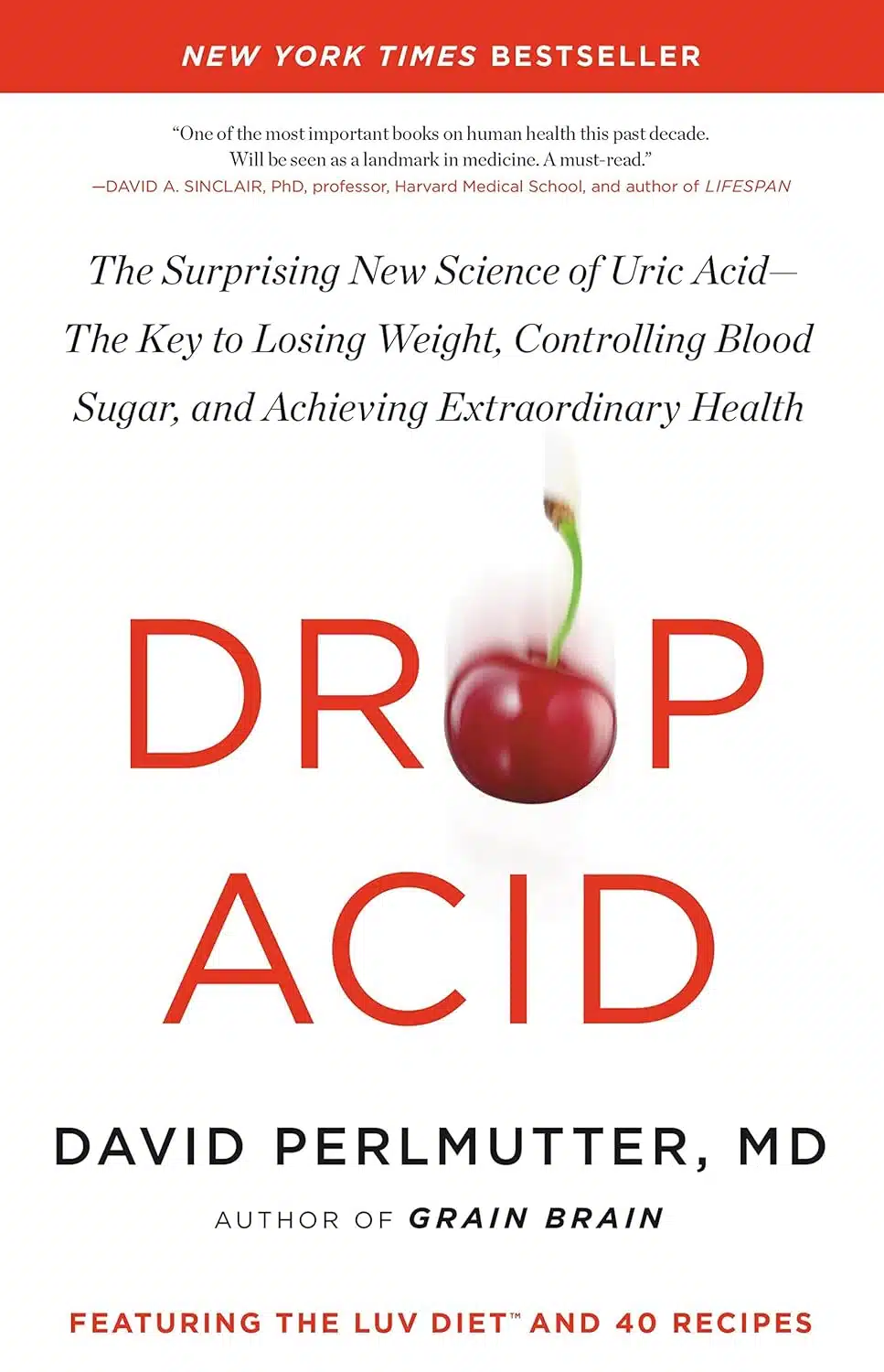
Drop Acid: The Surprising New Science of Uric Acid – by Dr. David Perlmutter

10almonds is reader-supported. We may, at no cost to you, receive a portion of sales if you purchase a product through a link in this article.

A lot of books have “the new science of” in the title or subtitle, and most of the time the science is not, in fact, new. So, how does this one measure up?

The science is so new that, in fact, it’s largely still in the hypothesis stage. Dr. Perlmutter acknowledges this, and simply makes the argument that it is a reasonable hypothesis, and that in time, it’ll either be validated or refuted.

Meanwhile, he advises us about (well-established) health risks associated with high uric acid levels, and recommends we avoid foods high in purines (as is also current scientific consensus), as well as fructose that has been stripped of fiber (scientific consensus holds for that fructose-without-fiber is indeed terrible for metabolic health, but does not hold that it has anything to do with uric acid levels), and grains (current scientific consensus holds that whole grains are positively healthy for most people, and again, does not connect them to uric acid levels).

The potential tie between metabolic health and uric acid levels is something this book explores a lot, before going on to give us a week-by-week guide to reducing our uric acid levels. There are also recipes, but not many.

The style is light pop-science, very easy to read, little hard science. There is a bibliography, but more often the references are for cited statistics, rather than for scientific claims, which frequently go unsupported by the science that has yet to be done.

Bottom line: this is a very speculative book, but it makes a reasonable case, and is at the very least an interesting read with some ideas one won’t find in every second dietary health book out there.

Click here to check out Drop Acid, and drop your uric acid levels!

Don’t Forget…

Did you arrive here from our newsletter? Don’t forget to return to the email to continue learning!
  • Mineral-Rich Mung Bean Pancakes
    Packed with minerals and protein, mung beans transform into savory pancakes with parsley, dill, and a hint of nutritional yeast—perfectly golden and irresistibly healthy!

Learn to Age Gracefully

Join the 98k+ American women taking control of their health & aging with our 100% free (and fun!) daily emails:

  • Could not getting enough sleep increase your risk of type 2 diabetes?

    10almonds is reader-supported. We may, at no cost to you, receive a portion of sales if you purchase a product through a link in this article.

    Not getting enough sleep is a common affliction in the modern age. If you don’t always get as many hours of shut-eye as you’d like, perhaps you were concerned by news of a recent study that found people who sleep less than six hours a night are at higher risk of type 2 diabetes.

    So what can we make of these findings? It turns out the relationship between sleep and diabetes is complex.

    The study

    Researchers analysed data from the UK Biobank, a large biomedical database which serves as a global resource for health and medical research. They looked at information from 247,867 adults, following their health outcomes for more than a decade.

    The researchers wanted to understand the associations between sleep duration and type 2 diabetes, and whether a healthy diet reduced the effects of short sleep on diabetes risk.

    As part of their involvement in the UK Biobank, participants had been asked roughly how much sleep they get in 24 hours. Seven to eight hours was the average and considered normal sleep. Short sleep duration was broken up into three categories: mild (six hours), moderate (five hours) and extreme (three to four hours). The researchers analysed sleep data alongside information about people’s diets.

    Some 3.2% of participants were diagnosed with type 2 diabetes during the follow-up period. Although healthy eating habits were associated with a lower overall risk of diabetes, when people ate healthily but slept less than six hours a day, their risk of type 2 diabetes increased compared to people in the normal sleep category.

    The researchers found sleep duration of five hours was linked with a 16% higher risk of developing type 2 diabetes, while the risk for people who slept three to four hours was 41% higher, compared to people who slept seven to eight hours.

    One limitation is the study defined a healthy diet based on the number of servings of fruit, vegetables, red meat and fish a person consumed over a day or a week. In doing so, it didn’t consider how dietary patterns such as time-restricted eating or the Mediterranean diet may modify the risk of diabetes among those who slept less.

    Also, information on participants’ sleep quantity and diet was only captured at recruitment and may have changed over the course of the study. The authors acknowledge these limitations.

    Why might short sleep increase diabetes risk?

    In people with type 2 diabetes, the body becomes resistant to the effects of a hormone called insulin, and slowly loses the capacity to produce enough of it in the pancreas. Insulin is important because it regulates glucose (sugar) in our blood that comes from the food we eat by helping move it to cells throughout the body.

    We don’t know the precise reasons why people who sleep less may be at higher risk of type 2 diabetes. But previous research has shown sleep-deprived people often have increased inflammatory markers and free fatty acids in their blood, which impair insulin sensitivity, leading to insulin resistance. This means the body struggles to use insulin properly to regulate blood glucose levels, and therefore increases the risk of type 2 diabetes.

    Further, people who don’t sleep enough, as well as people who sleep in irregular patterns (such as shift workers), experience disruptions to their body’s natural rhythm, known as the circadian rhythm.

    This can interfere with the release of hormones like cortisol, glucagon and growth hormones. These hormones are released through the day to meet the body’s changing energy needs, and normally keep blood glucose levels nicely balanced. If they’re compromised, this may reduce the body’s ability to handle glucose as the day progresses.

    These factors, and others, may contribute to the increased risk of type 2 diabetes seen among people sleeping less than six hours.

    A man checking the glucose monitor on his arm.
    Millions of people around the world have diabetes. WESTOCK PRODUCTIONS/Shutterstock

    While this study primarily focused on people who sleep eight hours or less, it’s possible longer sleepers may also face an increased risk of type 2 diabetes.

    Research has previously shown a U-shaped correlation between sleep duration and type 2 diabetes risk. A review of multiple studies found getting between seven to eight hours of sleep daily was associated with the lowest risk. When people got less than seven hours sleep, or more than eight hours, the risk began to increase.

    The reason sleeping longer is associated with increased risk of type 2 diabetes may be linked to weight gain, which is also correlated with longer sleep. Likewise, people who don’t sleep enough are more likely to be overweight or obese.

    Good sleep, healthy diet

    Getting enough sleep is an important part of a healthy lifestyle and may reduce the risk of type 2 diabetes.

    Based on this study and other evidence, it seems that when it comes to diabetes risk, seven to eight hours of sleep may be the sweet spot. However, other factors could influence the relationship between sleep duration and diabetes risk, such as individual differences in sleep quality and lifestyle.

    While this study’s findings question whether a healthy diet can mitigate the effects of a lack of sleep on diabetes risk, a wide range of evidence points to the benefits of healthy eating for overall health.

    The authors of the study acknowledge it’s not always possible to get enough sleep, and suggest doing high-intensity interval exercise during the day may offset some of the potential effects of short sleep on diabetes risk.

    In fact, exercise at any intensity can improve blood glucose levels.

    Giuliana Murfet, Casual Academic, Faculty of Health, University of Technology Sydney and ShanShan Lin, Senior Lecturer, School of Public Health, University of Technology Sydney

    This article is republished from The Conversation under a Creative Commons license. Read the original article.

    Share This Post

  • Health Shots − by Toby Amidor

    10almonds is reader-supported. We may, at no cost to you, receive a portion of sales if you purchase a product through a link in this article.

    First a quick note on qualifications: while not a doctor, she’s a RD, CDN, FAND, and as such, this is a very nutrition-focused book.

    As a general rule of thumb, juices are unhealthy because of being largely liquid sugar and no fiber, but in this case:

    1. even the juice-based tonics are very small portions, so even if some have a high glycemic index, they’ll still have a low glycemic load, which means that having one is unlikely to spike blood glucose and thus insulin
    2. many of the tonics have fiber in any case, due to how they are made.

    The tonics are divided into sections per what one wants to focus on, e.g. anti-inflammatory, brain health, sleep, gut health, skin/nails/hair, etc.

    That said, some of the recipes are a little optimistic about how much effect the dosage present will have. For example, we calculate an an average of 0.03mg of resveratrol in her grape-based shot boasting resveratrol benefits. For contrast, resveratrol supplements range from 500mg to 200mg. So, to get the equivalent of the least generous supplement, you’d need to drink 16,667 shots.

    Bottom line: some of the the health claims in this book are overstated, but by and large, it’s hard to go wrong consuming more plants, and these “health shots” are not a bad way to get a good dose of phytonutrients without hitting glycemic problems.

    Click here to check out Health Shots, and refresh yourself!

    Share This Post

  • Grapefruit vs Mango – Which is Healthier?

    10almonds is reader-supported. We may, at no cost to you, receive a portion of sales if you purchase a product through a link in this article.

    Our Verdict

    When comparing grapefruit to mango, we picked the mango.

    Why?

    It’s pretty clear-cut today, despite a fairly even start:

    In terms of macros, mango has a little more protein and carbs, but the differences are so small as to be negligible, while the two are equal on fiber; in realistic terms we’re calling this first round a tie.

    In the category of vitamins, grapefruit has more of vitamins B1 and B5, while mangos have more of vitamins A, B2, B3, B6, B7, B9, C, E, and K, winning easily in this round.

    Looking at minerals, grapefruit has more calcium and phosphorus, while mangos have more copper, iron, magnesium, manganese, potassium, selenium, and zinc, winning this round by quite a margin too.

    One more consideration that’s not shown in the nutritional values, is that grapefruit contains high levels of furanocoumarins, which can inhibit cytochrome P-450 3A4 isoenzyme and P-glycoptrotein transporters in the intestine and liver—slowing down their drug metabolism capabilities, thus effectively increasing the bioavailability of many drugs manifold.

    This may sound superficially like a good thing (improving bioavailability of things we want), but in practice it means that in the case of many drugs, if you take them with (or near in time to) grapefruit or grapefruit juice, then congratulations, you just took an overdose. This happens with a lot of meds for blood pressure, cholesterol (including statins), calcium channel-blockers, anti-depressants, benzo-family drugs, beta-blockers, and more. Oh, and Viagra, too. Which latter might sound funny, but remember, Viagra’s mechanism of action is blood pressure modulation, and that is not something you want to mess around with unduly. So, do check with your pharmacist to know if you’re on any meds that would be affected by grapefruit or grapefruit juice!

    PS: the same substance is quite available in pummelos and sour oranges (but not meaningfully in sweet oranges); you can see a chart here showing the relative furanocoumarin contents of many citrus fruits, or lack thereof as the case may be, as it is for lemons and most limes).

    Adding up the sections makes for an overwhelming overall win for mangos, but by all means do enjoy either or both, unless any of the furanocoumarin contraindications apply, in which case, definitely stick to the mangos!

    Want to learn more?

    You might like:

    Watch Out For Furanocoumarins!

    Enjoy!

    Share This Post

  • Cucumber vs Eggplant – Which is Healthier?

    10almonds is reader-supported. We may, at no cost to you, receive a portion of sales if you purchase a product through a link in this article.

    Our Verdict

    When comparing cucumber to eggplant, we picked the eggplant.

    Why?

    In terms of macros, eggplant has 6x the fiber, as well as slightly more carbs and protein, making it the clear winner in this category.

    In the category of vitamins, cucumber has more of vitamins A, C, and K, while eggplant has more of vitamins B1, B2, B3, B5, B6, B7, B9, E, and choline; an easy win for eggplant here.

    When it comes to minerals, cucumber has more calcium, iron, and zinc, while eggplant has more copper, magnesium, manganese, and potassium; a marginal win for eggplant this time.

    Looking at phytochemicals, the two vegetables are about equal here, with nothing especially noteworthy in their polyphenol profiles to set one ahead of the other. So, a tie.

    Adding up the sections makes for a clear overall win for eggplant, but by all means enjoy either or both, as diversity is good!

    Want to learn more?

    You might like:

    Some Surprising Truths About Hunger And Satiety ← our main feature in which we examine the science of volumetrics, including a study that shows how water incorporated into a food (but not served with a food) decreases caloric intake. So, cucumbers are great for this.

    Enjoy!

    Don’t Forget…

    Did you arrive here from our newsletter? Don’t forget to return to the email to continue learning!

    Learn to Age Gracefully

    Join the 98k+ American women taking control of their health & aging with our 100% free (and fun!) daily emails:

  • Cauliflower vs Pumpkin – Which is Healthier?

    10almonds is reader-supported. We may, at no cost to you, receive a portion of sales if you purchase a product through a link in this article.

    Our Verdict

    When comparing cauliflower to pumpkin, we picked the cauliflower.

    Why?

    In terms of macros, cauliflower has 2x the fiber for the same carbs, and 2x the protein, winning in this category.

    In the category of vitamins, cauliflower has more of vitamins B1, B5, B6, B9, C, and K, while pumpkin has more of vitamins A and E, giving cauliflower a 6:2 win here.

    Looking at minerals next, cauliflower has more calcium, magnesium, manganese, phosphorus, potassium, selenium, and zinc, while pumpkin has more copper and iron, yielding to cauliflower a 7:2 win this time.

    In other considerations, cauliflower has more polyphenols, and also sulforaphane (more details on that below), so that’s another point in cauliflower’s favor.

    Adding up the sections makes for a clear overall win for cauliflower, but by all means enjoy either or both, as diversity is good!

    Want to learn more?

    You might like:

    Broccoli Sprouts & Sulforaphane ← goes for cauliflower too

    Enjoy!

    Don’t Forget…

    Did you arrive here from our newsletter? Don’t forget to return to the email to continue learning!

    Learn to Age Gracefully

    Join the 98k+ American women taking control of their health & aging with our 100% free (and fun!) daily emails:

  • The Minerals That Neutralize Viruses (While Being Harmless To Humans)

    10almonds is reader-supported. We may, at no cost to you, receive a portion of sales if you purchase a product through a link in this article.

    Researchers in Estonia and Sweden (it was a joint project, with five researchers from each country) have found a way to use titanium dioxide nanoparticles to neutralize viruses, including COVID & flu.

    Titanium dioxide, yes, the common additive to foods, cosmetics, and more (in most cases, added as a non-bleaching whitening agent—simply, titanium dioxide is body-safe, white in color, and very reflective, making it a brilliant, shiny white). Also used in sunscreens, for its excellent safety profile and again, its full-spectrum reflectiveness.

    See also: Who Screens The Sunscreens?

    How it works

    Some viruses, including coronaviruses and influenza viruses, have an outer layer that’s a lipid membrane. The researchers found (by testing against multiple viruses, and by using a control of silicotungstate polyoxymethalate nanoparticles), that the ability of titanium dioxide to bind to phospholipids (and ability that the silicotungstate polyoxymethalate doesn’t have) means that the nanoparticles bind to the virus’s outer case, thus preventing it from effectively entering human cells (which it needs to do in order to infect the host, as this is how viruses replicate themselves).

    What this means, in practical terms

    While more research will be needed to know whether this can be used in the medicinal sense, it already means that a nanoparticle spray can be used to create virus-neutralizing layers on surfaces and in air filters. This alone could greatly reduce transmission in enclosed spaces such as public transport (ranging from taxis to airplanes), as well as other places where people get packed into a small space.

    If you have an air purifier at home, keep an eye out for when improved filters arrive on the market!

    See also: What’s Lurking In Your Household Air?

    Wait, you said “minerals”; are there more?

    It seems so, but we can’t truly say for sure until they’ve been tested. However, the researchers see no reason why other small metal oxides that bind strongly to phospholipids shouldn’t work exactly the same way—which would include iron oxide (yes, as in rust) and aluminum oxide (the coating that automatically forms immediately when aluminum is exposed to oxygen (aluminum is so reactive to oxygen, that it’s almost impossible to get aluminum without an oxidized surface, unless you use something else to coat it, or cut it in an oxygen-free atmosphere and keep it there).

    You can read the paper itself here:

    Molecular mechanisms behind the anti corona virus activity of small metal oxide nanoparticles

    And on a related note (different scientists, different science, similar principle, though, using mineral nanotechnology to kill microbes):

    ❝Researchers report that laboratory tests of their nanoflower-coated dressings demonstrate antibiotic, anti-inflammatory and biocompatible properties. They say these results show these tannic acid and copper(II) phosphate sprouted nanoflower bandages are promising candidates for treating infections and inflammatory conditions.❞

    Read in full: This delicate nanoflower is downright deadly to bacteria

    Want to learn more?

    Check out:

    Move over, COVID and Flu! We Have “Hybrid Viruses” To Contend With Now

    Take care!

    Don’t Forget…

    Did you arrive here from our newsletter? Don’t forget to return to the email to continue learning!

    Learn to Age Gracefully

    Join the 98k+ American women taking control of their health & aging with our 100% free (and fun!) daily emails: