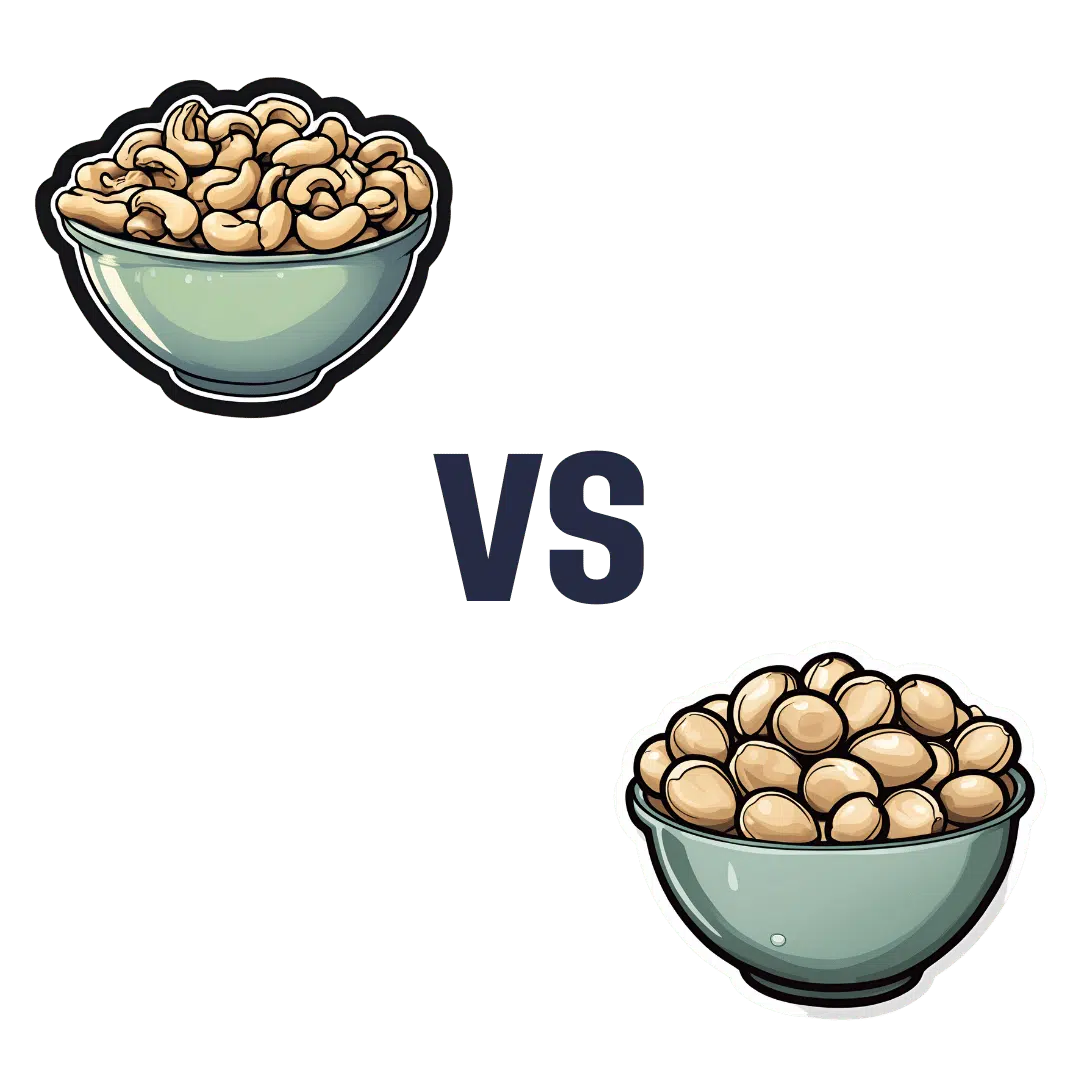
Cashew Nuts vs Macadamia Nuts – Which is Healthier?

10almonds is reader-supported. We may, at no cost to you, receive a portion of sales if you purchase a product through a link in this article.

Our Verdict

When comparing cashews to macadamias, we picked the cashews.

Why?

In terms of macros, cashews have more than 2x the protein, while macadamias have nearly 2x the fat. The fats are mostly monounsaturated, so it’s still healthy in moderation, but still, we’re going to prize the protein over it and call this category a nominal win for cashews.

When it comes to vitamins, things are fairly even; cashews have more of vitamins B5, B6, B9, and E, while macadamias have more of vitamins B1, B2, B3, and C.

In the category of minerals, cashews take the clear lead; cashews have more copper, iron, magnesium, phosphorus, potassium, selenium, and zinc, while macadamias have more calcium and manganese.

In short, enjoy both (as macadamias have their benefits too), but cashews win in total nutrient density.

Want to learn more?

You might like to read:

Why You Should Diversify Your Nuts

Take care!

Don’t Forget…

Did you arrive here from our newsletter? Don’t forget to return to the email to continue learning!

Learn to Age Gracefully

Join the 98k+ American women taking control of their health & aging with our 100% free (and fun!) daily emails:

  • Mindfulness – by Olivia Telford

    10almonds is reader-supported. We may, at no cost to you, receive a portion of sales if you purchase a product through a link in this article.

    Olivia Telford takes us on a tour of mindfulness, meditation, mindfulness meditation, and how each of these things impacts stress, anxiety, and depression—as well as less obvious things too, like productivity and relationships.

    In the category of how much this is a “how-to-” guide… It’s quite a “how-to” guide. We’re taught how to meditate, we’re taught assorted mindfulness exercises, and we’re taught specific mindfulness interventions such as beating various life traps (e.g. procrastination, executive dysfunction, etc) with mindfulness.

    The writing style is simple and to the point, explanatory and very readable. References are made to pop-science and hard science alike, and all in all, is not too far from the kind of writing you might expect to find here at 10almonds.

    Bottom line: if you’d like to practice mindfulness meditation and want an easy “in”, or perhaps you’re curious and wonder what mindfulness could tangibly do for you and how, then this book is a great choice for that.

    Click here to check out Mindfulness, and enjoy being more present in life!

    Share This Post

  • How to Start Calisthenics (Beginner Guide From Zero)

    10almonds is reader-supported. We may, at no cost to you, receive a portion of sales if you purchase a product through a link in this article.

    You don’t have to start with one-finger handstands while doing the splits in the air, even if that’s your end goal.

    Here’s a genuinely beginner-friendly step-by-step guide to getting started in calisthenics:

    As easy as…

    Calisthenics is, first and foremost, simply bodyweight training like push-ups, squats, and handstands, and as such, it doesn’t require weights, a gym, or much space. You can train anywhere using minimal space and household items like a couch for incline push-ups, so lack of equipment isn’t a barrier.

    Impressive skills like handstands or planches are more reasonable as long-term goals, so for now, focus on basic movements, rather than comparing yourself to advanced athletes who’ve been doing it every day for the past many years.

    First of all, step zero: starting calisthenics simply means moving your body, so you can begin immediately without waiting for the “perfect” time or setup.

    And now…

    1. Assess your level: test how many push-ups or squats you can do, or how long you can hold a plank or dead hang, to establish your current ability.
    2. Treat results as information: your starting point isn’t a judgment, and any level—whether beginner or advanced—is fine so long as you do begin.
    3. Set specific goals: use small, measurable targets like one push-up, a 10-second plank, or a 20-second dead hang, instead of vague goals like “get stronger.”
    4. Progress gradually: once you reach a goal, increase it incrementally to keep the progress going.
    5. Choose a routine: either do fixed training days or a flexible weekly target, but pick a structure that matches your own real-life habits.
    6. Prioritize consistency: regular effort matters more than perfection, and while missing a session doesn’t mean failure, missing more is starting to look like a pattern, so correct it as soon as you can!
    7. Use short sessions if needed: even brief workouts throughout your day are effective, and infinitely better than doing nothing.
    8. Avoid doing too much: going all out too early can lead to excessive soreness or injury, which slows progress.
    9. Avoid overplanning: excessive planning can delay action, so it’s better to start now, simply, and adjust as you go.
    10. Don’t quit early: skill development can take weeks, months, or years, so persistence will continue to be key.

    For more on all of this plus some visual demonstrations, enjoy:

    Click Here If The Embedded Video Doesn’t Load Automatically!

    Want to learn more?

    You might also like:

    What Difference Can 30 Days Of Calisthenics Make, Really?

    Take care!

    Share This Post

  • Nutrition To Combat Lymphedema & Lipedema

    10almonds is reader-supported. We may, at no cost to you, receive a portion of sales if you purchase a product through a link in this article.

    Dr. Kelly Sturm is a rehab specialist (Doctor of Physical Therapy), and also a certified lymphedema therapist. Here’s what helps her patients with lymphedema and lipedema:

    Don’t fan the flames

    Lymphedema and lipedema are inflammatory lymphatic diseases affecting mostly women. As such, an anti-inflammatory diet will be important, but there are other factors too:

    • Anti-inflammatory diet: this is to reduce the chronic inflammation associated with lymphatic diseases. This means eating plenty of fruit and vegetables, especially berries and leafy greens, and avoiding things like sugar, alcohol, caffeine, and processed foods. And of course, don’t smoke.
    • Intermittent fasting: this also helps by giving the body a chance to correct itself; when the body isn’t digesting food, it has a lot more resources to devote to its favorite activity: maintenance. This results in lower inflammation, and better fat redistribution.
    • Weight loss: not a bandwagon we often get on at 10almonds as it’s rarely the most important thing, but in this case it is of high importance (second only to dealing with the inflammation), as excess weight around the lymph nodes and vessels can lead to dysfunction and swelling. Thus, reducing the weight can ease that and allow the body to heal.

    For more details on all of the above, enjoy:

    Click Here If The Embedded Video Doesn’t Load Automatically!

    Want to learn more?

    You might also like to read:

    Take care!

    Share This Post

  • Millet vs Rye – Which is Healthier?

    10almonds is reader-supported. We may, at no cost to you, receive a portion of sales if you purchase a product through a link in this article.

    Our Verdict

    When comparing millet to rye, we picked the rye.

    Why?

    In terms of macros, they’re about equal on protein, and rye has more carbs and fiber, the ratio of which give it the lower glycemic index, so we say rye wins this category.

    In the category of vitamins, millet has more of vitamins B1, B2, B6, and B9, while rye has more of vitamins A, B5, E, and K. Notionally, that’s a 4:4 tie, though rye’s margins of difference are an order of magnitude greater, so we say rye takes a marginal victory on this one.

    When it comes to minerals, there’s nothing to debate here: millet has more copper, while rye has more calcium, manganese, phosphorus, potassium, selenium, and zinc. An easy win for rye on this one.

    Adding up the sections gives the overall win to rye, but there is one other thing worth mentioning: millet is naturally gluten-free, but rye is not, so if you are avoiding gluten for any reason, you’ll want to pick the millet in this case.

    See also: Gluten: What’s The Truth?

    Aside from that, by all means enjoy either or both, in moderation! Diversity is good.

    Want to learn more?

    You might like to read:

    Grains: Bread Of Life, Or Cereal Killer?

    Enjoy!

    Don’t Forget…

    Did you arrive here from our newsletter? Don’t forget to return to the email to continue learning!

    Learn to Age Gracefully

    Join the 98k+ American women taking control of their health & aging with our 100% free (and fun!) daily emails:

  • Hydroxyapatite Toothpaste – 6 Month Update

    10almonds is reader-supported. We may, at no cost to you, receive a portion of sales if you purchase a product through a link in this article.

    A dental hygienist tried hydroxyapatite toothpaste for 6 months, and this is what she found:

    The results are in

    In few words: she took before-and-after photos, or rather, regular photos through the 6-month process.

    What she was mostly looking for: tooth translucency, enamel imperfections, and stains.

    What she found: a slight improvement within two months, though over the course of the six months, the photos were somewhat inconsistent—however, this may have more to do with the machinations of her camera, the ambient lighting, etc, than it has to do with the toothpaste. In an ideal world, she’d be able to do a density test with a laser on one side and a sensor on the other, but it seems her budget didn’t stretch to that. In terms of subjective improvement, she found that her teeth felt better, even if the visual change was not consistently apparent.

    This is consistent with the idea that hydroxyapatite toothpaste can mineralize teeth throughout the tooth, not just from the outside in, due to the porous nature of the enamel. So, a lot of the change may have been on the inside.

    Ultimately, she neither recommends nor discommends the toothpaste, and acknowledges that more time, up to a year, may be needed for more noticeable results.

    For more on all of this plus visual demonstrations, enjoy:

    Click Here If The Embedded Video Doesn’t Load Automatically!

    Want to learn more?

    You might also like:

    Tooth Remineralization: How To Heal Your Teeth Naturally

    Take care!

    Don’t Forget…

    Did you arrive here from our newsletter? Don’t forget to return to the email to continue learning!

    Learn to Age Gracefully

    Join the 98k+ American women taking control of their health & aging with our 100% free (and fun!) daily emails:

  • Women take more antidepressants after divorce than men but that doesn’t mean they’re more depressed

    10almonds is reader-supported. We may, at no cost to you, receive a portion of sales if you purchase a product through a link in this article.

    Research out today from Finland suggests women may find it harder to adjust to later-life divorce and break-ups than men.

    The study used population data from 229,000 Finns aged 50 to 70 who had undergone divorce, relationship break-up or bereavement and tracked their use of antidepressants before and after their relationship ended.

    They found antidepressant use increased in the four years leading to the relationship dissolution in both genders, with women experiencing a more significant increase.

    But it’s too simplistic to say women experience poorer mental health or tend to be less happy after divorce than men.

    Remind me, how common is divorce?

    Just under 50,000 divorces are granted each year in Australia. This has slowly declined since the 1990s.

    More couple are choosing to co-habitate, instead of marry, and the majority of couples live together prior to marriage. Divorce statistics don’t include separations of cohabiting couples, even though they are more likely than married couples to separate.

    Those who divorce are doing so later in life, often after their children grow up. The median age of divorce increased from 45.9 in 2021 to 46.7 in 2022 for men and from 43.0 to 43.7 for women.

    The trend of late divorces also reflects people deciding to marry later in life. The median duration from marriage to divorce in 2022 was around 12.8 years and has remained fairly constant over the past decade.

    Why do couples get divorced?

    Changes in social attitudes towards marriage and relationships mean divorce is now more accepted. People are opting not to be in unhappy marriages, even if there are children involved.

    Instead, they’re turning the focus on marriage quality. This is particularly true for women who have established a career and are financially autonomous.

    Similarly, my research shows it’s particularly important for people to feel their relationship expectations can be fulfilled long term. In addition to relationship quality, participants reported needing trust, open communication, safety and acceptance from their partners.

    Grey divorce” (divorce at age 50 and older) is becoming increasingly common in Western countries, particularly among high-income populations. While factors such as an empty nest, retirement, or poor health are commonly cited predictors of later-in-life divorce, research shows older couples divorce for the same reasons as younger couples.

    What did the new study find?

    The study tracked antidepressant use in Finns aged 50 to 70 for four years before their relationship breakdown and four years after.

    They found antidepressant use increased in the four years leading to the relationship break-up in both genders. The proportion of women taking antidepressants in the lead up to divorce increased by 7%, compared with 5% for men. For de facto separation antidepressant use increased by 6% for women and 3.2% for men.

    Within a year of the break-up, antidepressant use fell back to the level it was 12 months before the break-up. It subsequently remained at that level among the men.

    But it was a different story for women. Their use tailed off only slightly immediately after the relationship breakdown but increased again from the first year onwards.

    Woman sits at the beach
    Women’s antidepressant use increased again.
    sk/Unsplash

    The researchers also looked at antidepressant use after re-partnering. There was a decline in the use of antidepressants for men and women after starting a new relationship. But this decline was short-lived for women.

    But there’s more to the story

    Although this data alone suggest women may find it harder to adjust to later-life divorce and break-ups than men, it’s important to note some nuances in the interpretation of this data.

    For instance, data suggesting women experience depression more often than men is generally based on the rate of diagnoses and antidepressant use, which does not account for undiagnosed and unmedicated people.

    Women are generally more likely to access medical services and thus receive treatment. This is also the case in Australia, where in 2020–2022, 21.6% of women saw a health professional for their mental health, compared with only 12.9% of men.

    Why women might struggle more after separating

    Nevertheless, relationship dissolution can have a significant impact on people’s mental health. This is particularly the case for women with young children and older women.

    So what factors might explain why women might experience greater difficulties after divorce later in life?

    Research investigating the financial consequences of grey divorce in men and women showed women experienced a 45% decline in their standard of living (measured by an income-to-needs ratio), whereas men’s dropped by just 21%. These declines persisted over time for men, and only reversed for women following re-partnering.

    Another qualitative study investigating the lived experiences of heterosexual couples post-grey divorce identified financial worries as a common theme between female participants.

    A female research participant (age 68) said:

    [I am most worried about] the money, [and] what I’m going to do when the little bit of money I have runs out […] I have just enough money to live. And, that’s it, [and if] anything happens I’m up a creek. And Medicare is incredibly expensive […] My biggest expense is medicine.

    Another factor was loneliness. One male research participant (age 54) described he preferred living with his ex-wife, despite not getting along with her, than being by himself:

    It was still [good] knowing that [the] person was there, and now that’s gone.

    Other major complications of later-life divorce are possible issues with inheritance rights and next-of-kin relationships for medical decision-making.

    Separation can be positive

    For some people, divorce or separation can lead to increased happiness and feeling more independent.

    And the mental health impact and emotional distress of a relationship dissolution is something that can be counterattacked with resilience. Resilience to dramatic events built from life experience means older adults often do respond better to emotional distress and might be able to adjust better to divorce than their younger counterparts.The Conversation

    Raquel Peel, Adjunct Senior Lecturer, University of Southern Queensland and Senior Lecturer, RMIT University

    This article is republished from The Conversation under a Creative Commons license. Read the original article.

    Don’t Forget…

    Did you arrive here from our newsletter? Don’t forget to return to the email to continue learning!

    Learn to Age Gracefully

    Join the 98k+ American women taking control of their health & aging with our 100% free (and fun!) daily emails: