
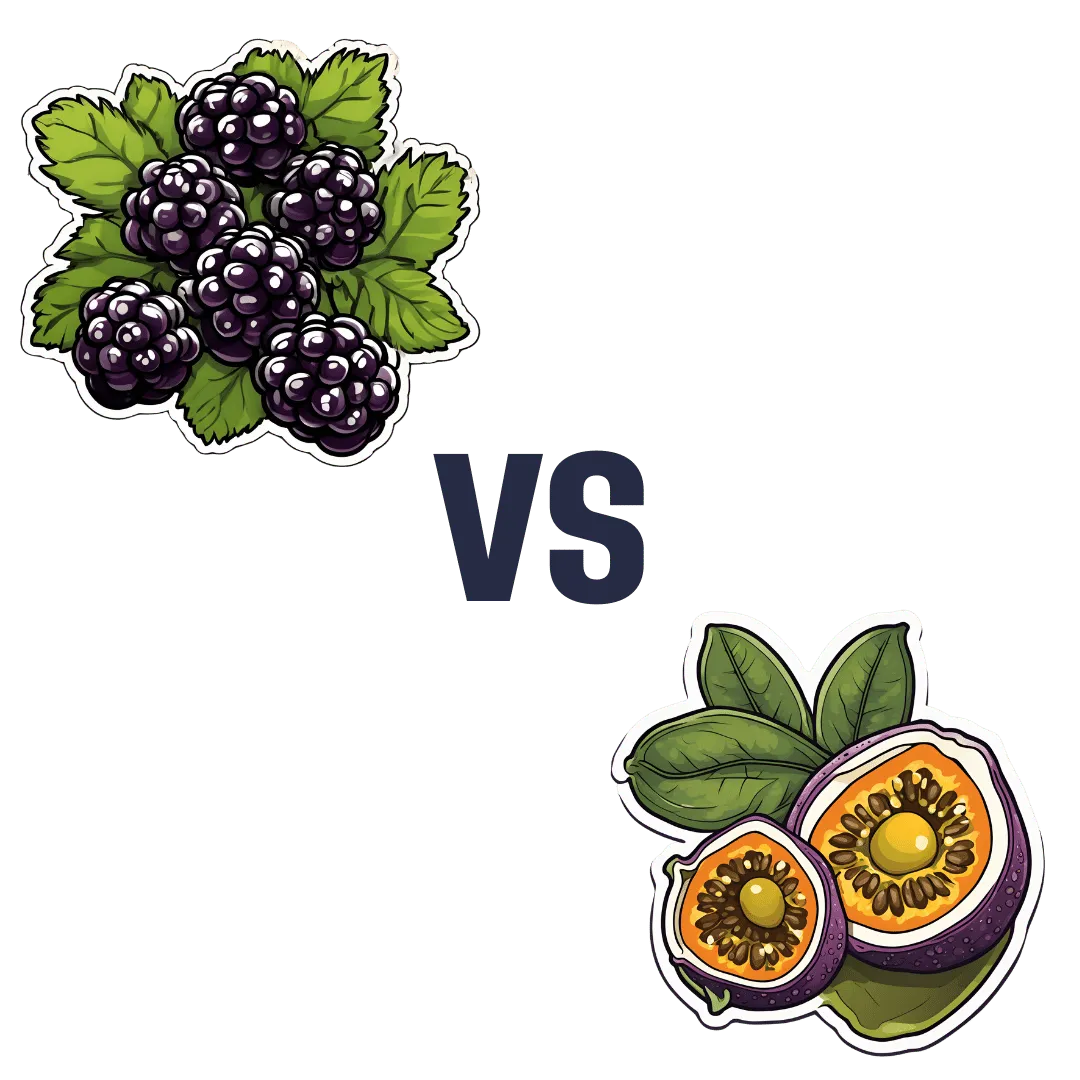
Blackberries vs Passion Fruit – Which is Healthier?
10almonds is reader-supported. We may, at no cost to you, receive a portion of sales if you purchase a product through a link in this article.
Our Verdict
When comparing blackberries to passion fruit, we picked the passion fruit.
Why?
Both are great! But…
In terms of macros, passion fruit has 2x the fiber, as well as more carbs and protein, making it the more macronutrient-dense option and scoring it an easy first-round victory.
In the category of vitamins, blackberries have more of vitamins B9, E, and K, while passion fruit has more of vitamins A, B2, B3, B6, and C, for a modest yet clear win in this round.
Looking at minerals, blackberries have more calcium, copper, and zinc, while passion fruit has more iron, magnesium, phosphorus, potassium, and selenium, winning it its third round in a row.
In other considerations, blackberries do have more polyphenols, so that’s a round to blackberries.
Adding up the sections makes for a clear overall win for passion fruit, but by all means do enjoy either or both, as diversity is best!
Want to learn more?
You might like:
Are You Getting The Right Kinds Of Flavonoids?
Enjoy!
Don’t Forget…
Did you arrive here from our newsletter? Don’t forget to return to the email to continue learning!
Recommended
Learn to Age Gracefully
Join the 98k+ American women taking control of their health & aging with our 100% free (and fun!) daily emails:
-
The Gut Bacteria That Improve Your General Decision-Making In Life
10almonds is reader-supported. We may, at no cost to you, receive a portion of sales if you purchase a product through a link in this article.
As one YouTube commenter said, “Trust your gut, but make sure you have a trustworthy gut first”!
Dr. Tracey Marks, psychiatrist, explains how:
Gut feelings and more
As you probably know, the gut and brain communicate via the vagus nerve, making gut bacteria highly influential.
How influential? Here are some key points from the video:
- Healthier gut bacteria are linked to more cautious risk-taking and future-oriented decisions.
- Gut bacteria influence serotonin (95% produced in the gut), dopamine, and neurotransmitters essential for decision-making.
- People with good gut health prioritize fairness in decision-making.
- The gut influences decision-making via neurotransmitter production, vagus nerve signaling, and inflammation control.
Gut bacteria produce metabolites (beyond the neurotransmitters mentioned above!) that affect nerve circuits for emotion and executive function. These postbiotics (postbiotics = byproducts of gut bacteria fermenting prebiotics) play a crucial role in brain health. Examples of things they make include short-chain fatty acids (butyrate), enzymes, peptides, and vitamins, which between them strengthen gut lining, reduce inflammation, regulate serotonin, and support immune function. Scientists are even exploring postbiotics for treating metabolic and inflammatory diseases.
Timeline of brain-gut axis health improvements
- Days 4–14: gut bacterial composition starts changing (you probably won’t notice anything brainwise, but you may get gas; this is normal and temporary)
- Weeks 2–6: mood and mental clarity improve (you’ll start feeling it here, most likely first in an abstract “life seems more beautiful” sort of way, plus less brain fog)
- Months 2–3: long-term neural adaptations form (this is where the decision-making improvements come in, so you’ll need some patience about this, but the mood boost you’ve now had since weeks 2–6 should make the next bit even easier).
Dr. Marks’ suggestions, to make the most of this:
- Diversify diet: aim for 30* different plant-based foods per week!
- Try fermented foods: start with small amounts of kimchi, kefir, etc.
- Increase fiber intake: add chia seeds or flaxseeds to meals!
- Limit artificial sweeteners: many of them disrupt gut bacteria.
- Maintain regular meal times: supports bacterial circadian rhythms.
- Don’t rely solely on supplements; whole foods are more effective!
*this is not a random number out of a hat; there is science behind the number! Here’s the science.
For more on all of this, enjoy:
Click Here If The Embedded Video Doesn’t Load Automatically!
Want to learn more?
You might also like:
Take care!
Share This Post
-
How We Age: The Science of Longevity – by Dr. Coleen Murphy
10almonds is reader-supported. We may, at no cost to you, receive a portion of sales if you purchase a product through a link in this article.
The author is not a glossy “name brand” and has nothing to sell (besides her book). This shows, because it’s clearly not a book that was rushed out as a marketing ploy. Indeed, she begins with the words:
❝This book took me several years to write and is largely based on information I gathered while teaching my class, “Molecular Mechanisms of Longevity: The Genetics, Genomics, and Cell Biology of Aging,” at Princeton University.❞
~ Dr. Coleen Murphy
Thus, as you may imagine, it’s a thorough book, thoughtful, with conscientious attention to detail. As a reader, you are essentially getting the knowledge of a Princeton genomics class.
She covers what’s going on in our genes, in our cells, and in our bodies, when we age; why some animals don’t, and what things affect that. She talks biomarkers of aging and the industry gold standard “Health-Related Quality of Life” metrics. We learn about insulin signalling and FOXO targets; the role of caloric restriction or intermittent fasting, topics such as molecular homeostasis in the regulation of longevity (hello senolytics and chaperone-mediated autophagy), the microbiome and epigenetics, as well as mitochondrial management, cell replacement (including induced pluripotent stem cells), and even DNA repair. And yes, a lot about cognitive aging and how to slow it too.
The style is academic and/but perfectly readable; she explains everything as we go. We’ll note, though, that it’s not dry academic—her personality comes through throughout, in a good way that makes it a pleasant read as well as an informative one.
Bottom line: if you’d like a much deeper understanding of the mechanics of aging than we have room to get into in our articles at 10almonds, this book is a highly recommendable perfect opportunity.
Click here to check out How We Age, and learn about the science of longevity!
PS: we’ve reviewed a few books about the science of aging/longevity recently, and they’ve each been good, but if you’re going to get only one, we recommend this one, as in this reviewer’s opinion, it’s the best 😎
Share This Post
-
The Well Plated Cookbook – by Erin Clarke
10almonds is reader-supported. We may, at no cost to you, receive a portion of sales if you purchase a product through a link in this article.
Clarke’s focus here is on what she calls “stealthy healthy”, with the idea of dishes that feel indulgent while being great for the health.
The recipes, of which there are well over 100, are indeed delicious and easy to make without being oversimplified, and since she encourages the use of in-season ingredients, many recipes come with a “market swaps” substitution guide, to make each recipe seasonal.
The book is largely not vegetarian, let alone vegan, but the required substitutions will be second-nature to any seasoned vegetarian or vegan. Indeed, “skip the meat sometimes” is one of the advices she offers near the beginning of the book, in the category of tips to make things even healthier.
Bottom line: if you want to add dishes to your repertoire that are great for entertaining and still super-healthy, this book will be a fine addition to your collection.
Click here to check out The Well Plated Cookbook, and get cooking!
Share This Post
Related Posts
-
Ketogenic Diet: Burning Fat Or Burning Out?
10almonds is reader-supported. We may, at no cost to you, receive a portion of sales if you purchase a product through a link in this article.
In Wednesday’s newsletter, we asked you for your opinion of the keto diet, and got the above-depicted, below-described set of responses:
- About 45% said “It has its benefits, but they don’t outweigh the risks”
- About 31% said “It is a good, evidence-based way to lose weight, be energized, and live healthily”
- About 24% said “It is a woeful fad diet and a fast-track to ruining one’s overall health”
So what does the science say?
First, what is the ketogenic diet?
There are two different stories here:
- Per science, it’s a medical diet designed to help treat refractory epilepsy in children.
- Per popular lore, it’s an energizing weight loss diet for Instagrammers and YouTubers.
Can it be both? The answer is: yes, but with some serious caveats, which we’ll cover over the course of today’s feature.
The ketogenic diet works by forcing the body to burn fat for energy: True or False?
True! This is why it helps for children with refractory epilepsy. By starving the body (including the brain) of glucose, the liver must convert fat into fatty acids and ketones, which latter the brain (and indeed the rest of the body) can now use for energy instead of glucose, thus avoiding one of the the main triggers of refractory epilepsy in children.
See: The Ketogenic Diet: One Decade Later | Pediatrics
Even the pediatric epilepsy studies, however, conclude it does have unwanted side effects, such as kidney stones, constipation, high cholesterol, and acidosis:
Source: Dietary Therapies for Epilepsy
The ketogenic diet is good for weight loss: True or False?
True! Insofar as it does cause weight loss, often rapidly. Of course, so do diarrhea and vomiting, but these are not usually held to be healthy methods of weight loss. As for keto, a team of researchers recently concluded:
❝As obesity rates in the populace keep rising, dietary fads such as the ketogenic diet are gaining traction.
Although they could help with weight loss, this study had a notable observation of severe hypercholesterolemia and increased risk of atherosclerotic cardiovascular disease among the ketogenic diet participants.❞
~ Dr. Shadan Khdher et al.
On which note…
The ketogenic diet is bad for the heart: True or False?
True! As Dr. Joanna Popiolek-Kalisz concluded recently:
❝In terms of cardiovascular mortality, the low-carb pattern is more beneficial than very low-carbohydrate (including the ketogenic diet). There is still scarce evidence comparing ketogenic to the Mediterranean diet.
Other safety concerns in cardiovascular patients such as adverse events related to ketosis, fat-free mass loss, or potential pharmacological interactions should be also taken into consideration in future research.❞
~ Dr. Joanna Popiolek-Kalisz
Read in full: Ketogenic diet and cardiovascular risk: state of the art review
The ketogenic diet is good for short-term weight loss, but not long-term maintenance: True or False?
True! Again, insofar as it works in the short term. It’s not the healthiest way to lose weight and we don’t recommend it, but it did does indeed precipitate short-term weight loss. Those benefits are not typically observed for longer than a short time, though, as the above-linked paper mentions:
❝The ketogenic diet does not fulfill the criteria of a healthy diet. It presents the potential for rapid short-term reduction of body mass, triglycerides level, Hb1Ac, and blood pressure.
Its efficacy for weight loss and the above-mentioned metabolic changes is not significant in long-term observations.❞
~ Ibid.
The ketogenic diet is a good, evidence-based way to lose weight, be energized, and live healthily: True or False?
False, simply, as you may have gathered from the above, but we’ve barely scratched the surface in terms of the risks.
That said, as mentioned, it will induce short-term weight loss, and as for being energized, typically there is a slump-spike-slump in energy:
- At first, the body is running out of glucose, and so naturally feels weak and tired.
- Next, the body enters ketosis, and so feels energized and enlivened ← this is the part where the popular enthusiastic reviews come from
- Then, the body starts experiencing all the longer-term problems associated with lacking carbohydrates and having an overabundance of fat, so becomes gradually more sick and tired.
Because of this, the signs of symptoms of being in ketosis (aside from: measurably increased ketones in blood, breath, and urine) are listed as:
- Bad breath
- Weight loss
- Appetite loss
- Increased focus and energy
- Increased fatigue and irritability
- Digestive issues
- Insomnia
The slump-spike-slump we mentioned is the reason for the seemingly contradictory symptoms of increased energy and increased fatigue—you get one and then the other.
Here’s a small but illustrative study, made clearer by its participants being a demographic whose energy levels are most strongly affected by dietary factors:
The ketogenic diet is a woeful fad diet and a fast-track to ruining one’s overall health: True or False?
True, subjectively in the first part, as it’s a little harsher than we usually go for in tone, though it has been called a fad diet in scientific literature. The latter part (ruining one’s overall health) is observably true.
One major problem is incidental-but-serious, which is that a low-carb diet is typically a de facto low-fiber diet, which is naturally bad for the gut and heart.
Other things are more specific to the keto diet, such as the problems with the kidneys:
However, kidney stones aren’t the worst of the problems:
Is Losing Weight Worth Losing Your Kidney: Keto Diet Resulting in Renal Failure
We’re running out of space and the risks associated with the keto diet are many, but for example even in the short term, it already increases osteoporosis risk:
❝Markers of bone modeling/remodeling were impaired after short-term low-carbohydrate high-fat diet, and only one marker of resorption recovered after acute carbohydrate restoration❞
~ Dr. Ida Heikura et al.
A Short-Term Ketogenic Diet Impairs Markers of Bone Health in Response to Exercise
Want a healthier diet?
We recommend the Mediterranean diet.
See also: Four Ways To Upgrade The Mediterranean
(the above is about keeping to the Mediterranean diet, while tweaking one’s choices within it for a specific extra health focus such as an anti-inflammatory upgrade, a heart-healthy upgrade, a gut-healthy upgrade, and a brain-healthy upgrade)
Enjoy!
Don’t Forget…
Did you arrive here from our newsletter? Don’t forget to return to the email to continue learning!
Learn to Age Gracefully
Join the 98k+ American women taking control of their health & aging with our 100% free (and fun!) daily emails:
-
Eye Exercises That Measurably Improve Your Vision
10almonds is reader-supported. We may, at no cost to you, receive a portion of sales if you purchase a product through a link in this article.
Our eyesight, like most of the rest of our body’s functions, will decline if not adequately maintained. Modern lifestyles see most of us indoors for most of the day (which means a reduced maximum focal length) and often looking at screens (even further reduced focal length), which means that part of our eyes responsible for focus will tend to atrophy and wither. And if we want to see something better, we adjust the settings instead of adjusting our eyes. However, it is perfectly possible to recover our clear youthful vision:
See the results for yourself (and see them clearly!)
The exercises that gave him the results he showed between the two tests, are:
- Blink for 30 seconds
- Focus on something in front and (keeping your focus on that stationary point) move your head left & right, upwards & downwards, and diagonally
- Take a break and blink for 30 seconds
- Keep your head still while you move your eyes left & right, upwards & downwards, and diagonally
- Focus on something in front while you move move your head left & right, upwards & downwards, and diagonally
This should temporarily improve your vision immediately, because of what has been going on in the capillaries in and around your eyes, but sustained results require sustained (i.e. daily) practice. This is because the vasculature is only part of the mechanism; it’s also a matter of improving the muscles responsible for focusing the eyes—and like any muscles, it’s not a case of “do it once and enjoy the results forever”. So, even just 2–3 minutes each day is recommended.
For more on all of this plus a visual demonstration, enjoy:
Click Here If The Embedded Video Doesn’t Load Automatically!
Want to learn more?
You might also like to read:
Are Your Glasses Making Your Eyesight Worse?
or, if you are very serious about having excellent vision for life:
Vision for Life, Revised Edition – by Dr. Meir Schneider ← this one’s a book, and a very good one at that
Take care!
Don’t Forget…
Did you arrive here from our newsletter? Don’t forget to return to the email to continue learning!
Learn to Age Gracefully
Join the 98k+ American women taking control of their health & aging with our 100% free (and fun!) daily emails:
-
Yes, you do need to clean your tongue. Here’s how and why
10almonds is reader-supported. We may, at no cost to you, receive a portion of sales if you purchase a product through a link in this article.
Has your doctor asked you to stick out your tongue and say “aaah”? While the GP assesses your throat, they’re also checking out your tongue, which can reveal a lot about your health.
The doctor will look for any changes in the tongue’s surface or how it moves. This can indicate issues in the mouth itself, as well as the state of your overall health and immunity.
But there’s no need to wait for a trip to the doctor. Cleaning your tongue twice a day can help you check how your tongue looks and feels – and improve your breath.
luisrsphoto/Shutterstock What does a healthy tongue look like?
Our tongue plays a crucial role in eating, talking and other vital functions. It is not a single muscle but rather a muscular organ, made up of eight muscle pairs that help it move.
The surface of the tongue is covered by tiny bumps that can be seen and felt, called papillae, giving it a rough surface.
These are sometimes mistaken for taste buds – they’re not. Of your 200,000-300,000 papillae, only a small fraction contain taste buds. Adults have up to 10,000 taste buds and they are invisible to the naked eye, concentrated mainly on the tip, sides and back of the tongue. https://www.youtube.com/embed/uYvpUl7li9Y?wmode=transparent&start=0
A healthy tongue is pink although the shade may vary from person to person, ranging from dark to light pink.
A small amount of white coating can be normal. But significant changes or discolouration may indicate a disease or other issues.
How should I clean my tongue?
Cleaning your tongue only takes around 10-15 seconds, but it’s is a good way to check in with your health and can easily be incorporated into your teeth brushing routine.
Build-up can occur if you stop brushing or scraping your tongue even for a few days. Anthony Shkraba/Pexels You can clean your tongue by gently scrubbing it with a regular toothbrush. This dislodges any food debris and helps prevent microbes building up on its rough textured surface.
Or you can use a special tongue scraper. These curved instruments are made of metal or plastic, and can be used alone or accompanied by scrubbing with your toothbrush.
Your co-workers will thank you as well – cleaning your tongue can help combat stinky breath. Tongue scrapers are particularly effective at removing the bacteria that commonly causes bad breath, hidden in the tongue’s surface.
What’s that stuff on my tongue?
So, you’re checking your tongue during your twice-daily clean, and you notice something different. Noting these signs is the first step. If you observe any changes and they worry you, you should talk to your GP.
Here’s what your tongue might be telling you.
White coating
Developing a white coating on the tongue’s surface is one of the most common changes in healthy people. This can happen if you stop brushing or scraping the tongue, even for a few days.
In this case, food debris and microbes have accumulated and caused plaque. Gentle scrubbing or scraping will remove this coating. Removing microbes reduces the risk of chronic infections, which can be transferred to other organs and cause serious illnesses.
Scrubbing or scraping your tongue only takes around ten seconds and can be done while brushing your teeth. Ketut Subiyanto/Pexels Yellow coating
This may indicate oral thrush, a fungal infection that leaves a raw surface when scrubbed.
Oral thrush is common in elderly people who take multiple medications or have diabetes. It can also affect children and young adults after an illness, due to the temporary suppression of the immune system or antibiotic use.
If you have oral thrush, a doctor will usually prescribe a course of anti-fungal medication for at least a month.
Black coating
Smoking or consuming a lot of strong-coloured food and drink – such as tea and coffee, or dishes with tumeric – can cause a furry appearance. This is known as a black hairy tongue. It’s not hair, but an overgrowth of bacteria which may indicate poor oral hygiene.
Smoking can add to poor oral hygiene and make the tongue look black. Sophon Nawit/Shutterstock Pink patches
Pink patches surrounded by a white border can make your tongue look like a map – this is called “geographic tongue”. It’s not known what causes this condition, which usually doesn’t require treatment.
Pain and inflammation
A red, sore tongue can indicate a range of issues, including:
- nutritional deficiencies such as folic acid or vitamin B12
- diseases including pernicious anaemia, Kawasaki disease and scarlet fever
- inflammation known as glossitis
- injury from hot beverages or food
- ulcers, including cold sores and canker sores
- burning mouth syndrome.
Dryness
Many medications can cause dry mouth, also called xerostomia. These include antidepressants, anti-psychotics, muscle relaxants, pain killers, antihistamines and diuretics. If your mouth is very dry, it may hurt.
What about cancer?
White or red patches on the tongue that can’t be scraped off, are long-standing or growing need to checked out by a dental professional as soon as possible, as do painless ulcers. These are at a higher risk of turning into cancer, compared to other parts of the mouth.
Oral cancers have low survival rates due to delayed detection – and they are on the rise. So checking your tongue for changes in colour, texture, sore spots or ulcers is critical.
Dileep Sharma, Professor and Head of Discipline – Oral Health, University of Newcastle
This article is republished from The Conversation under a Creative Commons license. Read the original article.
Don’t Forget…
Did you arrive here from our newsletter? Don’t forget to return to the email to continue learning!
Learn to Age Gracefully
Join the 98k+ American women taking control of their health & aging with our 100% free (and fun!) daily emails:


