
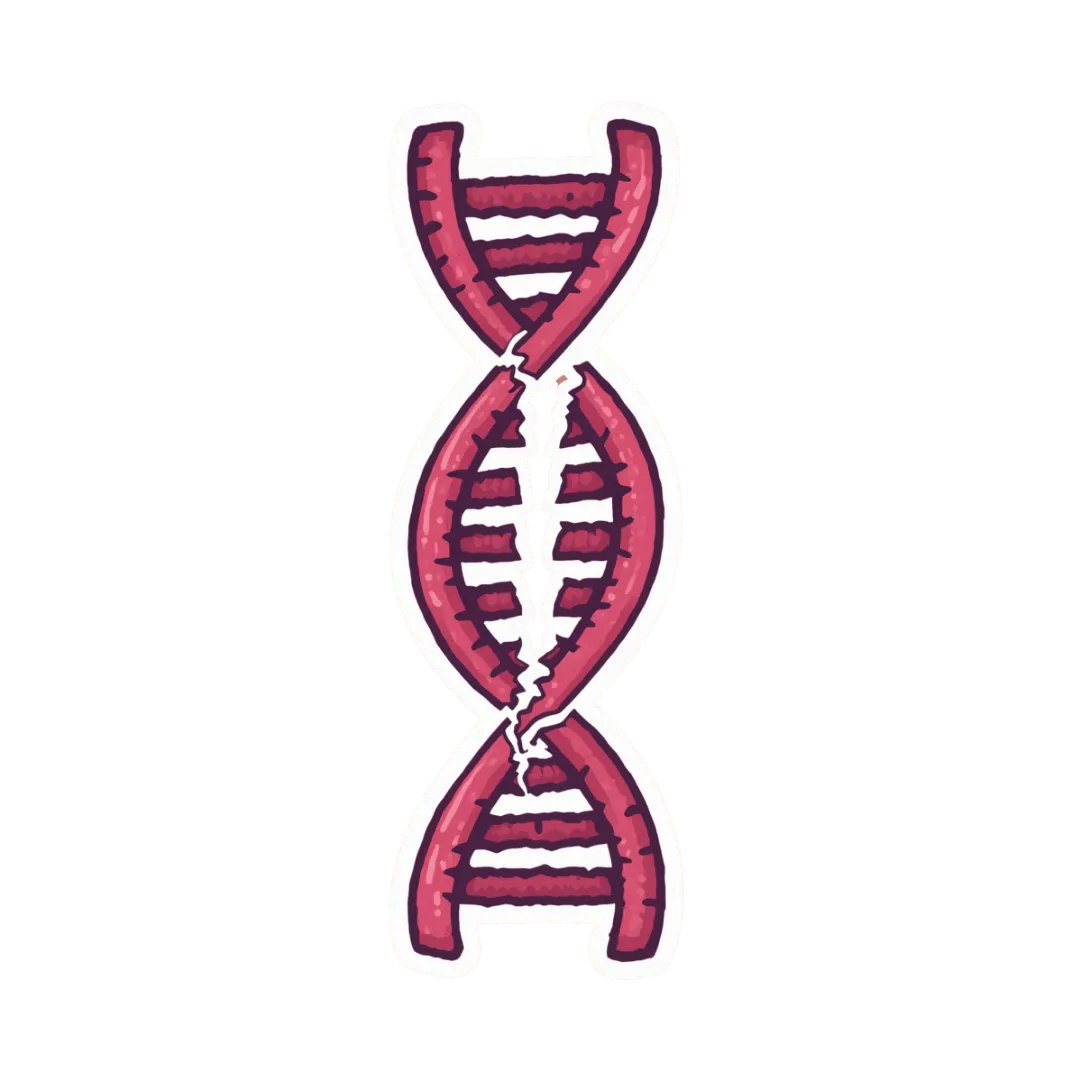
What Happens When Your DNA Is Damaged?
10almonds is reader-supported. We may, at no cost to you, receive a portion of sales if you purchase a product through a link in this article.

Dr. Monica Menesini shows us what’s going on:
The daily onslaught
The DNA of any given living cell in a human body is damaged tens of thousands of times per day. Across your body’s cells, this amounts to an enormous number of DNA errors every day. This damage is varied in its effects; it can affect nucleotides (the “building blocks” of DNA), cause incorrect base pairings and mutations, create breaks in one or both DNA strands, and/or even rearrange sections of DNA.
While that does happen in all living cells, it definitely happens to some more than others, because DNA can also be damaged after replication by environmental substances, such as compounds in tobacco smoke, and naturally occurring molecules inside your cells, such as hydrogen peroxide. When a single DNA base is chemically damaged, base excision repair can remove the damaged base, trim the surrounding DNA, and replace the affected nucleotides. UV light can cause adjacent nucleotides to bond together, distorting the DNA double helix. Nucleotide excision repair removes a longer section of roughly 24 nucleotides and replaces it with undamaged DNA.
Other damage can be more complicated; for example, high-frequency radiation, including gamma rays and x-rays, can break one or both DNA strands. Double-strand breaks are particularly dangerous and can cause cell death.
There are things the body can do about it, though, for example:
- Homologous recombination: one major repair pathway uses an undamaged, similar DNA sequence as a template to accurately reconstruct the damaged section.
- Non-homologous end joining: another pathway directly reconnects broken DNA ends without using a template. It is less accurate and can sometimes rearrange or disrupt genes, but it can repair breaks when a matching DNA template is unavailable.
It’s also worth noting that defects in DNA repair are associated with premature aging and many types of cancer, so this is quite important.
For more on all of this, enjoy:
Click Here If The Embedded Video Doesn’t Load Automatically!
Want to learn more?
You might also like:
What Melatonin Does To Your DNA
Take care!
Don’t Forget…
Did you arrive here from our newsletter? Don’t forget to return to the email to continue learning!

Learn to Age Gracefully
Join the 98k+ American women taking control of their health & aging with our 100% free (and fun!) daily emails: