
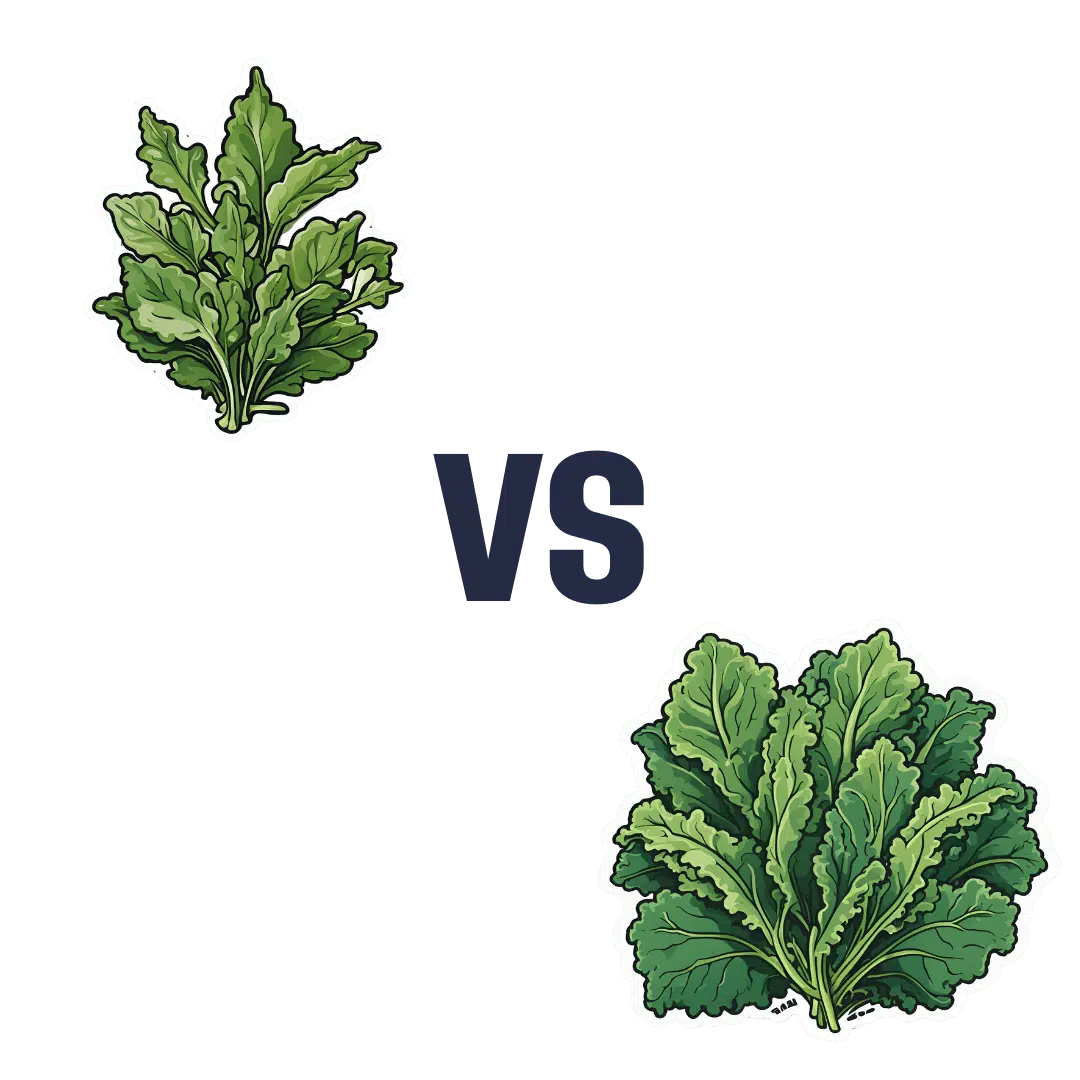
Dandelion Greens vs Kale – Which is Healthier?
10almonds is reader-supported. We may, at no cost to you, receive a portion of sales if you purchase a product through a link in this article.

Our Verdict
When comparing dandelion greens to kale, we picked the kale.
Why?
Both are great, and…
Long-time 10almonds readers with a good memory may now be wondering: wait a minute, how is this possible; didn’t dandelion greens beat collard greens which beat kale?
And yes, those are all true claims; there’s a sort of rock-paper-scissors thing going on here.
While at first glance this seems like a paradox, it’s actually because of how we look at the different categories (macros, vitamins, minerals, other) and tot up the scores within those sections to see which wins each section, and add up the section wins to declare a winner. This means that if one option is higher in some vitamins but lower in others, the question of which ones it’s better or worse in won’t change the score, but can make a big difference to whether it beats something else, which may or may not be stronger or weaker in those specific vitamins. And so on for each category.
And this, dear reader, is another reason why it’s important to get not just a nutrient-dense diet, but also a varied one! You can’t just eat the top 3 healthiest things and consider your diet optimized; it doesn’t work like that.
With all that now in mind, let’s get on to the details of today’s comparison:
In terms of macros, the only difference is that kale has a touch more protein; the numbers are small, because well, it’s leaves, but this is a slender nominal win for kale, or else a tie in this category.
In the category of vitamins, dandelion greens have more of vitamins B1, B2, and E, while kale has more of vitamins B3, B5, B6, B7, B9, and C, scoring an easy second-round win.
Looking at minerals, dandelion greens have more calcium and iron, while kale has more copper, magnesium, manganese, phosphorus, potassium, selenium, and zinc, sweeping this round as well.
In other consideration, both are very abundant in polyphenols, and we must consider this category a tie.
Adding up the sections makes for a clear overall win for kale, but by all means do enjoy either or both as, it bears repeating, diversity really is best!
Want to learn more?
You might like:
What’s Your Plant Diversity Score? ← another reason (different from the above reason) that it’s good to mix things up rather than just using the same ingredients out of habit!
Enjoy!
Don’t Forget…
Did you arrive here from our newsletter? Don’t forget to return to the email to continue learning!
Recommended
Learn to Age Gracefully
Join the 98k+ American women taking control of their health & aging with our 100% free (and fun!) daily emails: