
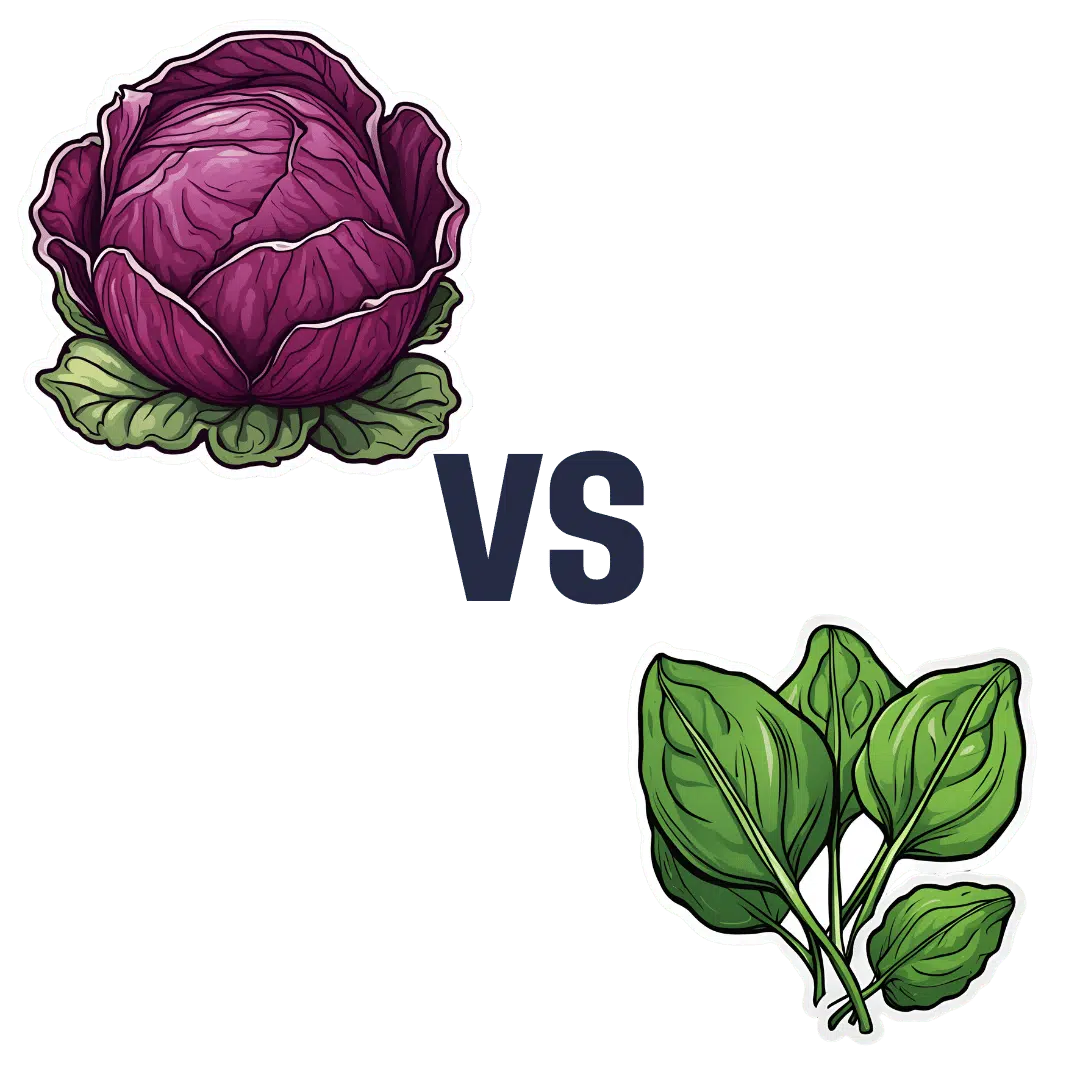
Red Cabbage vs Spinach – Which is Healthier?
10almonds is reader-supported. We may, at no cost to you, receive a portion of sales if you purchase a product through a link in this article.

Our Verdict
When comparing red cabbage to spinach, we picked the spinach.
Why?
We recently compared [white] cabbage to spinach, and spinach won, so it was interesting to see whether it being red cabbage would tip the scales. It didn’t.
In terms of macros, these are once again very similar: mostly water, small amounts of carbs and protein, and enough fiber to hold them together. Nominally, red cabbage has very slightly more carbs and spinach has very slightly more protein, but the numbers are so low in both cases as to render this category still a tie in our regard, for all practical purposes. A purist argument could be made to call it a win for spinach, though.
In the category of vitamins, it’s only slightly less imbalanced than it was for white cabbage vs spinach; red cabbage has more of vitamins B5, B5, and C, while spinach has more of vitamins A, B1, B2, B3, B7, B9, E, K, and choline; a clear win for spinach.
When it comes to minerals, cabbage is once again not higher in any minerals, and spinach has more calcium, copper, iron, magnesium, manganese, phosphorus, potassium, selenium, and zinc. Another easy win for spinach.
With regard to phytochemicals, red cabbage fared better than white cabbage did, but spinach still has a much higher polyphenol content (mostly flavonols), and on the flipside, spinach has a much higher oxalate content (that’s not a problem for most people, but bad if you have certain kidney issues). So this category could be swung any which way depending on the state of your kidneys. For simplicity, we’ll record this round as a tie, but its constituent parts are worth bearing in mind.
Adding up the sections makes for an overall win for spinach, but by all means enjoy either or both; diversity is good, and cabbage of any kind is always a nutritional powerhouse; it just looks bad standing next to spinach!
Want to learn more?
You might like:
21 Most Beneficial Polyphenols & What Foods Have Them
Enjoy!
Don’t Forget…
Did you arrive here from our newsletter? Don’t forget to return to the email to continue learning!
Recommended
Learn to Age Gracefully
Join the 98k+ American women taking control of their health & aging with our 100% free (and fun!) daily emails: