
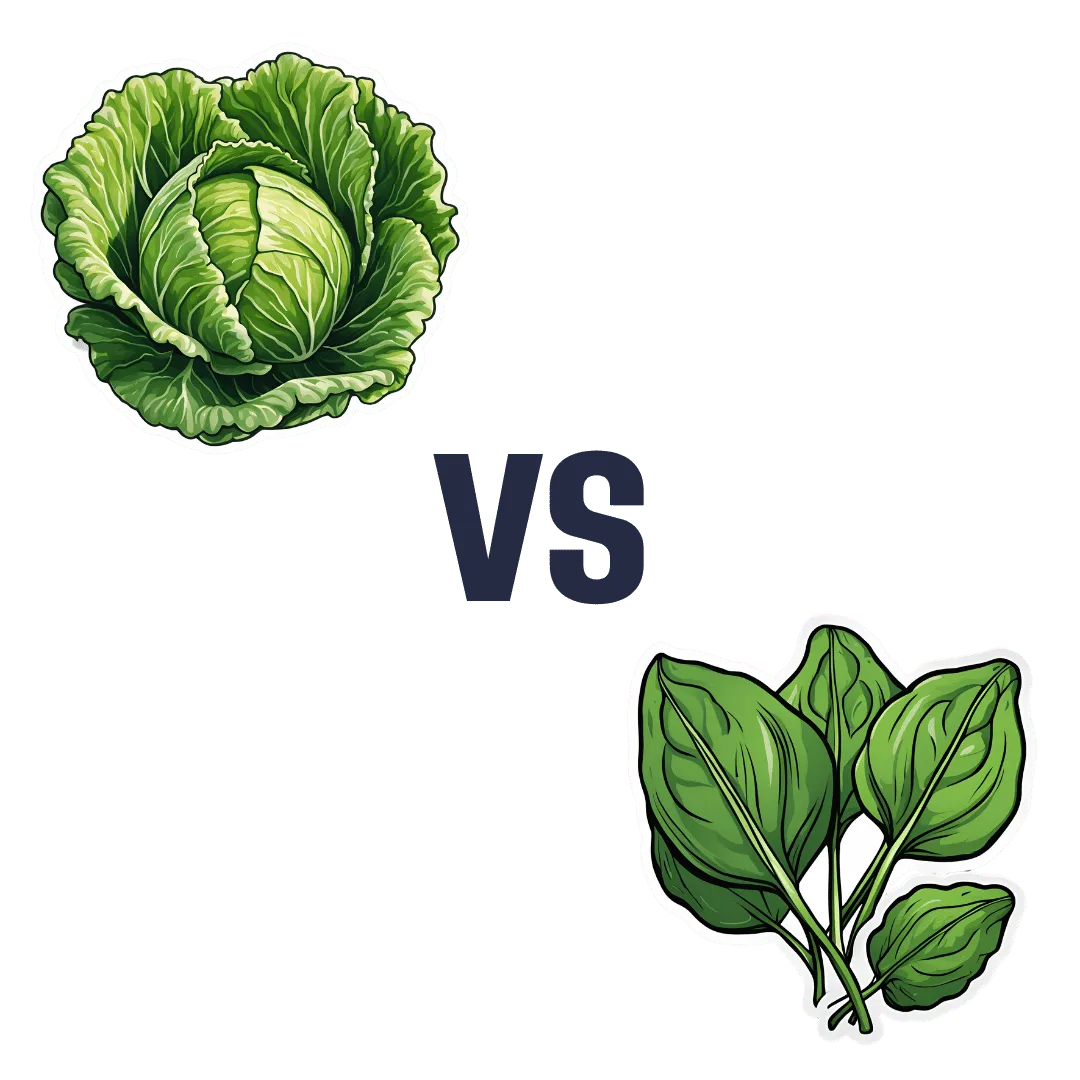
Cabbage vs Spinach – Which is Healthier?
10almonds is reader-supported. We may, at no cost to you, receive a portion of sales if you purchase a product through a link in this article.
Our Verdict
When comparing cabbage to spinach, we picked the spinach.
Why?
Why, oh why indeed? ← lamentations of this cabbage-loving writer
But more seriously:
In terms of macros, these are very similar: mostly water, small amounts of carbs and protein, and enough fiber to hold them together. The only notable point of distinction here is that cabbage higher in soluble fiber, while spinach has more insoluble fiber, however these are both important, just different, and ultimately balanced in any case, so we’ll call this round a tie.
In the category of vitamins, cabbage has more of vitamins B5 and C, while spinach has more of vitamins A, B1, B2, B3, B6, B7, B9, E, K, and choline; a clear win for spinach.
When it comes to minerals, cabbage is not higher in any minerals, and spinach has more calcium, copper, iron, magnesium, manganese, phosphorus, potassium, selenium, and zinc. Another easy win for spinach.
With regard to phytochemicals, spinach has a much higher polyphenol content (mostly flavonols), and on the flipside, spinach has a much higher oxalate content (that’s not a problem for most people, but bad if you have certain kidney issues). So this category could be swung any which way depending on the state of your kidneys. For simplicity, we’ll record this round as a tie, but its constituent parts are worth bearing in mind.
Adding up the sections makes for an overall win for spinach, but by all means enjoy either or both; diversity is good!
Want to learn more?
You might like:
What Do The Different Kinds Of Fiber Do? 30 Foods That Rank Highest
Enjoy!
Don’t Forget…
Did you arrive here from our newsletter? Don’t forget to return to the email to continue learning!
Recommended
Learn to Age Gracefully
Join the 98k+ American women taking control of their health & aging with our 100% free (and fun!) daily emails:
-
Glycine: The Cheapest Anti-Aging Supplement That Actually Works
10almonds is reader-supported. We may, at no cost to you, receive a portion of sales if you purchase a product through a link in this article.
Dr. Leonid Kim explains glycine’s role in anti-aging:
The essential non-essential
Glycine is a “non-essential” amino acid (i.e., our body is able to synthesize it, so we don’t die quickly and horribly if it’s not in our diet, which is what happens if “essential” amino acids are missing) that’s nonetheless essential (in the sense of being necessary) for many things including collagen formation, liver support, neurotransmitter regulation, and glutathione production, which latter protects your cells from oxidative stress and mitochondrial damage—in other words, aging.
A quick side-note about glutathione: glutathione is made from glutamate, cysteine, and glycine; glycine and cysteine are often rate-limiting, so low levels of either can reduce your antioxidant capacity
And a side-side-note about cysteine: cysteine is unstable and often in short supply during stress or illness; n-acetylceysteine (NAC) delivers usable cysteine, allowing glycine to complete glutathione synthesis—this is why the combined approach (glyNAC) is sometimes preferred.
That said, glycine alone is typically enough for healthy younger people using it mainly for sleep, while glyNAC may be more appropriate if you have insulin resistance, diabetes, fatty liver, PCOS, high blood pressure, high cholesterol, chronic inflammation, or an autoimmune condition.
As for what to expect:
- Metabolic and anti-inflammatory actions: evidence suggests glycine can help with inflammation and can even become conditionally essential during metabolic disease in particular, illness in general, and/or chronic inflammation. Glycine levels also tend to be lower in people with insulin resistance or other metabolic syndrome considerations, so may benefit extra from supplementing in those cases, too.
- Sleep effects: glycine before bed can improve sleep quality by helping you fall asleep more quickly, cooling your core temperature, calming orexin (wakefulness) receptor neurons, regulating serotonin, and supporting full muscle relaxation during REM sleep, for greater restfulness.
As for dosing if doing it one way or the other:
- Dosing for glycine: the most studied dose is 3 g taken 30–60 minutes before sleep; it tastes sweet, dissolves easily in water, and is generally well tolerated; very high doses used in schizophrenia studies (40–90 g per day) looked tolerable short-term but aren’t advisable due to unclear long-term safety and possible neurobehavioral or cardiovascular concerns.
- Dosing for glyNAC: published human studies typically use 100 mg/kg glycine + 100 mg/kg NAC per day (about 7 g of each for a 70-kg person), usually split into two doses; many people start around 3 g per day and increase slowly.
For more on all of this, enjoy:
Click Here If The Embedded Video Doesn’t Load Automatically!
Want to learn more?
You might also like:
- The Sweet Truth About Glycine
- N-Acetyl Cysteine For The Liver & More
- Why You Can’t Skimp On Amino Acids
Take care!
Share This Post
-
If You Have 60 Days To Get Lean…
10almonds is reader-supported. We may, at no cost to you, receive a portion of sales if you purchase a product through a link in this article.
…then this is how:
Getting it right
If you have 60 days in which to get lean… Then probably you don’t, really. There will be more time following those 60 days. Unless you’re going to die in 60 days, in which case, is getting lean really your priority?
But let’s say that, in 60 days, you pressingly want to look a certain way in a bikini, or slide under a certain body metric to access a certain gatekept-by-size medical treatment, that kind of thing.
How to do it?
First, understand that your expected rate of fat loss depends on how much body fat you currently have, with higher body fat allowing faster loss and lower body fat needing slower, smaller deficits.
On that note: since since 1 lb of fat ≈ 3,500 calories, a daily deficit of 500 calories typically leads to 1 lb/week loss, with smaller or larger deficits scaling proportionally, up to a point.
You reasonably might, for example, aim to lose around 0.5–1% of your body weight per week, with 0.75% being a good balance for preserving muscle while losing fat.
With that in mind, set a rough 12-week goal (e.g: 8–12 lb for a moderate starting point) but stay flexible if you reach a body composition you’re happy with earlier.
Some considerations as you go:
- Protein and food quality: base meals around protein (0.75–1 g per lb body weight) and include plenty of fruits and vegetables to improve fullness, fiber intake, and hunger control.
- Movement in general: fat loss comes from a calorie deficit, but adding activity like walking reduces how much you need to cut from food and thus improves sustainability.
- Cardio specifically: prioritize low-impact, consistent cardio, choosing forms you can realistically stick to (i.e. whether that’s HIIT or longer cardio; HIIT is technically better, but only if you actually do it!).
- Resistance training: include strength training to maintain or build muscle, which improves your metabolism overall and prevents a “skinny fat” situation.
- Track your progress: monitor changes using daily weigh-ins (averaged weekly), progress photos, measurements, and/or how your clothes fit to get a clearer picture than weight alone.
- Expect fluctuations: expect normal weight changes (e.g. due to hormonal cycles or water retention), so rely on looking at the bigger picture of your data trends, rather than day-to-day scale readings.
Speaking of the bigger picture: do note that if your goal weight isn’t maintainable, it’s better to settle at a slightly higher, sustainable weight than to rebound and stressfully despair.
Lastly, remember that effective fat loss should improve your health and quality of life, not come at the cost of it.
For more on all of this, enjoy:
Click Here If The Embedded Video Doesn’t Load Automatically!
Want to learn more?
You might also like:
How To Lose Weight (Healthily!) ← our own main feature on this topic
Take care!
Share This Post
-
10 Great Exercises to Improve Your Eyesight
10almonds is reader-supported. We may, at no cost to you, receive a portion of sales if you purchase a product through a link in this article.
If your eyesight has been declining a bit, all is not lost. Just like many other muscles in the body, the muscles of the eye—including those responsible for changing the focal length of your vision—can atrophy without exercise. So, without further ado, here are the exercises recommended:
The eyes (still) have it
- Blink for a minute: blink rapidly for 30–60 seconds to regulate blood circulation, lubricate your eyes, and prevent dryness.
- Rotate your head while staring ahead: turn your head in a circular motion while keeping your gaze straight ahead. This improves blood circulation to your eyes.
- Look to your right and left: slowly move your gaze from right to left while breathing. This one relaxes and stretches the eye muscles.
- Close your eyes and relax: close your eyes for at least 30 seconds to relax and strengthen your photoreceptor cells.
- Move your gaze in different directions: shift your gaze right-left, up-down, in circular motions, and trace a figure 8 with your eyes. This improves visual perception for both near- and far-sightedness.
- Close and open your eyes: tighten your eyes shut for 3–5 seconds, then open them. Repeat seven times to improve blood circulation and relax your eye muscles. ← 10almonds note: the duration makes this different from #4, so do try both!
- Push against your temples with your fingers: gently press your temples with your fingers for two seconds, then release. Repeat 4–5 times to improve fluid circulation in your eyes.
- Draw geometric figures with your gaze: use your eyes to trace shapes such as triangles, squares, and circles to enhance your eye coordination and muscle strength.
- Move your eyeballs up and down: close your eyes and slowly move your eyeballs up and down five times to stretch and relax the muscles ← 10almonds note: this seems to be the same as part of #5 and has a considerable overlap with #8, but we’re listing it anyway, or else everyone will wonder where #9 went!
- Strengthen near and far focusing: focus on your thumb 10 inches away for 10–15 seconds, then switch focus to an object 10–20 feet away. Repeat five times to improve focus adjustment ability.
By practicing these exercises daily, we are told that you can improve eye health and vision within a week.
For more on all these, plus visual demonstrations, enjoy:
Click Here If The Embedded Video Doesn’t Load Automatically!
Want to learn more?
You might also like to read:
Vision for Life, Revised Edition – by Dr. Meir Schneider
Take care!
Share This Post
Related Posts
-
Self-Compassion – by Dr. Kristin Neff
10almonds is reader-supported. We may, at no cost to you, receive a portion of sales if you purchase a product through a link in this article.
A lot of people struggle with self-esteem, and depending on one’s surrounding culture, it can even seem socially obligatory to be constantly valuing oneself highly (or else, who else will if we do not?). But, as Dr. Neff points out, there’s an inherent problem with reinforcing for oneself even a positive message like “I am smart, strong, and capable!” because sometimes all of us have moments of being stupid, weak, and incapable (occasionally all three at once!), which places us in a position of having to choose between self-deceit and self-deprecation, neither of which are good.
Instead, Dr. Neff advocates for self-compassion, for treating oneself as one (hopefully) would a loved one—seeing their/our mistakes, weaknesses, failures, and loving them/ourself anyway.
She does not, however, argue that we should accept just anything from ourselves uncritically, but rather, we identify our mistakes, learn, grow, and progress. So not “I should have known better!”, nor even “How was I supposed to know?!”, but rather, “Now I have learned a thing”.
The style of the book is quite personal, as though having a heart-to-heart over a hot drink perhaps, but the format is organized and progresses naturally from one idea to the next, taking the reader to where we need to be.
Bottom line: if you have trouble with self-esteem (as most people do), then that’s a trap that there is a way out of, and it doesn’t require being perfect or lowering one’s standards, just being kinder to oneself along the way—and this book can help inculcate that.
Click here to check out Self-Compassion, and indeed be kind to yourself!
Don’t Forget…
Did you arrive here from our newsletter? Don’t forget to return to the email to continue learning!
Learn to Age Gracefully
Join the 98k+ American women taking control of their health & aging with our 100% free (and fun!) daily emails:
-
What Happens To Your Body When You Plank 1 Minute Every Day
10almonds is reader-supported. We may, at no cost to you, receive a portion of sales if you purchase a product through a link in this article.
Planks improve strength, flexibility, balance, posture, reduce chronic back pain, lower blood pressure, and enhance physique. But can we really get benefits from just 1 minute per day?
To the core
The benefits that can be expected, according to the science cited in this video, include:
- Within 2–3 weeks, daily planking of just 1 minute per day activates deep core muscles, enhancing balance, which helps in everyday tasks and prevents muscle imbalances.
- Strengthening core muscles through planks also helps alleviate lower back pain, with research supporting its effectiveness within 3 weeks.
- Posture is important for good health, and planks align the spine and hips, improving posture naturally, which also helps alleviate back issues. So, there’s a good kind of synergy to this exercise.
- Of course, many people exercising have the goal of a more toned body; regular planking leads to a toned core, sculpted shoulders, and leaner legs.
- For those who care more about mobility, though, planking enhances flexibility in hamstrings, feet, and toes within 4–6 weeks.
- Anything else? Yes, isometric exercises like planks are highly effective at reducing blood pressure, and, counterintuitively, more so than aerobic exercises.
The video also looks at a study in which participants did 20 minutes per day instead of 1, which predictably also significantly improved strength, endurance, flexibility, and reduced body fat.
However, another study cited gives the stats for just 1 minute daily, and that was not even a whole minute, so much as 30 seconds hold, 1 minute rest, 30 seconds hold—and still showed very good improvements.
For more on all this, plus links to three studies mentioned in the video, enjoy:
Click Here If The Embedded Video Doesn’t Load Automatically!
Want to learn more?
You might also like to read:
Isometric Exercises That Are Good If You Have Osteoporosis (or if you don’t, but the point is, they are safe and beneficial for people with osteoporosis)
Take care!
Don’t Forget…
Did you arrive here from our newsletter? Don’t forget to return to the email to continue learning!
Learn to Age Gracefully
Join the 98k+ American women taking control of their health & aging with our 100% free (and fun!) daily emails:
-
Why do some people’s hair and nails grow quicker than mine?
10almonds is reader-supported. We may, at no cost to you, receive a portion of sales if you purchase a product through a link in this article.
Throughout recorded history, our hair and nails played an important role in signifying who we are and our social status. You could say, they separate the caveman from businessman.
It was no surprise then that many of us found a new level of appreciation for our hairdressers and nail artists during the COVID lockdowns. Even Taylor Swift reported she cut her own hair during lockdown.
So, what would happen if all this hair and nail grooming got too much for us and we decided to give it all up. Would our hair and nails just keep on growing?
The answer is yes. The hair on our head grows, on average, 1 centimeter per month, while our fingernails grow an average of just over 3 millimetres.
When left unchecked, our hair and nails can grow to impressive lengths. Aliia Nasyrova, known as the Ukrainian Rapunzel, holds the world record for the longest locks on a living woman, which measure an impressive 257.33 cm.
When it comes to record-breaking fingernails, Diana Armstrong from the United States holds that record at 1,306.58 cm.
Most of us, however, get regular haircuts and trim our nails – some with greater frequency than others. So why do some people’s hair and nails grow more quickly?
Jari Lobo/Pexels Remind me, what are they made out of?
Hair and nails are made mostly from keratin. Both grow from matrix cells below the skin and grow through different patterns of cell division.
Nails grow steadily from the matrix cells, which sit under the skin at the base of the nail. These cells divide, pushing the older cells forward. As they grow, the new cells slide along the nail bed – the flat area under the fingernail which looks pink because of its rich blood supply.
Nails, like hair, are made mostly of keratin. Scott Gruber/Unsplash A hair also starts growing from the matrix cells, eventually forming the visible part of the hair – the shaft. The hair shaft grows from a root that sits under the skin and is wrapped in a sac known as the hair follicle.
This sac has a nerve supply (which is why it hurts to pull out a hair), oil-producing glands that lubricate the hair and a tiny muscle that makes your hair stand up when it’s cold.
At the follicle’s base is the hair bulb, which contains the all-important hair papilla that supplies blood to the follicle.
Matrix cells near the papilla divide to produce new hair cells, which then harden and form the hair shaft. As the new hair cells are made, the hair is pushed up above the skin and the hair grows.
But the papilla also plays an integral part in regulating hair growth cycles, as it sends signals to the stem cells to move to the base of the follicle and form a hair matrix. Matrix cells then get signals to divide and start a new growth phase.
Unlike nails, our hair grows in cycles
Scientists have identified four phases of hair growth, the:
- anagen or growth phase, which lasts between two and eight years
- catagen or transition phase, when growth slows down, lasting around two weeks
- telogen or resting phase, when there is no growth at all. This usually lasts two to three months
- exogen or shedding phase, when the hair falls out and is replaced by the new hair growing from the same follicle. This starts the process all over again.
Hair follicles enter these phases at different times so we’re not left bald. Mosterpiece/Shutterstock Each follicle goes through this cycle 10–30 times in its lifespan.
If all of our hair follicles grew at the same rate and entered the same phases simultaneously, there would be times when we would all be bald. That doesn’t usually happen: at any given time, only one in ten hairs is in the resting phase.
While we lose about 100–150 hairs daily, the average person has 100,000 hairs on their head, so we barely notice this natural shedding.
So what affects the speed of growth?
Genetics is the most significant factor. While hair growth rates vary between individuals, they tend to be consistent among family members.
Nails are also influenced by genetics, as siblings, especially identical twins, tend to have similar nail growth rates.
Genetics have the biggest impact on growth speed. Cottonbro Studio/Pexels But there are also other influences.
Age makes a difference to hair and nail growth, even in healthy people. Younger people generally have faster growth rates because of the slowing metabolism and cell division that comes with ageing.
Hormonal changes can have an impact. Pregnancy often accelerates hair and nail growth rates, while menopause and high levels of the stress hormone cortisol can slow growth rates.
Nutrition also changes hair and nail strength and growth rate. While hair and nails are made mostly of keratin, they also contain water, fats and various minerals. As hair and nails keep growing, these minerals need to be replaced.
That’s why a balanced diet that includes sufficient nutrients to support your hair and nails is essential for maintaining their health.
Nutrition can impact hair and nail growth. Cottonbro Studio/Pexels Nutrient deficiencies may contribute to hair loss and nail breakage by disrupting their growth cycle or weakening their structure. Iron and zinc deficiencies, for example, have both been linked to hair loss and brittle nails.
This may explain why thick hair and strong, well-groomed nails have long been associated with perception of good health and high status.
However, not all perceptions are true.
No, hair and nails don’t grow after death
A persistent myth that may relate to the legends of vampires is that hair and nails continue to grow after we die.
In reality, they only appear to do so. As the body dehydrates after death, the skin shrinks, making hair and nails seem longer.
Morticians are well aware of this phenomenon and some inject tissue filler into the deceased’s fingertips to minimise this effect.
So, it seems that living or dead, there is no escape from the never-ending task of caring for our hair and nails.
Michelle Moscova, Adjunct Associate Professor, Anatomy, UNSW Sydney
This article is republished from The Conversation under a Creative Commons license. Read the original article.
Don’t Forget…
Did you arrive here from our newsletter? Don’t forget to return to the email to continue learning!
Learn to Age Gracefully
Join the 98k+ American women taking control of their health & aging with our 100% free (and fun!) daily emails:


