
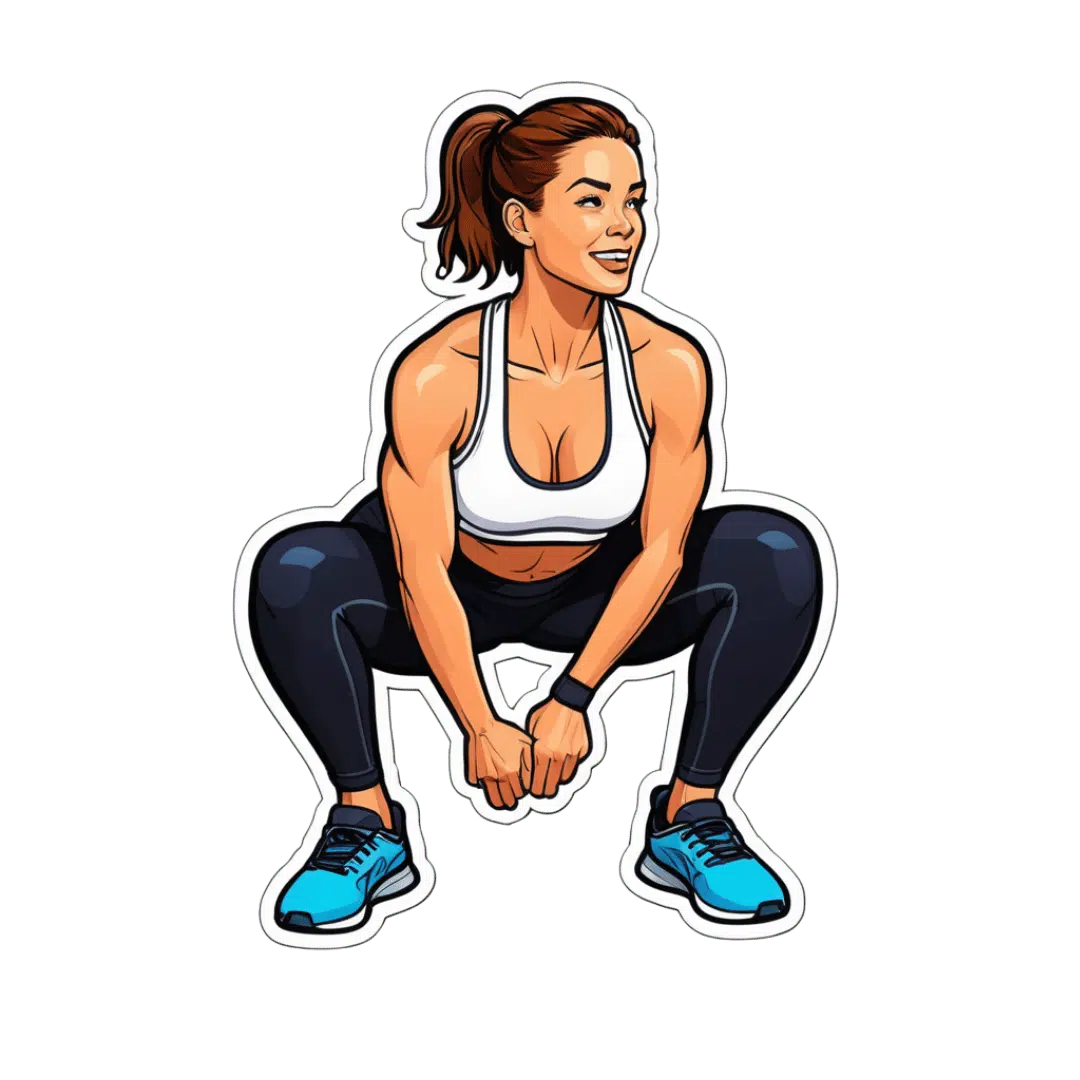
Are Squats the Ultimate Game-Changer?
10almonds is reader-supported. We may, at no cost to you, receive a portion of sales if you purchase a product through a link in this article.

Dr. Jess Grochowsky, PT, DPT, MTC, CLT, CMPTP, says the answer is yes, and here’s why:
The most complete exercise
Squats are a powerful full-body exercise that targets legs, core, and (when weights are used) upper body. All in all, they enhance strength, mobility, metabolism, and joint health, making them essential for longevity and maintaining quality of movement throughout life.
In particular, they allow a much greater range of movement through more dimensions than most exercises do, meaning that (unlike a lot of more linear exercises) they build functional strength that sees us well in everyday life—mobility, joint control, and muscle stability.
Proper Squat Technique:
- The squat involves lowering the center of mass (which is slightly behind your navel and slightly down; exact position depends on your body composition and proportions) toward the floor.
- Use the “head to hips” principle to maintain a straight spine: as the head moves forward, the hips go back.
- Different foot positions (sumo, narrow, etc) target various muscles.
4 key variables to adjust squats:
- Base of support: the surface you stand on (firm vs unstable like a Bosu ball) affects stability and muscle engagement.
- Foot position: wide stances increase stability and target inner thighs and glutes; narrow stances focus more on quads.
- Weights: can use free weights, kettlebells, or bars. Adding weights increases intensity and can incorporate upper body exercises (e.g. bicep curls, overhead presses, etc).
- Squat depth: ranges from partial to deep squats, depending on functional goals.
Types of squats and variations given in the video:
- Firm surface squats: provide stability and allow even weight distribution.
- Unstable surface squats: engage smaller stabilizing muscles.
- Yoga ball squats: shift the center of mass backward, increasing quad and glute activation.
- Weighted squats: add resistance to increase muscle load and core stability (e.g. one-sided weights for oblique engagement).
- Dynamic weighted squats: incorporate quick movements, like kettlebell swings, for power and coordination.
- Single-leg squats: enhance balance and increase workload on one side of the body.
For more on all of these plus visual demonstrations, enjoy:
Click Here If The Embedded Video Doesn’t Load Automatically!
Want to learn more?
You might also like to read:
Take care!
Don’t Forget…
Did you arrive here from our newsletter? Don’t forget to return to the email to continue learning!

Learn to Age Gracefully
Join the 98k+ American women taking control of their health & aging with our 100% free (and fun!) daily emails: