

Yes, you do need to clean your tongue. Here’s how and why

10almonds is reader-supported. We may, at no cost to you, receive a portion of sales if you purchase a product through a link in this article.

Has your doctor asked you to stick out your tongue and say “aaah”? While the GP assesses your throat, they’re also checking out your tongue, which can reveal a lot about your health.

The doctor will look for any changes in the tongue’s surface or how it moves. This can indicate issues in the mouth itself, as well as the state of your overall health and immunity.

But there’s no need to wait for a trip to the doctor. Cleaning your tongue twice a day can help you check how your tongue looks and feels – and improve your breath.

luisrsphoto/Shutterstock

What does a healthy tongue look like?

Our tongue plays a crucial role in eating, talking and other vital functions. It is not a single muscle but rather a muscular organ, made up of eight muscle pairs that help it move.

The surface of the tongue is covered by tiny bumps that can be seen and felt, called papillae, giving it a rough surface.

These are sometimes mistaken for taste buds – they’re not. Of your 200,000-300,000 papillae, only a small fraction contain taste buds. Adults have up to 10,000 taste buds and they are invisible to the naked eye, concentrated mainly on the tip, sides and back of the tongue. https://www.youtube.com/embed/uYvpUl7li9Y?wmode=transparent&start=0

A healthy tongue is pink although the shade may vary from person to person, ranging from dark to light pink.

A small amount of white coating can be normal. But significant changes or discolouration may indicate a disease or other issues.

How should I clean my tongue?

Cleaning your tongue only takes around 10-15 seconds, but it’s is a good way to check in with your health and can easily be incorporated into your teeth brushing routine.
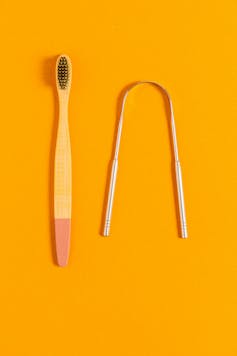
A toothbrush and a silver tongue scraper on an orange background.
Build-up can occur if you stop brushing or scraping your tongue even for a few days. Anthony Shkraba/Pexels

You can clean your tongue by gently scrubbing it with a regular toothbrush. This dislodges any food debris and helps prevent microbes building up on its rough textured surface.

Or you can use a special tongue scraper. These curved instruments are made of metal or plastic, and can be used alone or accompanied by scrubbing with your toothbrush.

Your co-workers will thank you as well – cleaning your tongue can help combat stinky breath. Tongue scrapers are particularly effective at removing the bacteria that commonly causes bad breath, hidden in the tongue’s surface.

What’s that stuff on my tongue?

So, you’re checking your tongue during your twice-daily clean, and you notice something different. Noting these signs is the first step. If you observe any changes and they worry you, you should talk to your GP.

Here’s what your tongue might be telling you.

White coating

Developing a white coating on the tongue’s surface is one of the most common changes in healthy people. This can happen if you stop brushing or scraping the tongue, even for a few days.

In this case, food debris and microbes have accumulated and caused plaque. Gentle scrubbing or scraping will remove this coating. Removing microbes reduces the risk of chronic infections, which can be transferred to other organs and cause serious illnesses.
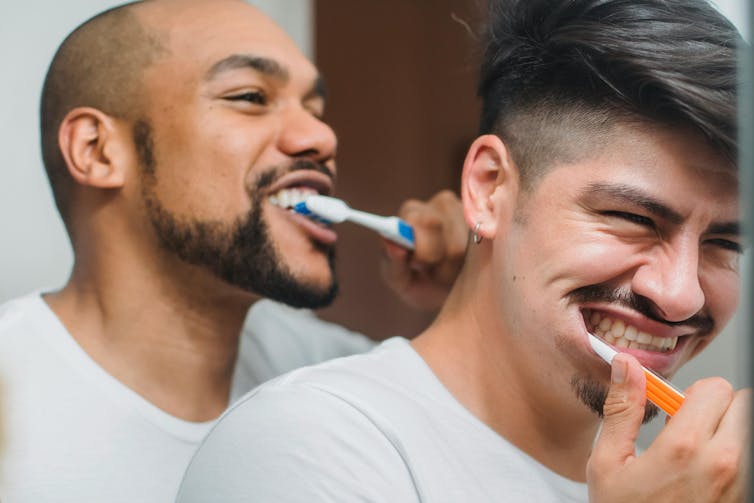
Two young men laughing while they brush their teeth.
Scrubbing or scraping your tongue only takes around ten seconds and can be done while brushing your teeth. Ketut Subiyanto/Pexels

Yellow coating

This may indicate oral thrush, a fungal infection that leaves a raw surface when scrubbed.

Oral thrush is common in elderly people who take multiple medications or have diabetes. It can also affect children and young adults after an illness, due to the temporary suppression of the immune system or antibiotic use.

If you have oral thrush, a doctor will usually prescribe a course of anti-fungal medication for at least a month.

Black coating

Smoking or consuming a lot of strong-coloured food and drink – such as tea and coffee, or dishes with tumeric – can cause a furry appearance. This is known as a black hairy tongue. It’s not hair, but an overgrowth of bacteria which may indicate poor oral hygiene.

Smoke wafting from a cigarette in a woman's hand.
Smoking can add to poor oral hygiene and make the tongue look black. Sophon Nawit/Shutterstock

Pink patches

Pink patches surrounded by a white border can make your tongue look like a map – this is called “geographic tongue”. It’s not known what causes this condition, which usually doesn’t require treatment.

Pain and inflammation

A red, sore tongue can indicate a range of issues, including:

Dryness

Many medications can cause dry mouth, also called xerostomia. These include antidepressants, anti-psychotics, muscle relaxants, pain killers, antihistamines and diuretics. If your mouth is very dry, it may hurt.

What about cancer?

White or red patches on the tongue that can’t be scraped off, are long-standing or growing need to checked out by a dental professional as soon as possible, as do painless ulcers. These are at a higher risk of turning into cancer, compared to other parts of the mouth.

Oral cancers have low survival rates due to delayed detection – and they are on the rise. So checking your tongue for changes in colour, texture, sore spots or ulcers is critical.

Dileep Sharma, Professor and Head of Discipline – Oral Health, University of Newcastle

This article is republished from The Conversation under a Creative Commons license. Read the original article.

Don’t Forget…

Did you arrive here from our newsletter? Don’t forget to return to the email to continue learning!
Learn to Age Gracefully

Join the 98k+ American women taking control of their health & aging with our 100% free (and fun!) daily emails:

  • Hawthorn For The Heart (& More)

    10almonds is reader-supported. We may, at no cost to you, receive a portion of sales if you purchase a product through a link in this article.

    Hawthorn, The Heart-Healthy Helper

    Hawthorn, a berry of the genus Crataegus (there are many species, but they seem to give more or less the same benefits), has been enjoyed for hundreds of years, if not thousands, as a herbal remedy for many ailments, mostly of the cardiovascular, digestive, and/or endocrine systems:

    Crataegus pinnatifida: Chemical Constituents, Pharmacology, and Potential Applications

    Antioxidant & Anti-inflammatory

    Like most berries, it’s full of helpful polyphenols, with antioxidant and anti-inflammatory properties. Indeed, as Dr. Nabavi et al. wrote,

    Crataegus monogyna Jacq. (hawthorn) is one of the most important edible plants of the Rosaceae family and is also used in traditional medicine.

    Growing evidence has shown that this plant has various interesting physiological and pharmacological activities due to the presence of different bioactive natural compounds.

    In addition, scientific evidence suggests that the toxicity of hawthorn is negligible. ❞

    ~ Dr. Nabavi et al.

    Read in full: Polyphenolic Composition of Crataegus monogyna Jacq.: From Chemistry to Medical Applications

    While “the toxicity of hawthorn is negligible” may be reasonably considered a baseline for recommending an edible plant, it’s still important as just that: a baseline. It’s good to know that berries are safe, after all!

    More positively, about those antioxidant and anti-inflammatory properties:

    Polyphenols from hawthorn peels and fleshes differently mitigate dyslipidemia, inflammation and oxidative stress

    This one was a mouse study, but it’s important as it about modulating liver injury after being fed a high fructose diet.

    In other words: it a) helps undo the biggest cause of non-alcoholic fatty liver disease, b) logically, likely guards against diabetes also (by the same mechanism)

    Anti-Diabetes Potential

    Curious about that latter point, we looked for studies, and found, for example:

    Noteworthily, those studies are from the past couple of years, which is probably why we’re not seeing many human trials for this yet—everything has to be done in order, and there’s a lengthy process between each.

    We did find some human trials with hawthorn in diabetes patients, for example:

    Hypotensive effects of hawthorn for patients with diabetes taking prescription drugs: a randomised controlled trial

    …but as you see, that’s testing not its antidiabetic potential, so far demonstrated only in mice and rats (so far as we could find), but rather its blood pressure lowering effects, using diabetic patients as a sample.

    Blood pressure benefits

    Hawthorn has been studied specifically for its hypotensive effect, for example:

    Promising hypotensive effect of hawthorn extract: a randomized double-blind pilot study of mild, essential hypertension

    As an extra bonus, did you notice in the conclusion,

    ❝Furthermore, a trend towards a reduction in anxiety (p = 0.094) was also observed in those taking hawthorn compared with the other groups.

    These findings warrant further study, particularly in view of the low dose of hawthorn extract used.❞

    ~ Dr. Ann Walker et al.

    …it seems that not a lot more study has been done yet, but that is promising too!

    Other blood metrics

    So, it has antidiabetic and antihypertensive benefits, what of blood lipids?

    Hawthorn Fruit Extract Elevates Expression of Nrf2/HO-1 and Improves Lipid Profiles

    And as for arterial plaque?

    Clinical study on treatment of carotid atherosclerosis with extraction of polygoni cuspidati rhizoma et radix and crataegi fructus: a randomized controlled trial

    here it was tested alongside another herb, and performed well (also against placebo).

    In summary…

    Hawthorn (Crataegus sp.) is…

    • a potent berry containing many polyphenols with good antioxidant and anti-inflammatory effects
    • looking promising against diabetes, but research for this is still in early stages
    • found to have other cardioprotective effects (antihypertensive, improves lipid profiles), too
    • considered to have negligible toxicity

    Where can I get it?

    As ever, we don’t sell it, but here for your convenience is an example product on Amazon

    Enjoy!

    Share This Post

  • Do We Need Sunscreen In Winter, Really?

    10almonds is reader-supported. We may, at no cost to you, receive a portion of sales if you purchase a product through a link in this article.

    It’s Q&A Day at 10almonds!

    Have a question or a request? We love to hear from you!

    In cases where we’ve already covered something, we might link to what we wrote before, but will always be happy to revisit any of our topics again in the future too—there’s always more to say!

    As ever: if the question/request can be answered briefly, we’ll do it here in our Q&A Thursday edition. If not, we’ll make a main feature of it shortly afterwards!

    So, no question/request too big or small 😎

    ❝I keep seeing advice that we shoudl wear sunscreen out in winter even if it’s not hot or sunny, but is there actually any real benefit to this?❞

    Short answer: yes (but it’s indeed not as critical as it is during summer’s hot/sunny days)

    Longer answer: first, let’s examine the physics of summer vs winter when it comes to the sun…

    In summer (assuming we live far enough from the equator to have this kind of seasonal variation), the part of the planet where we live is tilted more towards the sun. This makes it closer, and more importantly, it’s more directly overhead during the day. The difference in distance through space isn’t as big a deal as the difference in distance through the atmosphere. When the sun is more directly overhead, its rays have a shorter path through our atmosphere, and thus less chance of being blocked by cloud cover / refracted elsewhere / bounced back off into space before it even gets that far.

    In winter, the opposite of all that is true.

    Morning/evening also somewhat replicate this compared to midday, because the sun being lower in the sky has a similar effect to seasonal variation causing it to be less directly overhead.

    For this reason, even though visually the sun may be just as bright on a winter morning as it is on a summer midday, the rays have been filtered very differently by the time they get to us.

    This is one reason why you’re much less likely to get sunburned in the winter, compared to the summer (others include the actual temperature difference, your likely better hydration, and your likely more modest attire protecting you).

    However…

    The reason it is advisable to wear sunscreen in winter is not generally about sunburn, and is rather more about long-term cumulative skin damage (ranging from accelerated aging to cancer) caused by the UV rays—specifically, mostly UVA rays, since UVB rays (with their higher energy but shorter wavelength) have nearly all been blocked by the atmosphere.

    Here’s a good explainer of that from the American Cancer Society:

    UV (Ultraviolet) Radiation and Cancer Risk

    👆 this may seem like a no-brainer, but there’s a lot explained here that demystifies a lot of things, covering ionizing vs non-ionizing radiation, x-rays and gamma-rays, the very different kinds of cancer caused by different things, and what things are dangerous vs which there’s no need to worry about (so far as best current science can say, at least).

    Consequently: yes, if you value your skin health and avoidance of cancer, wearing sunscreen when out even in the winter is a good idea. Especially if your phone’s weather app says the UV index is “moderate” or above, but even if it’s “low”, it doesn’t hurt to include it as part of your skincare routine.

    But what if sunscreens are dangerous?

    Firstly, not all sunscreens are created equal:

    Learn more: Who Screens The Sunscreens?

    Secondly: consider putting on a protective layer of moisturizer first, and then the sunscreen on top. Bear in mind, this is winter we’re talking about, so you’re probably not going out in a bikini, so this is likely a face-neck-hands job and you’re done.

    What about vitamin D?

    Humans evolved to have more or less melanin in our skin depending on where we lived, and white people evolved to wring the most vitamin D possible out of the meagre sun far from the equator. Black people’s greater melanin, on the other hand, offers some initial protection against the sun (but any resultant skin cancer is then more dangerous than it would be for white people if it does occur, so please do use sunscreen whatever your skintone).

    Nowadays many people live in many places which may or may not be the places we evolved for, and so we have to take that into account when it comes to sun exposure.

    Here’s a deeper dive into that, for those who want to learn:

    The Sun Exposure Dilemma

    Take care!

    Share This Post

  • Beetroot vs Green Beans – Which is Healthier?

    10almonds is reader-supported. We may, at no cost to you, receive a portion of sales if you purchase a product through a link in this article.

    Our Verdict

    When comparing beetroot to green beans, we picked the beetroot.

    Why?

    Both have their merits!

    In terms of macros, there’s really nothing between them and we’re calling this first category a tie.

    In the category of vitamins, beetroot has more of vitamins B5, B6, B7, and B9, while green beans have more of vitamins A, B1, B2, B3, C, E, and K, winning.

    Looking at minerals, beetroot has more copper, phosphorus, potassium, selenium, and zinc, while green beans have more calcium, yielding a 5:1 win to beetroot here.

    In other considerations, beetroot has more nitrates, more polyphenols, and a generous betalain content, especially betanin, for a compelling win in this round.

    Adding up the sections makes for an overall win for beetroot, but by all means do enjoy either or both, as diversity is best!

    Want to learn more?

    You might like:

    Beetroot For More Than Just Your Blood Pressure

    Enjoy!

    Share This Post

  • How To Really Look After Your Joints

    10almonds is reader-supported. We may, at no cost to you, receive a portion of sales if you purchase a product through a link in this article.

    The Other Ways To Look After Your Joints

    When it comes to joint health, most people have two quick go-to items:

    • Stretching
    • Supplements like omega-3 and glucosamine sulfate

    Stretching, and specifically, mobility exercises, are important! We’ll have to do a main feature on these sometime soon. But for today, we’ll just say: yes, gentle daily stretches go a long way, as does just generally moving more.

    And, those supplements are not without their merits. For example:

    Of those, glucosamine sulfate may have an extra benefit in now just alleviating the symptoms, but also slowing the progression of degenerative joint conditions (like arthritis of various kinds). This is something it shares with chondroitin sulfate:

    Effect of glucosamine or chondroitin sulfate on the osteoarthritis progression: a meta-analysis

    An unlikely extra use for the humble cucumber…

    As it turns out, cucumber extract beats glucosamine and chondroitin by 200%, at 1/135th of the dose.

    You read that right, and it’s not a typo. See for yourself:

    Effectiveness of Cucumis sativus extract versus glucosamine-chondroitin in the management of moderate osteoarthritis: a randomized controlled trial

    Reduce inflammation, have happier joints

    Joint pain and joint degeneration in general is certainly not just about inflammation; there is physical wear-and-tear too. But combatting inflammation is important, and turmeric, which we’ve done a main feature on before, is a potent helper in this regard:

    Efficacy of Turmeric Extracts and Curcumin for Alleviating the Symptoms of Joint Arthritis: A Systematic Review and Meta-Analysis of Randomized Clinical Trials

    See also: Keep Inflammation At Bay

    (a whole list of tips for, well, keeping inflammation at bay)

    About that wear-and-tear…

    Your bones and joints are made of stuff, and that stuff needs to be replaced. As we get older, the body typically gets worse at replacing it in a timely and efficient fashion. We can help it do its job, by giving it more of the stuff it needs.

    And what stuff is that?

    Well, minerals like calcium and phosphorus are important, but a lot is also protein! Specifically, collagen. We did a main feature on this before, which is good, as it’d take us a lot of space to cover all the benefits here:

    We Are Such Stuff As Fish Are Made Of

    Short version? People take collagen for their skin, but really, its biggest benefit is for our bones and joints!

    Wrap up warmly and… No wait, skip that.

    If you have arthritis, you may indeed “feel it in your bones” when the weather changes. But the remedy for that is not to try to fight it, but rather, to strengthen your body’s ability to respond to it.

    The answer? Cryotherapy, with ice baths ranking top:

    Note that this can be just localized, so for example if the problem joints are your wrists, a washing-up bowl with water and ice will do just nicely.

    Note also that, per that last study, a single session will only alleviate the pain, not the disease itself. For that (per the other studies) more sessions are required.

    We did a main feature about cryotherapy a while back, and it explains how and why it works:

    A Cold Shower A Day Keeps The Doctor Away?

    Take care!

    Don’t Forget…

    Did you arrive here from our newsletter? Don’t forget to return to the email to continue learning!

    Learn to Age Gracefully

    Join the 98k+ American women taking control of their health & aging with our 100% free (and fun!) daily emails:

  • 5 Things To Know About Passive Suicidal Ideation

    10almonds is reader-supported. We may, at no cost to you, receive a portion of sales if you purchase a product through a link in this article.

    If you’ve ever wanted to go to sleep and never wake up, or have some accident/incident/illness take you with no action on your part, or a loved one has ever expressed such thoughts/feelings to you… Then this video is for you. Dr. Scott Eilers explains:

    Tired of living

    We’ll not keep them a mystery; here are the five things that Dr. Eilers wants us to know about passive suicidal ideation:

    • What it is: a desire for something to end your life without taking active steps. While it may seem all too common, it’s not necessarily inevitable or unchangeable.
    • What it means in terms of severity: it isn’t a clear indicator of how severe someone’s depression is. It doesn’t necessarily mean that the person’s depression is mild; it can be severe even without active suicidal thoughts, or indeed, suicidality at all.
    • What it threatens: although passive suicidal ideation doesn’t usually involve active planning, it can still be dangerous. Over time, it can evolve into active suicidal ideation or lead to risky behaviors.
    • What it isn’t: passive suicidal ideation is different from intrusive thoughts, which are unwanted, distressing thoughts about death. The former involves a desire for death, while the latter does not.
    • What it doesn’t have to be: passive suicidal ideation is often a symptom of underlying depression or a mood disorder, which can be treated through therapy, medication, or a combination of both. Seeking treatment is crucial and can be life-changing.

    For more on all of the above, here’s Dr. Eilers with his own words:

    Click Here If The Embedded Video Doesn’t Load Automatically!

    Want to learn more?

    You might also like to read:

    Take care!

    Don’t Forget…

    Did you arrive here from our newsletter? Don’t forget to return to the email to continue learning!

    Learn to Age Gracefully

    Join the 98k+ American women taking control of their health & aging with our 100% free (and fun!) daily emails:

  • Why Mosquitoes Bite Some People More Than Others

    10almonds is reader-supported. We may, at no cost to you, receive a portion of sales if you purchase a product through a link in this article.

    Are you a blood buffet? There are things you can do to change your snack appeal:

    The unlucky 20%

    Yes, mosquitoes really do prefer some people over others, and about 20% of people appear to be consistently more attractive to mosquitoes year after year.

    How they starts female* mosquitoes use specialized sensory receptors on their antennae to detect carbon dioxide, body heat, odors, visual cues, and air movement. Notably, carbon dioxide from your breath can attract mosquitoes from roughly 10 meters away and activates their host-seeking behavior.

    *this is because female mosquitoes need nutrients from blood to produce eggs, while male mosquitoes prefer to feed on nectar.

    How they narrow it down down: the mosquitoes are strongly attracted to chemicals produced when skin microbes break down sweat, sebum, and other skin secretions. Now, everyone has a unique skin microbiome, which creates a distinctive mixture of odor compounds that can make some people more attractive than others. Including to mosquitoes.

    In particular, researchers have found that mosquito receptors for acidic compounds are especially important for locating humans, and people with higher levels of certain skin acids tend to attract more mosquitoes.

    Things to avoid because they temporarily increase attractiveness*: heavy sweating, alcohol consumption, and pregnancy can all make a person more appealing to mosquitoes. So, while most people try to avoid sweating, and mosquitoes are not usually a deciding factor when it comes to deciding whether to get pregnant, at the very least alcohol consumption is something that can be consciously avoided.

    *To mosquitoes, at least. Results may vary for humans!

    For more on all of this, enjoy:

    Click Here If The Embedded Video Doesn’t Load Automatically!

    Want to learn more?

    You might also like:

    Mosquitoes can spread the flesh-eating Buruli ulcer. Here’s how you can protect yourself

    Take care!

    Don’t Forget…

    Did you arrive here from our newsletter? Don’t forget to return to the email to continue learning!

    Learn to Age Gracefully

    Join the 98k+ American women taking control of their health & aging with our 100% free (and fun!) daily emails: