
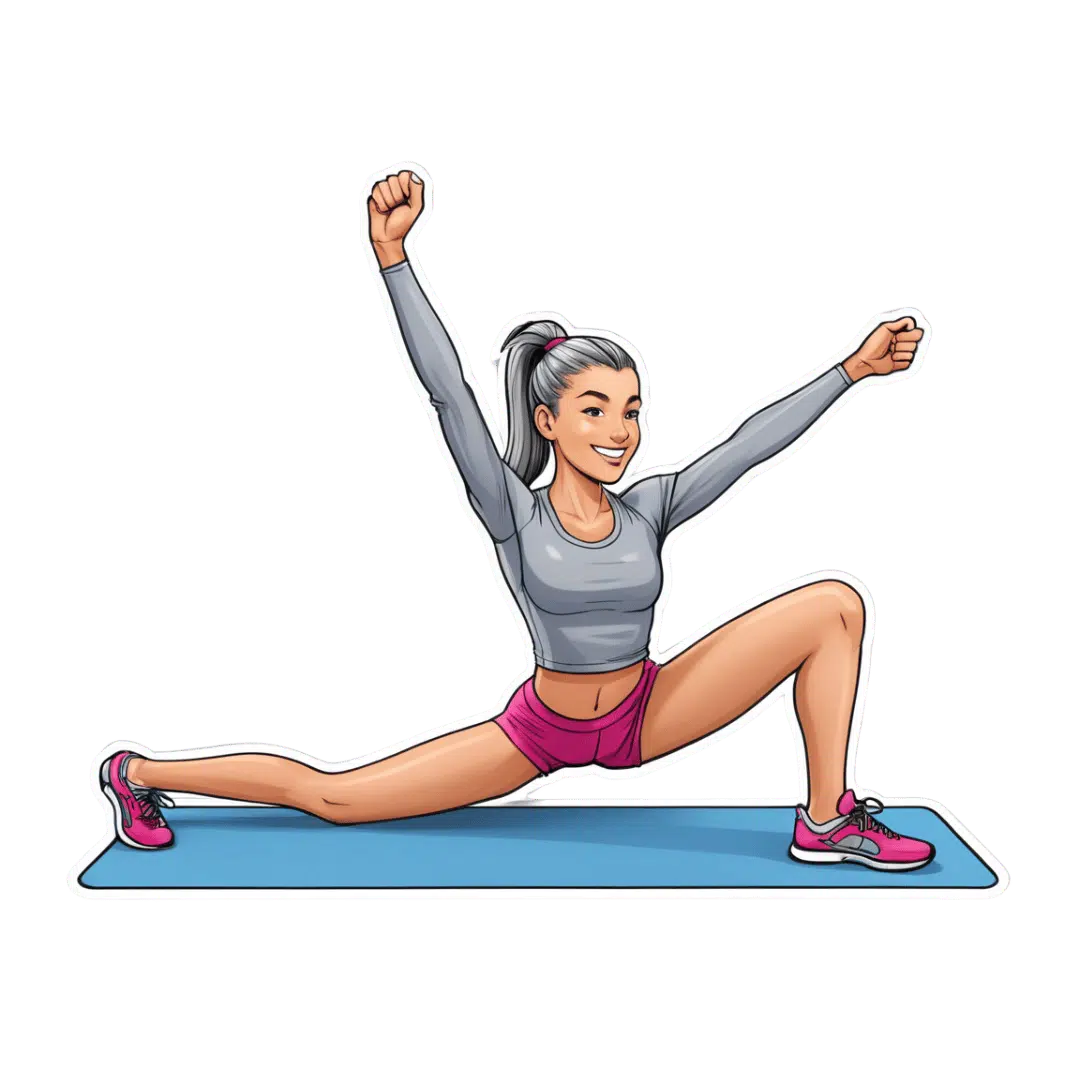
The Best Way To Get Flexible, By Science
10almonds is reader-supported. We may, at no cost to you, receive a portion of sales if you purchase a product through a link in this article.
Liv Townsend, of Livinleggings fame, comes bearing research papers:
Little and often
Science was done (references in the video), and found:
- Stretching for 5 minutes or less total across the week? Not great results.
- Stretching for between 5 and 10 minutes? Much better.
- Stretching for more than 10 minutes? Little to no extra benefit.
So, 5–10 minutes per week? That sounds easy. Shall we do it all on a Monday morning and get it over with?
Nope, because the science also found:
- Stretching six days a week gave the absolute best results.
- Stretching three times per week also gave improvements.
- Stretching once per week gave no significant improvements.
So, spread out over several days per week, if not every day, seems ideal. Now, how long to spend per stretch? Research is consistent on this:
- 30 seconds per stretch (holding the stretch) is the sweet spot.
- 30 seconds is better than 15 seconds.
- 60 seconds brings no extra benefit over 30 seconds, so don’t waste your time!*
*Unless you want to, of course. Time you enjoyed wasting was not time wasted 🙂
Now, will science tell us how many sets to do? Yes it will:
- Doing two to four sets of each stretch produces the best gains.
- After that, doing more sets doesn’t give extra flexibility.
Example: Stretching Your Hamstrings
Here’s how it would look:
- Hold a hamstring stretch for 30 seconds.
- Rest (or switch to the other leg).
- Repeat for three sets each side.
This takes about three minutes total. Do this three times per week, and you’ve only spent nine minutes, yet you’ll see big flexibility gains!
For more on all of this (including the actual study references), plus visual demonstrations of some other stretches for a more comprehensive stretching routine, enjoy:
Click Here If The Embedded Video Doesn’t Load Automatically!
Want to learn more?
You might also like:
Yoga Teacher: “If I wanted to get flexible (from scratch) in 2025, here’s what I’d do”
Take care!
Don’t Forget…
Did you arrive here from our newsletter? Don’t forget to return to the email to continue learning!
Recommended
Learn to Age Gracefully
Join the 98k+ American women taking control of their health & aging with our 100% free (and fun!) daily emails:
-
Cranberries vs Gooseberries – Which is Healthier?
10almonds is reader-supported. We may, at no cost to you, receive a portion of sales if you purchase a product through a link in this article.
Our Verdict
When comparing cranberries to gooseberries, we picked the gooseberries.
Why?
It wasn’t close:
In terms of macros, cranberries have more carbs while gooseberries have more fiber, so that’s a win for gooseberries. A nominal win as the differences aren’t huge, but clear enough to be a win nevertheless.
In the category of vitamins, cranberries have more vitamin E, while gooseberries have more of vitamins A, B1, B2, B3, B5, B6, B7, B9, and C, winning easily.
Looking at minerals next, cranberries have more manganese, while gooseberries have more calcium, copper, iron, magnesium, phosphorus, potassium, selenium, and zinc, scoring their third win in a row by quite a margin.
In other considerations, cranberries have some special properties that amount to a mixed bag of pros and cons (see details in the “learn more” below), while gooseberries are higher in polyphenols. Since cranberries have good and bad things in this round while gooseberries have just good, we say gooseberries in this round, too.
Adding up the sections makes for a clear overall win for gooseberries, but by all means enjoy either or both, as diversity is best (unless one of the contraindications for cranberries applies, in which case, skip those)!
Want to learn more?
You might like:
Health Benefits Of Cranberries (But: You’d Better Watch Out) ← cranberries’ bonus properties (including: famously very good at decreasing UTI risk) come with some warnings, including that they may increase the risk of kidney stones if you are prone to such, and also that cranberries have anti-clotting effects, which are great for heart health but can be a risk of you’re on blood thinners or have a bleeding disorder.
Enjoy!
Share This Post
-
Castor Oil: All-Purpose Life-Changer, Or Snake Oil?
10almonds is reader-supported. We may, at no cost to you, receive a portion of sales if you purchase a product through a link in this article.
As “trending” health products go, castor oil is enjoying a lot of popularity presently, lauded as a life-changing miracle-worker, and social media is abuzz with advice to put it everywhere from your eyes to your vagina.
But:
- what things does science actually say it’s good for,
- what things lack evidence, and
- what things go into the category of “wow definitely do not do that”?
We don’t have the space to go into all of its proposed uses (there are simply far too many), but we’ll examine some common ones:
To heal/improve the skin barrier
Like most oils, it’s functional as a moisturizer. In particular, its high (90%!) ricinoleic fatty acid content does indeed make it good at that, and furthermore, has properties that can help reduce skin inflammation and promote wound healing:
Bioactive polymeric formulations for wound healing ← there isn’t a conveniently quotable summary we can just grab here, but you can see the data and results, from which we can conclude:
- formulations with ricinoleic acid (such as with castor oil) performed very well for topical anti-inflammatory purposes
- they avoided the unwanted side effects associated with some other contenders
- they consistently beat other preparations in the category of wound-healing
To support hair growth and scalp health
There is no evidence that it helps. We’d love to provide a citation for this, but it’s simply not there. There’s also no evidence that it doesn’t help. For whatever reason, despite its popularity, peer-reviewed science has simply not been done for this, or if it has, it wasn’t anywhere publicly accessible.
It’s possible that if a person is suffering hair loss specifically as a result of prostaglandin D2 levels, that ricinoleic acid will inhibit the PGD2, reversing the hair loss, but even this is hypothetical so far, as the science is currently only at the step before that:
However, due to some interesting chemistry, the combination of castor oil and warm water can result in acute (and irreversible) hair felting, in other words, the strands of hair suddenly glue together to become one mass which then has to be cut off:
“Castor Oil” – The Culprit of Acute Hair Felting
👆 this is a case study, which is generally considered a low standard of evidence (compared to high-quality Randomized Controlled Trials as the highest standard of evidence), but let’s just say, this writer (hi, it’s me) isn’t risking her butt-length hair on the off-chance, and doesn’t advise you to, either. There are other hair-oils out there; argan oil is great, coconut oil is totally fine too.
As a laxative
This time, there’s a lot of evidence, and it’s even approved for this purpose by the FDA, but it can be a bit too good, insofar as taking too much can result in diarrhea and uncomfortable cramping (the cramps are a feature not a bug; the mechanism of action is stimulatory, i.e. it gets the intestines squeezing, but again, it can result in doing that too much for comfort):
Castor Oil: FDA-Approved Indications
To soothe dry eyes
While putting oil in your eyes may seem dubious, this is another one where it actually works:
❝Castor oil is deemed safe and tolerable, with strong anti-microbial, anti-inflammatory, anti-nociceptive, analgesic, antioxidant, wound healing and vasoconstrictive properties.
These can supplement deficient physiological tear film lipids, enabling enhanced lipid spreading characteristics and reducing aqueous tear evaporation.
Studies reveal that castor oil applied topically to the ocular surface has a prolonged residence time, facilitating increased tear film lipid layer thickness, stability, improved ocular surface staining and symptoms.❞
Source: Therapeutic potential of castor oil in managing blepharitis, meibomian gland dysfunction and dry eye
Against candidiasis (thrush)
We couldn’t find science for (or against) castor oil’s use against vaginal candidiasis, but here’s a study that investigated its use against oral candidiasis:
…in which castor oil was the only preparation that didn’t work against the yeast.
Summary
We left a lot unsaid today (so many proposed uses, it feels like a shame to skip them), but in few words: it’s good for skin (including wound healing) and eyes; but we’d give it a miss for hair, candidiasis, and digestive disorders.
Want to try some?
We don’t sell it, but here for your convenience is an example product on Amazon 😎
Take care!
Share This Post
-
Mango vs Peach – Which is Healthier?
10almonds is reader-supported. We may, at no cost to you, receive a portion of sales if you purchase a product through a link in this article.
Our Verdict
When comparing mango to peach, we picked the mango.
Why?
Both have their merits:
In terms of macros, mango has slightly more carbs, and the other macros are too close to call. Since the carbs difference also isn’t very big, we’re calling this round a tie, but you could call it a small nominal win if you like.
In the category of vitamins, mango has more of vitamins A, B1, B2, B3, B5, B6, B7, B9, C, E, K, and choline, while peaches are not higher in any vitamins. An easy win for mangos.
Looking at minerals, mango has more calcium, copper, magnesium, manganese, and selenium, while peaches have more iron, phosphorus, potassium, and zinc. A marginal 5:4 win for mangos, though it’s worth noting that mango did also have the wider margins of difference (thus setting it a little further ahead if we want to count that).
In other considerations, peaches do have more polyphenols, as well as some anticancer properties that aren’t known of mangos. So that’s a point in peaches’ favor.
Adding up the sections makes for an overall win for mangos, but it’s close, since as we say, both have their merits.
Want to learn more?
You might like:
Top 8 Fruits That Prevent & Kill Cancer
Enjoy!
Share This Post
Related Posts
-
How To Stay Alive (When You Really Don’t Want To)
10almonds is reader-supported. We may, at no cost to you, receive a portion of sales if you purchase a product through a link in this article.
How To Stay Alive (When You Really Don’t Want To)
A subscriber recently requested:
❝Request: more people need to be aware of suicidal tendencies and what they can do to ward them off❞
…and we said we’d do that one of these Psychology Sundays, so here we are, doing it!
First of all, we’ll mention that we did previously do a main feature on managing depression (in oneself or a loved one); here it is:
The Mental Health First Aid That You’ll Hopefully Never Need
Now, not all depression leads to suicidality, and not all suicide is pre-empted by depression, but there’s a large enough crossover that it seems sensible to put that article here, for anyone who might find it of use, or even just of interest.
Now, onwards, to the specific, and very important, topic of suicide.
This should go without saying, but some of today’s content may be a little heavy.
We invite you to read it anyway if you’re able, because it’s important stuff that we all should know, and not talking about it is part of what allows it to kill people.
So, let’s take a deep breath, and read on…
The risk factors
Top risk factors for suicide include:
- Not talking about it
- Having access to a firearm
- Having a plan of specifically how to commit suicide
- A lack of social support
- Being over 40
Now, some of these are interesting sociologically, but aren’t very useful practically; what a convenient world it’d be if we could all simply choose to be under 40, for instance.
Some serve as alarm bells, such as “having a plan of specifically how to commit suicide”.
If someone has a plan, that plan’s never going to disappear entirely, even if it’s set aside!
(this writer is deeply aware of the specifics of how she has wanted to end things before, and has used the advice she gives in this article herself numerous times. So far so good, still alive to write about it!)
Specific advices, therefore, include:
Talk about it / Listen
Depending on whether it’s you or someone else at risk:
- Talk about it, if it’s you
- Listen attentively, if it’s someone else
There are two main objections that you might have at this point, so let’s look at those:
“I have nobody to talk to”—it can certainly feel that way, sometimes, but you may be surprised who would listen if you gave them the chance. If you really can’t trust anyone around you, there are of course suicide hotlines (usually per area, so we’ll not try to list them here; a quick Internet search will get you what you need).
If you’re worried it’ll result in bad legal/social consequences, check their confidentiality policy first:
- Some hotlines can and will call the police, for instance.
- Others deliberately have a set-up whereby they couldn’t even trace the call if they wanted to.
- On the one hand, that means they can’t intervene
- On the other hand, that means they’re a resource for anyone who will only trust a listener who can’t intervene.
“But it is just a cry for help”—then that person deserves help. What some may call “attention-seeking” is, in effect, care-seeking. Listen, without judgement.
Remove access to firearms, if applicable and possible
Ideally, get rid of them (safely and responsibly, please).
If you can’t bring yourself to do that, make them as inconvenient to get at as possible. Stored securely at your local gun club is better than at home, for example.
If your/their plan isn’t firearm-related, but the thing in question can be similarly removed, remove it. You/they do not need that stockpile of pills, for instance.
And of course you/they could get more, but the point is to make it less frictionless. The more necessary stopping points between thinking “I should just kill myself” and being able to actually do it, the better.
Have/give social support
What do the following people have in common?
- A bullied teenager
- A divorced 40-something who just lost a job
- A lonely 70-something with no surviving family, and friends that are hard to visit
Often, at least, the answer is: the absence of a good social support network
So, it’s good to get one, and be part of some sort of community that’s meaningful to us. That could look different to a lot of people, for example:
- A church, or other religious community, if we be religious
- The LGBT+ community, or even just a part of it, if that fits for us
- Any mutual-support oriented, we-have-this-shared-experience community, could be anything from AA to the VA.
Some bonus ideas…
If you can’t live for love, living for spite might suffice. Outlive your enemies; don’t give them the satisfaction.
If you’re going to do it anyway, you might as well take the time to do some “bucket list” items first. After all, what do you have to lose? Feel free to add further bucket list items as they occur to you, of course. Because, why not? Before you know it, you’ve postponed your way into a rich and fulfilling life.
Finally, some gems from Matt Haig’s “The Comfort Book”:
- “The hardest question I have been asked is: “How do I stay alive for other people if I have no one?” The answer is that you stay alive for other versions of you. For the people you will meet, yes, but also the people you will be.”
- “Stay for the person you will become”
- “You are more than a bad day, or week, or month, or year, or even decade”
- “It is better to let people down than to blow yourself up”
- “Nothing is stronger than a small hope that doesn’t give up”
- “You are here. And that is enough.”
You can find Matt Haig’s excellent “The Comfort Book” on Amazon, as well as his more well-known book more specifically on the topic we’ve covered today, “Reasons To Stay Alive“.
Don’t Forget…
Did you arrive here from our newsletter? Don’t forget to return to the email to continue learning!
Learn to Age Gracefully
Join the 98k+ American women taking control of their health & aging with our 100% free (and fun!) daily emails:
-
Make Social Media Work For Your Mental Health
10almonds is reader-supported. We may, at no cost to you, receive a portion of sales if you purchase a product through a link in this article.
Social Media, But Healthy
Social media has a bad reputation, and rightly so. It’s calculated to trick you into doomscrolling and rage-posting, and it encourages you to compare your everyday life to other people’s carefully-curated highlight reels.
Rebalancing Dopamine (Without “Dopamine Fasting”)
But it doesn’t have to be so.
Find your community
One of the biggest strengths social media has going for it is that it can, if used well, be a powerful tool for community. As for why that’s important from a health perspective, see:
How To Beat Loneliness & Isolation
Loneliness & isolation do, of course, kill people. By:
- Accidents, e.g. household fall but nobody notices for a week
- Depression and resultant decline (and perhaps even active suicidality)
- Cognitive decline from a lack of social contact
Read more:
- The Mental Health First-Aid That You’ll Hopefully Never Need
- How To Stay Alive (When You Really Don’t Want To)
- The Five Key Traits Of Healthy Aging
So, what’s “community” to you, and to what extent can you find it online? Examples might include:
- A church, or other religious community, if we be religious
- The LGBT+ community, or even just a part of it, if that fits for us
- Any mutual-support oriented, we-have-this-shared-experience community, could be anything from AA to the VA.
Find your people, and surround yourself with them. There are more than 8,000,000,000 people on this planet, you will not find all the most compatible ones with you on your street.
Grow & nurture your community
Chances are, you have a lot to contribute. Your life experiences are valuable.
Being of service to other people is strongly associated “flourishing”, per the science.
Indeed, one of the questions on the subjective wellness scale test is to ask how much one agrees with the statement “I actively contribute to the happiness and wellbeing of others”.
See: Are You Flourishing? (There’s a Scale)
So, help people, share your insights, create whatever is relevant to your community and fits your skills (it could be anything from art to tutorials to call-to-action posts or whatever works for you and your community)
As a bonus: when people notice you are there for them, they’ll probably be there for you, too. Not always, sadly, but there is undeniable strength in numbers.
Remember it’s not the boss of you
Whatever social media platform(s) you use, the companies in question will want you to use it in the way that is most profitable for them.
Usually that means creating a lot of shallow content, clicking on as many things as possible, and never logging off.
Good ways to guard against that include:
- Use the social media from a computer rather than a handheld device
- Disable “infinite scroll” in the settings, if possible
- Set a timer and stick to it
- Try to keep your interactions to only those that are relevant and kind (for the good of your own health, let alone anyone else’s)
On that latter note…
Before posting, ask “what am I trying to achieve here?” and ensure your action is aligned with your actual desires, and not just reactivity. See also:
A Bone To Pick… Up And Then Put Back Where We Found It
Take care!
Don’t Forget…
Did you arrive here from our newsletter? Don’t forget to return to the email to continue learning!
Learn to Age Gracefully
Join the 98k+ American women taking control of their health & aging with our 100% free (and fun!) daily emails:
-
Clean – by Dr. James Hamblin
10almonds is reader-supported. We may, at no cost to you, receive a portion of sales if you purchase a product through a link in this article.
Our skin is our largest organ, and it’s easy to forget that, and how much it does for us. All things considered, it’s good to take good care of it! But what if we sometimes take too much “care” of it?
Dr. James Hamblin, a medical doctor-turned-writer, has explored this a lot both personally and in research. Through such, he has come to the conclusion there’s definitely a “sweet spot” of personal hygiene:
- Too little, and the Bubonic plague sweeps through Europe, or other plagues sweep through other places when European invaders came.
- Too much, and we strip our skin of one of its greatest qualities: the ability to protect us.
Dr. Hamblin asks (and answers) such questions as:
- What is good hygiene, and what is neurotically doing ourselves multiple levels of harm because advertising companies shamed us into doing so?
- Is it good or bad to use a series of products, each to undo the problem caused by the previous?
- What the difference between a 5-step skincare routine, and a series of gratuitous iatrogenic damage?
- Which products clean us most helpfully, and which clean us most harmfully?
- How often should we bathe/shower, really?
If the book has a weak point, it’s that it’s written mostly with his body in mind. That makes a difference when it comes to hairwashing, for example. He’s a white guy with short hair. If you’re black and/or have long hair, for example, your haircare needs will be quite different. Similarly, many women engage in shaving/depilation in places that most men don’t, and the consequences of that choice (and implications for any extra washing needs/harms) aren’t covered.
Bottom line: notwithstanding the aforementioned blind-spots, this book will help readers reduce the amount of harm we are doing to our bodies with our washing routines, without sacrificing actual hygiene.
Click here to check out Clean and help your skin to help you!
Don’t Forget…
Did you arrive here from our newsletter? Don’t forget to return to the email to continue learning!
Learn to Age Gracefully
Join the 98k+ American women taking control of their health & aging with our 100% free (and fun!) daily emails:


