
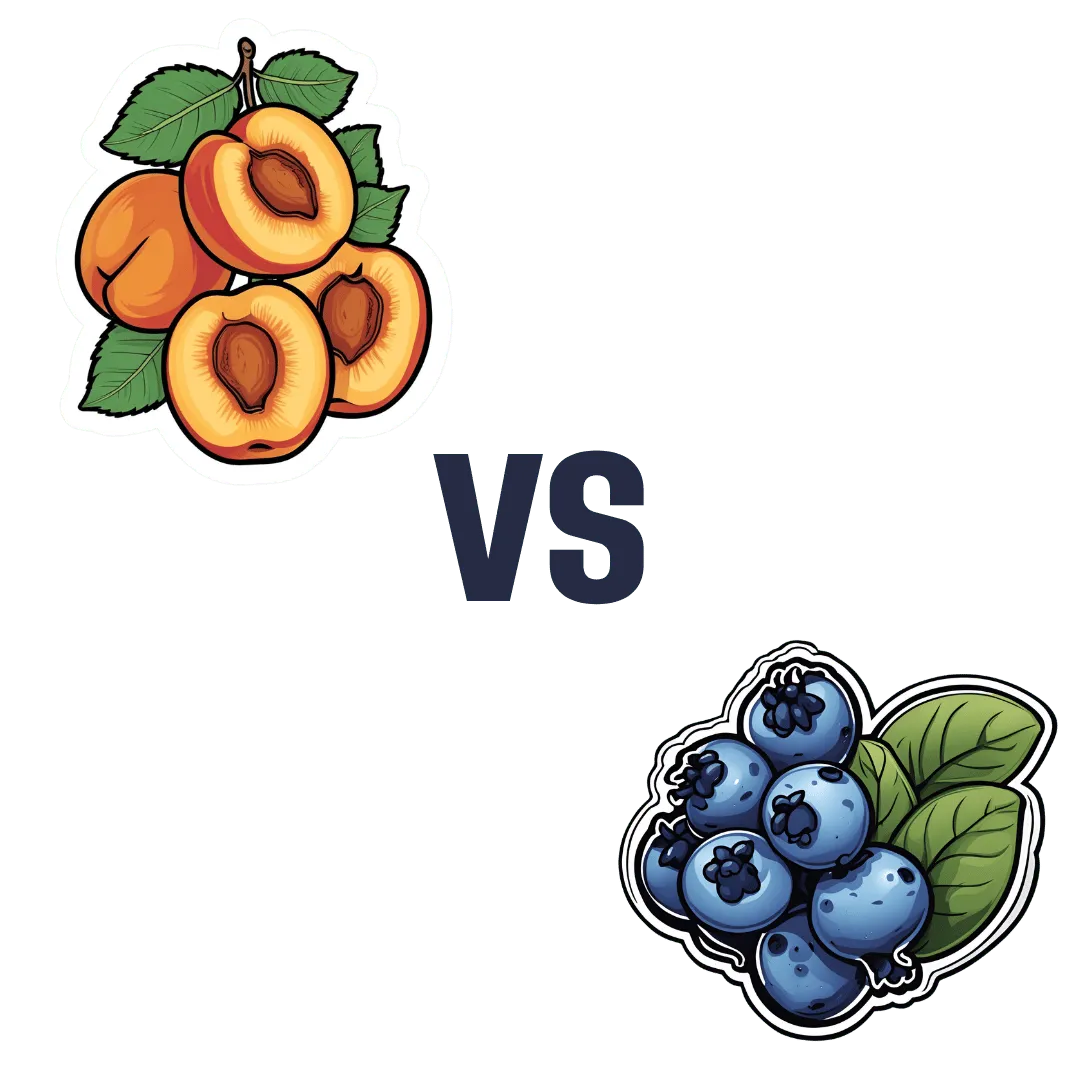
Apricots vs Blueberries – Which is Healthier?
10almonds is reader-supported. We may, at no cost to you, receive a portion of sales if you purchase a product through a link in this article.

Our Verdict
When comparing apricots to blueberries, we picked the apricots.
Why?
Both have their merits!
In terms of macros, apricots have about 2x the protein (but it’s not a lot) while blueberries have very slightly more fiber and carbs. Ultimately we’re calling this category a tie, but it could be swung one way or the other if you have strong feelings about prioritizing things.
In the category of vitamins, apricots have more of vitamins A, B3, B5, B7, B9, C, and E, while blueberries have more of vitamins B1, and K. A clear win for apricots here, even before considering the huge margin of difference on vitamin A (apricots having 32x the amount that blueberries do).
When it comes to minerals, apricots have more calcium, copper, iron, magnesium, manganese, phosphorus, potassium, and zinc, while blueberries have more manganese. Another win for apricots!
In other considerations, apricots have some specific cancer-killing properties beyond what blueberries can boast (see the “learn more” section below for details), while blueberries have more polyphenols in total. So, there strengths on each side here. We’re going to call this category a tie, but as with the macros, an argument could be made for either fruit.
Adding up the sections gives us an overall win for apricots, but it’s close, and blueberries are certainly great too, so by all means enjoy either or both!
Want to learn more?
You might like:
Top 8 Fruits That Prevent & Kill Cancer
Enjoy!
Don’t Forget…
Did you arrive here from our newsletter? Don’t forget to return to the email to continue learning!
Learn to Age Gracefully
Join the 98k+ American women taking control of their health & aging with our 100% free (and fun!) daily emails: