
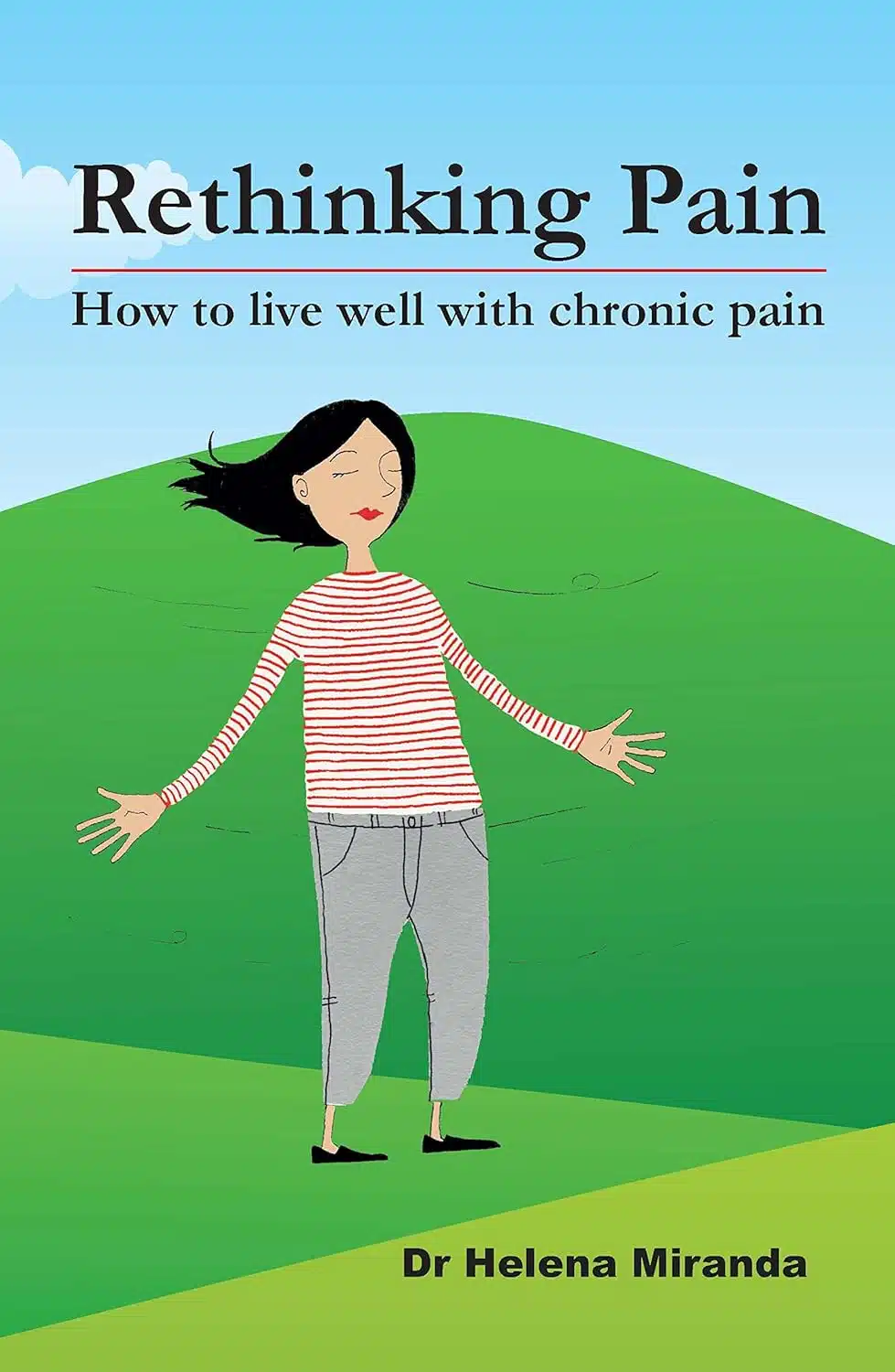
Rethinking Pain – by Dr. Helena Miranda
10almonds is reader-supported. We may, at no cost to you, receive a portion of sales if you purchase a product through a link in this article.

This is about about managing pain, not merely reducing it. Of course, reducing it is good and the book does cover that too, but oftentimes it cannot be banished entirely, or at least not in any useful fashion (for example, anesthetic may remove all pain, but it is not a way to go through life). So instead: first how to cope, and then how to do better than just coping.
Dr. Miranda (a medical doctor, pain specialist, and chronic pain sufferer) gives us 18 tools for pain management, advising on how to make them work as well as possible given the situation—without which, the more superficial versions of the advice are often useless.
For example, if you are chronically suffering pain, then the superficial advice “value your sleep” is not, in and of itself, helpful—because you already know that you sure do value the little sleep you get, wish you got more, and wish it didn’t (in the case of many kinds of chronic pain) result in things being worse, rather than better, when you wake up (because of the immobility). But instead, here we get advice on how to indeed make the most of things, make them better, and minimize the downsides.
In a similar vein, some of the tools recommended like “manage your weight” and “try yoga” may, based on the headings alone, make a reader want to throw the book out of the nearest window, on account of having heard a bajillion times already that something (often something that’s not even accessible) will be a magical panacea and that not doing the thing being recommended means that you are making no effort and therefore deserve any suffering that comes as a result. And yet! Dr. Miranda does go on to give actually useful advice in each of these and many more.
The style is easy-reading pop-science, without any hard science along the way, nor psychological jargon either. There is a bibliography at the back, but the main part of the book just assume that we can take all statements at face value, and will not need reassuring with citation markers.
Bottom line: there’s a lot of good advice in here, from someone who knows the terrain well as both a doctor and a patient, and as a result, this book goes quite a bit deeper than a quick glance at it might make you think.
Click here to check out Rethinking Pain, and live well despite chronic pain!
Don’t Forget…
Did you arrive here from our newsletter? Don’t forget to return to the email to continue learning!
Recommended
Learn to Age Gracefully
Join the 98k+ American women taking control of their health & aging with our 100% free (and fun!) daily emails: