
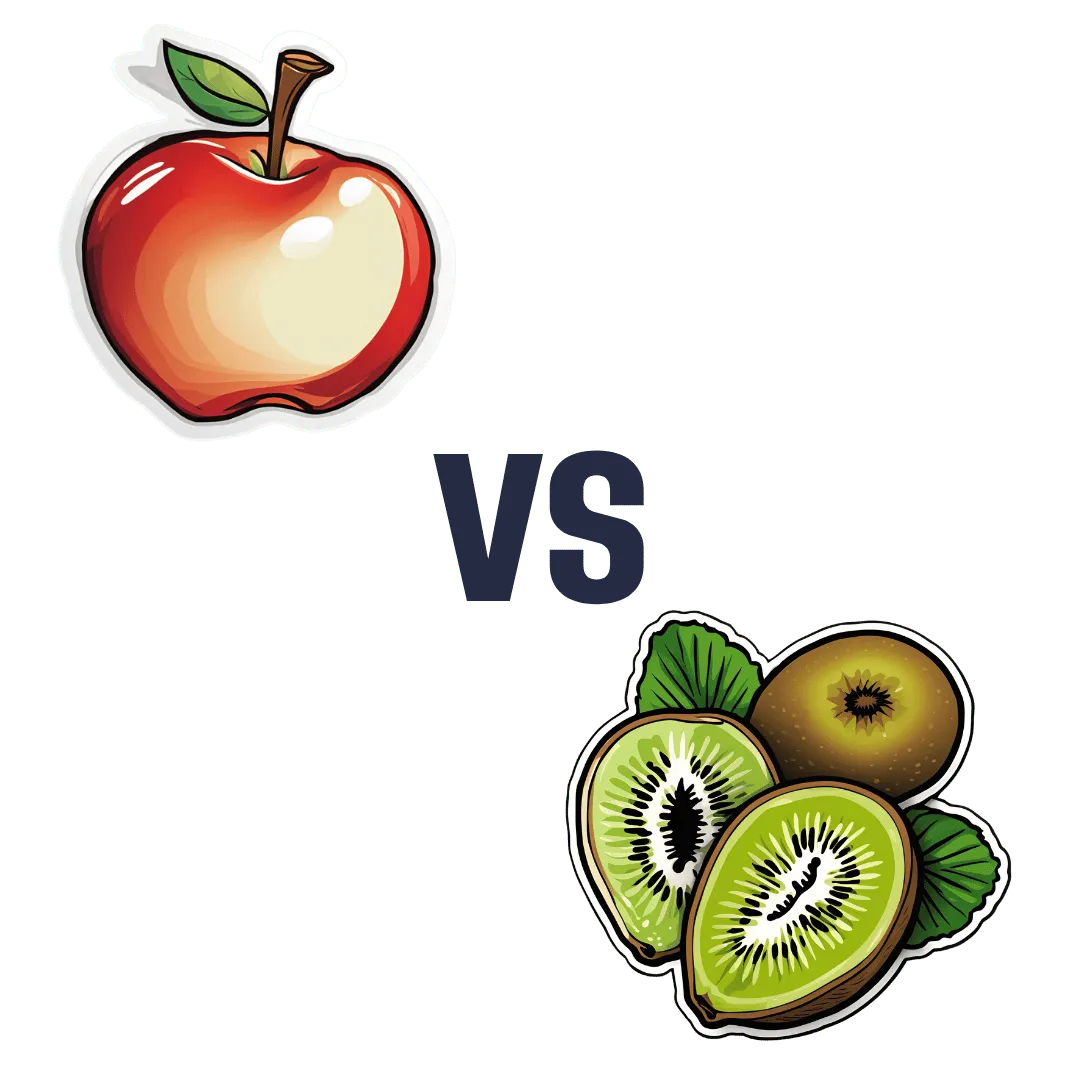
Apple vs Kiwi Fruit – Which is Healthier?
10almonds is reader-supported. We may, at no cost to you, receive a portion of sales if you purchase a product through a link in this article.
Our Verdict
When comparing apples to kiwi fruit, we picked the kiwi.
Why?
It wasn’t close!
In terms of macros, kiwi has more fiber and protein, scoring an easy first-round victory.
In the category of vitamins, apples are not higher in any vitamins, while kiwi is higher in vitamins A, B1, B3, B5, B6, B7, B9, C, E, and (appropriately enough) especially K, sweeping this round easily.
Looking at minerals, apples are not higher in any minerals, while kiwi has more calcium, copper, iron, magnesium, manganese, phosphorus, potassium, selenium, and zinc, for another total win here.
In other considerations, kiwi also has some anticancer properties that apples can’t boast, so that’s another point in kiwi’s favor.
Adding up the sections makes for an overwhelmingly clear overall win for kiwi fruit, but by all means enjoy either or both, as diversity is best!
Want to learn more?
You might like:
Top 8 Fruits That Prevent & Kill Cancer ← kiwi is top of the list!
Enjoy!
Don’t Forget…
Did you arrive here from our newsletter? Don’t forget to return to the email to continue learning!
Recommended
Learn to Age Gracefully
Join the 98k+ American women taking control of their health & aging with our 100% free (and fun!) daily emails:
-
90% Of People Skip This Essential Exercise—Are You One Of Them?
10almonds is reader-supported. We may, at no cost to you, receive a portion of sales if you purchase a product through a link in this article.
Single-leg strengthening is essential for joint health at any age (unless you want to bunny-hop up and down the stairs with both feet at once, for example), yet many people overlook it. This neglect often leads to pain, stiffness, and a higher risk of injury.
Dr. Alyssa Kuhn, arthritis specialist, explains how to do it:
On the rise
In this video, different exercise variations—beginner, intermediate, and advanced—are presented to help you build strength at your own pace:
Beginner: start by using a chair, adding a cushion for support if needed. Sit at the edge and position one foot slightly in front of the other in a staggered stance. Stand up and sit down in a controlled manner, allowing the back leg to bear more weight and work harder than the front leg. Do 8–10 repetitions per side and pay attention to whether one side feels weaker. To build strength, incorporate this movement into daily activities, such as standing up from the couch. Master this variation before progressing, to avoid knee injury.
Intermediate: to make the exercise more challenging, you can either use a lower chair, or extend your front foot further out, shifting more weight to your back leg. Only modify one variable at a time to maintain control. Do 8–10 repetitions per side, ensuring proper form. A common mistake is allowing the back knee to move inward, which can cause knee stress. To prevent this, use a mirror to check your form and keep the knee and ankle aligned during movement.
Advanced: when you’re ready, extend your front leg completely with the heel on the ground and toes up, removing its stability and forcing the back leg to work even harder. Maintain controlled movement while keeping your knee and ankle aligned. Repeat the exercise on both sides, focusing extra effort on the weaker leg to build balanced strength.
For more on each of these, plus visual demonstrations, enjoy:
Click Here If The Embedded Video Doesn’t Load Automatically!
Want to learn more?
You might also like:
The Secret To Better Squats: Foot, Knee, & Ankle Mobility
Take care!
Share This Post
-
Starfruit vs Lemon – Which is Healthier?
10almonds is reader-supported. We may, at no cost to you, receive a portion of sales if you purchase a product through a link in this article.
Our Verdict
When comparing starfruit to lemon, we picked the starfruit.
Why?
It’s close!
In terms of macros, there’s really nothing between them. Nominally, starfruit has very slightly more carbs, but it’s 2.5g/100g difference, and they’re equal on protein and fiber, so we’re calling this round a tie.
In the category of vitamins, starfruit has more of vitamins A, B3, B5, K, and choline, while lemons have more of vitamins B1, B2, B6, and C, meaning a marginal 5:4 win for starfruit.
Looking at minerals, starfruit has more copper, magnesium, manganese, selenium, and zinc, while lemons have more calcium, iron, and phosphorus, meaning a 5:3 win for starfruit this time.
Adding up the sections makes for an overall win for starfruit, but by all means enjoy either or both; diversity is good!
Want to learn more?
You might like:
What’s Your Plant Diversity Score?
Enjoy!
Share This Post
-
Do You Have A Personalized Health Plan? (Here’s How)
10almonds is reader-supported. We may, at no cost to you, receive a portion of sales if you purchase a product through a link in this article.
“Good health” is quite a broad umbrella, and while we all have a general idea of what “healthy” looks like, it’s easy to focus on some areas and overlook others.
Of course, how much one does this will still depend on one’s level of interest in health, which can change over the course of life, and (barring serious midlife health-related curveballs such as a cancer diagnosis or something) often looks like an inverse bell curve:
- As small kids, we probably barely thought about health
- As teenagers, we probably had a narrow view of health (often related to whatever is considered sexually attractive at the time)
- In our 20s, may have a bit of a health kick in which we learn and apply a lot… Which often then gets to later take a bit of a back seat to work responsibilities and so forth
- This is commonly followed by a few decades of just trying to make it to Friday by any means necessary (definite risk factor for substance abuse of various kinds), double if we have kids, triple if we have work, kids, and are also solely responsible for managing the household.
- Then just as suddenly as it is predictably, we are ambushed when approaching retirement age by a cluster of age-related increased health risks that we now get to do our best to mitigate—the focus here is “not dying early”. A lot of health education occurs at this time.
- Finally, upon retirement, we actually get the time to truly focus on our health again, and now it’s easier to learn about all aspects of health, even if now there’s a need to juggle many health issues all at once, most of which affect the others.
See also: How Likely Are You To Live To 100? ← in which we can also see a graph of 10almonds subscribers’ ages, consistent with the above
So, let’s recap, and personalize our health plan
There are often things we wish we could have focused on sooner, so now’s the time to figure out what future-you in your next decade (or later!) is going to thank you for having done now.
So, while 20-year-old us might have been focusing on fat levels or athletic performance, how much does that really help us now? (With apologies to any readers in their 20s, but also, with the bonus for you: now’s the perfect time to plan ahead!)
At 10almonds, while we cover very many health topics, we often especially focus on:
- Brain health
- Heart health
- Gut health
…because they affect everything else so much. We’ve listed them there in the order they appear in the body, but in fact it can be useful to view them upside down, because:
- Gut health is critical for good metabolic health (a happy efficient gut allows us to process nutrients, including energy, efficiently)
- Metabolic health is critical for good heart health (a nicely ticking metabolism will not strain our heart)
- Heart health is critical for good brain health (a strong heart will nourish the brain with well-oxygenated blood and the nutrients it also carries)
So, this isn’t a catch-22 at all! There is a clear starting point:
“How do I do the other bits, though?”
We have you covered here: Your Health Audit, From Head To Toe
“Wait, where’s the personalization?”
This comes once you’ve got those above things in order.
Hopefully you know what particular health risks you have—as in, particular to you.
First, you will have any current diagnoses, and a plan for treating those. Many chronic illnesses can be reversed or at least lessened with lifestyle changes, in particular, if we reduce chronic inflammation, which is implicated in countless chronic illnesses, and exacerbates most of the rest.
So: How to Prevent (or Reduce) Inflammation
The same goes for any heightened risks you have as a result of those current diagnoses.
Next, you will have any genetic health risks—so here’s where genetic testing is a good one-shot tool, to get a lot of information all in one go.
Learn more: The Real Benefit Of Genetic Testing
…and then, of course, take appropriate steps to avoid suffering the things of which you are at increased genetic risk.
Finally, you will have any personal concerns or goals—in other words, what do you want to still be able to do, later in life? It’s easy to say “everything”, but what’s most important?
This writer’s example: I want to remain mobile, free from pain, and sharp of mind.
That doesn’t mean I’ll neglect the rest of my health, but it does mean that I will regularly weigh my choices against whether they are consistent with those three things.
As for how to plan for that?
Check out: Train For The Event Of Your Life! ← this one is mostly about the mobility aspect; staying free from pain is in large part a matter of avoiding inflammation which we already discussed, and staying sharp of mind relies on the gut-heart-brain pipeline we also covered.
You can also, of course, personalize your diet per which areas of health are the most important for you:
Four Ways To Upgrade The Mediterranean (most anti-inflammatory, gut-healthiest, heart-healthiest, brain-healthiest)
Take care!
Share This Post
Related Posts
-
How To Keep On Keeping On?
10almonds is reader-supported. We may, at no cost to you, receive a portion of sales if you purchase a product through a link in this article.
How To Keep On Keeping On… Long Term!
For many when it comes to health-related goals and practices, it’s easy to find ourselves in a bit of a motivational dip around this time of year. The enthusiasm of new year’s resolutions has been and gone, and there’s not yet much of a drive to “get a beach body” or “be summer-ready”.
A word to the wise on those before moving on, though:
- How to get a beach body: take your body to a beach. Voilà. Beach body.
- Remember: the beach is there for your pleasure and entertainment, not the other way around!
- How to be summer-ready: the real question is, will summer be ready for you?
But what is this, demotivational rhetoric to discourage you from getting fit and healthy?
Not at all, but rather, to be sure that you’re pursuing your own goals and not just what you feel might be expected of you.
All that in mind, let’s get to the tips…
Focus on adding health
It can be tempting (and even, good) to cut down on unhealthy things. But when it comes to motivation, it’s harder to stay motivated for deprivation, than it is for some healthy addition to life.
So for example, this philosophy would advocate for:
- Instead of counting calories, count steps! Or even…
- Instead of counting calories, count colors! Eat the rainbow and all that. No, skittles do not count, but eating a variety of naturally different-colored foods will tend to result in adding different nutrients to your diet.
- Instead of cutting out sugar, add fruit! How many per day will you go for? If you don’t eat much fruit as it is, consider making it a goal to have even just one piece of fruit a day, then build up from there. Find fruit you like! If you pick the fruit you want instead of the fruit you think you “should” have, it’s basically a dessert snack.
We’ve recommended it before, and we’ll recommend it again, but if you’re interested in “adding health”, you should definitely check out:
Dr. Greger’s Daily Dozen (checklist, plus app if you want it)
More details: it’s a checklist of 12 things you should try to include in your diet, with a free streak-tracking app, if you want it, all based on the same scientific research as the best-selling book “How Not To Die”.
“Minimum effort!”
Did you see the movie “Deadpool”? The protagonist has a catch-phrase as he goes into battle, saying to himself “Maximum effort!”.
And, that’s all very well and good if your superpower is immediate recovery from pretty much anything, but for the rest of us, sometimes it’s good to hold ourselves to “minimum effort!”.
Sometimes, something worth doing is worth doing just a little a bit. It’s always better than nothing! Even if feels like you gained nothing from it, it’s the foundation of a habit, and the habit will grow and add up. Sometimes it may even take you by surprise…
Don’t feel like doing 20 bodyweight squats? Do literally just one. Make a deal with yourself: do just one, then you can stop if you like. Then after you’ve done one, you might think to yourself “huh, that wasn’t so bad”, and you try out a few more. Maybe after 5 you can feel your blood pumping a bit and you think “you know what, that’s enough for now”, and great, you did 5x as much exercise as you planned! Wonder what you’ll do tomorrow!
(personal note from your writer here: I’ve managed to “just extend this exercise a little bit more than last time” my way into hour-long exercise sessions before now; I started with “just 10 squats” or “just one sun salutation” etc, to get myself out of a no-exercise period that I’d slipped into, and it’s amazing how quickly adding just a little bit to the previous day’s “minimum effort!” adds up to a very respectable daily exercise session)
Wondering what a good, easy, respectable short term goal could be?
Check Out, For Example: The Seven-Minute Workout
(You might have heard of this one before; it’s an incredibly efficient well-optimized short complete workout that requires no special equipment, just a bit of floorspace and a wall—the above app allows for customizations of it per your preferences, but the basic routine is an excellent starting point for most people)
Commit to yourself (and do any self-negotiation up-front)
Really commit, though. No “or I will look silly because I told people I’d do it”, no “or I will donate x amount to charity” etc, just “I will do it and that’s that”. If you find yourself second-guessing yourself or renegotiating with yourself, just shut that down immediately and refuse to consider it.
Note: you should have break-clauses in this contract with yourself, though. For example, “unless I am ill or injured” is a sensible rule to have in advance for most exercise regimes that weren’t undertaken with your illness or injury in mind.
Make a “To-Don’t” list
Much like how addicts are often advised to not try to quit more than one thing at once, we must also be mindful of not taking on too much at once. It can be very tempting to think:
“I will turn my life around, now! I’ll quit alcohol and animal products and sugar and refined grains, and I’ll go for a run each morning, and I’ll do this and that and there, I’ve got it, here is the blueprint for my healthy perfect life from this day forth!”
And, it’s great to have any and all of that as your end goal if you want, but please, pick one or two things at most to start with, focus on those, and when those have become second nature to you and just a normal part of your life, then choose the next thing to work on.
(You can plan out the whole thing in advance if you want! i.e., I’ll do this, then this, then this, but just… make sure that you’ve really got each one down to a matter of comfort and ease before you take up the next one)
In summary:
- Focus on adding health, whatever that looks like to you
- Figure out what “minimum effort!” is for you, and let that be your baseline
- Commit to yourself (and do any self-negotiation up-front, not later)
- Decide what you’re not going to do yet, and stick to that, too.
Don’t Forget…
Did you arrive here from our newsletter? Don’t forget to return to the email to continue learning!
Learn to Age Gracefully
Join the 98k+ American women taking control of their health & aging with our 100% free (and fun!) daily emails:
- How to get a beach body: take your body to a beach. Voilà. Beach body.
-
WHO Overturns Dogma on Airborne Disease Spread. The CDC Might Not Act on It.
10almonds is reader-supported. We may, at no cost to you, receive a portion of sales if you purchase a product through a link in this article.
The World Health Organization has issued a report that transforms how the world understands respiratory infections like covid-19, influenza, and measles.
Motivated by grave missteps in the pandemic, the WHO convened about 50 experts in virology, epidemiology, aerosol science, and bioengineering, among other specialties, who spent two years poring through the evidence on how airborne viruses and bacteria spread.
However, the WHO report stops short of prescribing actions that governments, hospitals, and the public should take in response. It remains to be seen how the Centers for Disease Control and Prevention will act on this information in its own guidance for infection control in health care settings.
The WHO concluded that airborne transmission occurs as sick people exhale pathogens that remain suspended in the air, contained in tiny particles of saliva and mucus that are inhaled by others.
While it may seem obvious, and some researchers have pushed for this acknowledgment for more than a decade, an alternative dogma persisted — which kept health authorities from saying that covid was airborne for many months into the pandemic.
Specifically, they relied on a traditional notion that respiratory viruses spread mainly through droplets spewed out of an infected person’s nose or mouth. These droplets infect others by landing directly in their mouth, nose, or eyes — or they get carried into these orifices on droplet-contaminated fingers. Although these routes of transmission still happen, particularly among young children, experts have concluded that many respiratory infections spread as people simply breathe in virus-laden air.
“This is a complete U-turn,” said Julian Tang, a clinical virologist at the University of Leicester in the United Kingdom, who advised the WHO on the report. He also helped the agency create an online tool to assess the risk of airborne transmission indoors.
Peg Seminario, an occupational health and safety specialist in Bethesda, Maryland, welcomed the shift after years of resistance from health authorities. “The dogma that droplets are a major mode of transmission is the ‘flat Earth’ position now,” she said. “Hurray! We are finally recognizing that the world is round.”
The change puts fresh emphasis on the need to improve ventilation indoors and stockpile quality face masks before the next airborne disease explodes. Far from a remote possibility, measles is on the rise this year and the H5N1 bird flu is spreading among cattle in several states. Scientists worry that as the H5N1 virus spends more time in mammals, it could evolve to more easily infect people and spread among them through the air.
Traditional beliefs on droplet transmission help explain why the WHO and the CDC focused so acutely on hand-washing and surface-cleaning at the beginning of the pandemic. Such advice overwhelmed recommendations for N95 masks that filter out most virus-laden particles suspended in the air. Employers denied many health care workers access to N95s, insisting that only those routinely working within feet of covid patients needed them. More than 3,600 health care workers died in the first year of the pandemic, many due to a lack of protection.
However, a committee advising the CDC appears poised to brush aside the updated science when it comes to its pending guidance on health care facilities.
Lisa Brosseau, an aerosol expert and a consultant at the Center for Infectious Disease Research and Policy in Minnesota, warns of a repeat of 2020 if that happens.
“The rubber hits the road when you make decisions on how to protect people,” Brosseau said. “Aerosol scientists may see this report as a big win because they think everything will now follow from the science. But that’s not how this works and there are still major barriers.”
Money is one. If a respiratory disease spreads through inhalation, it means that people can lower their risk of infection indoors through sometimes costly methods to clean the air, such as mechanical ventilation and using air purifiers, and wearing an N95 mask. The CDC has so far been reluctant to press for such measures, as it updates foundational guidelines on curbing airborne infections in hospitals, nursing homes, prisons, and other facilities that provide health care. This year, a committee advising the CDC released a draft guidance that differs significantly from the WHO report.
Whereas the WHO report doesn’t characterize airborne viruses and bacteria as traveling short distances or long, the CDC draft maintains those traditional categories. It prescribes looser-fitting surgical masks rather than N95s for pathogens that “spread predominantly over short distances.” Surgical masks block far fewer airborne virus particles than N95s, which cost roughly 10 times as much.
Researchers and health care workers have been outraged about the committee’s draft, filing letters and petitions to the CDC. They say it gets the science wrong and endangers health. “A separation between short- and long-range distance is totally artificial,” Tang said.
Airborne viruses travel much like cigarette smoke, he explained. The scent will be strongest beside a smoker, but those farther away will inhale more and more smoke if they remain in the room, especially when there’s no ventilation.
Likewise, people open windows when they burn toast so that smoke dissipates before filling the kitchen and setting off an alarm. “You think viruses stop after 3 feet and drop to the ground?” Tang said of the classical notion of distance. “That is absurd.”
The CDC’s advisory committee is comprised primarily of infection control researchers at large hospital systems, while the WHO consulted a diverse group of scientists looking at many different types of studies. For example, one analysis examined the puff clouds expelled by singers, and musicians playing clarinets, French horns, saxophones, and trumpets. Another reviewed 16 investigations into covid outbreaks at restaurants, a gym, a food processing factory, and other venues, finding that insufficient ventilation probably made them worse than they would otherwise be.
In response to the outcry, the CDC returned the draft to its committee for review, asking it to reconsider its advice. Meetings from an expanded working group have since been held privately. But the National Nurses United union obtained notes of the conversations through a public records request to the agency. The records suggest a push for more lax protection. “It may be difficult as far as compliance is concerned to not have surgical masks as an option,” said one unidentified member, according to notes from the committee’s March 14 discussion. Another warned that “supply and compliance would be difficult.”
The nurses’ union, far from echoing such concerns, wrote on its website, “The Work Group has prioritized employer costs and profits (often under the umbrella of ‘feasibility’ and ‘flexibility’) over robust protections.” Jane Thomason, the union’s lead industrial hygienist, said the meeting records suggest the CDC group is working backward, molding its definitions of airborne transmission to fit the outcome it prefers.
Tang expects resistance to the WHO report. “Infection control people who have built their careers on this will object,” he said. “It takes a long time to change people’s way of thinking.”
The CDC declined to comment on how the WHO’s shift might influence its final policies on infection control in health facilities, which might not be completed this year. Creating policies to protect people from inhaling airborne viruses is complicated by the number of factors that influence how they spread indoors, such as ventilation, temperature, and the size of the space.
Adding to the complexity, policymakers must weigh the toll of various ailments, ranging from covid to colds to tuberculosis, against the burden of protection. And tolls often depend on context, such as whether an outbreak happens in a school or a cancer ward.
“What is the level of mortality that people will accept without precautions?” Tang said. “That’s another question.”
KFF Health News is a national newsroom that produces in-depth journalism about health issues and is one of the core operating programs at KFF—an independent source of health policy research, polling, and journalism. Learn more about KFF.
Subscribe to KFF Health News’ free Morning Briefing.
Don’t Forget…
Did you arrive here from our newsletter? Don’t forget to return to the email to continue learning!
Learn to Age Gracefully
Join the 98k+ American women taking control of their health & aging with our 100% free (and fun!) daily emails:
-
Hip & Knee Pain During/After Sleeping? Here’s How To Fix That
10almonds is reader-supported. We may, at no cost to you, receive a portion of sales if you purchase a product through a link in this article.
Dr. Alyssa Kuhn, arthritis expert, shows the best sleep positions for alleviating/avoiding different pains:
Sleep position matters
Finding a comfortable sleeping position can be difficult, and stiff joints have a mutually-worsening effect (i.e., the stiff joints make sleeping more difficult, and difficulty sleeping makes the joints stiffer).
So, with that in min:
- How to sleep on your side: this position can relieve hip, knee, back, and shoulder pain, but letting your top leg drape down twists your back and strains your hips. Place a pillow between your knees to keep them aligned and prevent pressure. That part may be obvious, but there’s a counterpart: if doing this, it’s often critical to place another pillow under your top arm—or use a body pillow—to keep your shoulders and neck in a neutral position.
- How to reduce hip pressure: if your bottom hip hurts, try a thin blanket under your side to shift your weight slightly backwards, or rotate slightly forwards with your bottom leg straight while hugging a body pillow to offload that hip.
- How to sleep on your back: if side sleeping is uncomfortable, lying on your back with a pillow or half roll under your knees can reduce lower back arching and relax your hips and spine. If lying flat feels too harsh, use one or two extra pillows to recline slightly. Only do this if the other methods don’t work though, as back-sleeping is usually not ideal for most people.
On choosing a pillow for use in these methods: avoid ones that are too flat or slip out of place, as this ruins alignment. A strapped pillow can stay secure, making it easier to roll over without twisting your hips.
Lastly: experiment with these setups for a few nights and make small adjustments as needed. If pain or stiffness continues, look at lifestyle factors such as daily movement, hydration, and nutrition, since these also affect sleep quality and joint comfort.
For more on all of this plus visual demonstrations, enjoy:
Click Here If The Embedded Video Doesn’t Load Automatically!
Want to learn more?
You might also like:
Sleeping Positions & Your Heart & Brain ← on why back-sleeping is not ideal, if it can be reasonably avoided
Take care!
Don’t Forget…
Did you arrive here from our newsletter? Don’t forget to return to the email to continue learning!
Learn to Age Gracefully
Join the 98k+ American women taking control of their health & aging with our 100% free (and fun!) daily emails:


