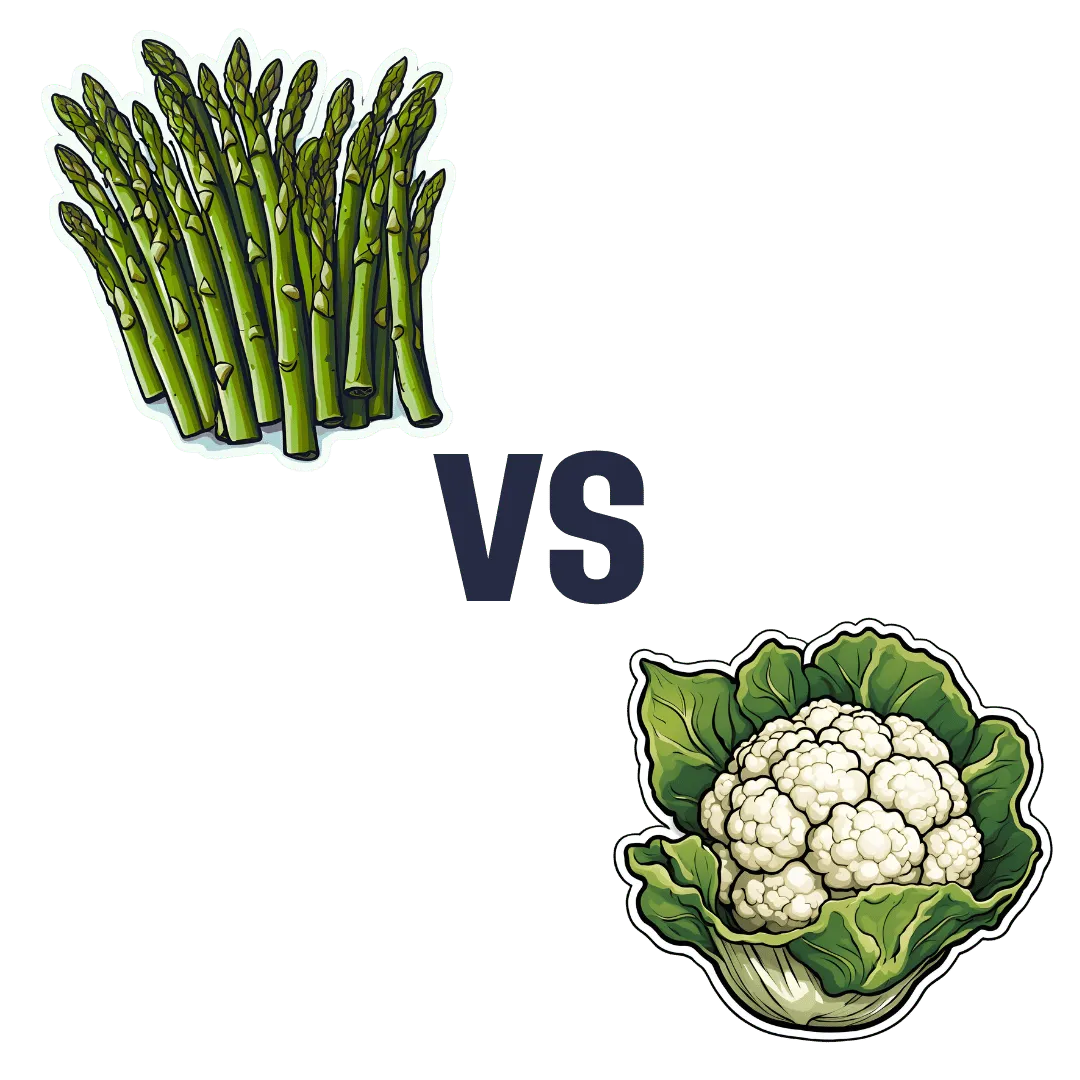
Asparagus vs Cauliflower – Which is Healthier?
10almonds is reader-supported. We may, at no cost to you, receive a portion of sales if you purchase a product through a link in this article.

Our Verdict
When comparing asparagus to cauliflower, we picked the asparagus.
Why?
In terms of macros, asparagus has (slightly) more protein and (very slightly) more fiber, while cauliflower has (slightly) more carbs. Nominally, we could swing this either way depending on preferences, probably in favor of asparagus, but if we’re honest about this, we’re going to call this round close enough to be a tie, for all practical purposes.
In the category of vitamins, asparagus has more of vitamins A, B1, B2, B3, B7 E, and K, while cauliflower has more of vitamins B5, B6, and C, making this round a clear 7:3 win for asparagus.
Looking at minerals, asparagus has more calcium, copper, iron, manganese, phosphorus, selenium, and zinc, while cauliflower has (slightly) more magnesium and potassium. A convincing 7:2 victory for asparagus here!
In other considerations, asparagus is also much higher in polyphenols, especially quercetin, while cauliflower has sulforaphane.
Adding up the sections makes for a clear overall win for asparagus, but by all means enjoy either or both, as they both have their merits, and diversity is best!
Want to learn more?
You might like:
- Broccoli Sprouts & Sulforaphane ← this article talks mostly about broccoli sprouts rather than cauliflower sprouts, but sprouts of any cultivar of Brassica oleracea (e.g. Brussels sprouts, broccoli, cauliflower, cabbage, kale, etc) are great for sulforaphane
- Fight Inflammation & Protect Your Brain, With Quercetin
- 21 Most Beneficial Polyphenols & What Foods Have Them
Enjoy!
Don’t Forget…
Did you arrive here from our newsletter? Don’t forget to return to the email to continue learning!
Recommended

Learn to Age Gracefully
Join the 98k+ American women taking control of their health & aging with our 100% free (and fun!) daily emails: